- ecommerce automation
- lifecycle marketing
- cart recovery
- CRM integration
- winback flows
Marketing Automation for Ecommerce That Drives Revenue
By Crescade · · 14 min read
Design marketing automation for ecommerce that lifts revenue. Practical lifecycle flows, CRM integration, and measurement tactics for growing brands.
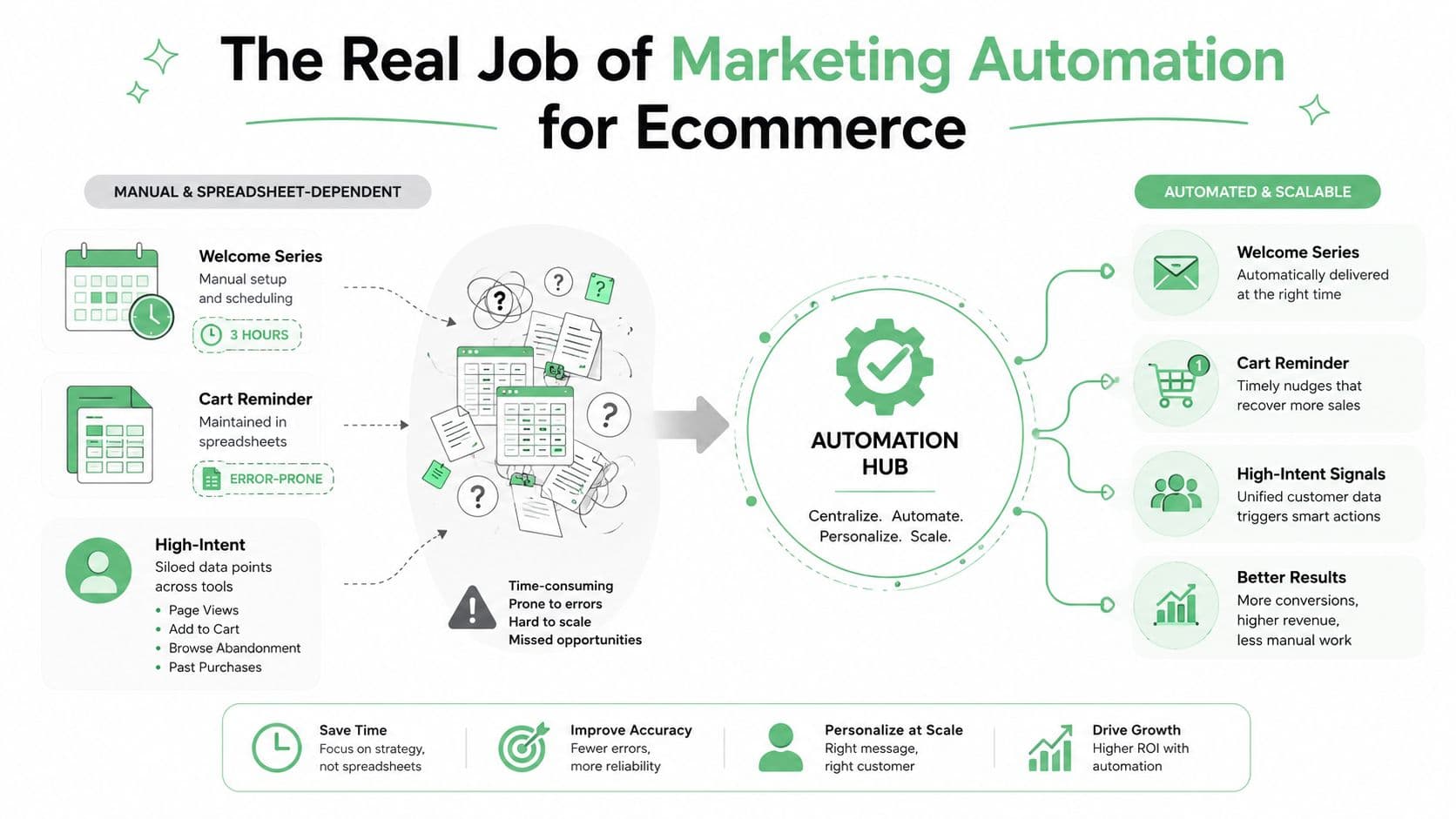
Your store has enough traffic to generate meaningful demand, but the team is still building welcome emails manually, checking abandoned carts in spreadsheets, and sending the same promotion to shoppers with very different levels of intent. The right answer isn't another broadcast calendar or a larger software stack.Marketing automation for ecommerce works when it turns reliable customer signals into timely decisions, then measures those decisions against revenue per recipient, conversion, retention, and profit.
Table of Contents
Why Triggered Flows Beat Batch Sends on Revenue
Designing the Core Lifecycle Flows
Cross-Sell, Replenishment, and Win-Back SequencesConnecting CRM Data So Automation Actually Fires
Measuring Revenue Per Recipient and Flow Performance
A 90-Day Rollout Plan and What to Do Next
The Real Job of Marketing Automation for Ecommerce
Growth-stage ecommerce teams usually reach automation when manual execution starts hiding commercial problems. A welcome series takes too long to launch, cart recovery depends on someone remembering to export a list, and a recent buyer receives an acquisition promotion before the product has even arrived. Adding more campaigns only increases the noise.
The first job of automation is to assign predictable lifecycle decisions to software. That gives people more time for merchandising, creative, offer strategy, and customer experience. The system should decide who qualifies, what event starts the journey, which message comes next, and when the person must be removed.
Start with decisions, not platforms
Before comparing ESPs, CDPs, or AI workflow builders, document each flow in a simple operating brief:
- Trigger: The event that starts the journey, such as an opt-in, product view, cart creation, or purchase.
- Entry conditions: The identity, product, inventory, and order data required.
- Audience: The customer or prospect who should receive the journey.
- Timing: The delay between the event and each message.
- Suppression: The conditions that prevent a send.
- Exit: The event that ends the journey, usually purchase, support escalation, or an explicit preference change.
- Success metric: Revenue per recipient, conversion rate, incremental lift, or a retention outcome.
The initial priority should be four high-intent moments. Welcome new subscribers or account holders. Recover valid carts from known shoppers. Re-engage identified browsers selectively. Onboard recent buyers before asking for another order.
Practical rule: If a flow fails to enter, segment, or suppress correctly, treat it as a data problem before treating it as a copy problem.
A useful overview of the trigger-based model is Clepher's guide tomarketing automation for ecommerce. The important lesson is operational, not brand-specific. A small number of well-defined journeys will usually teach the team more than a large collection of untested automations.
Why Triggered Flows Beat Batch Sends on Revenue
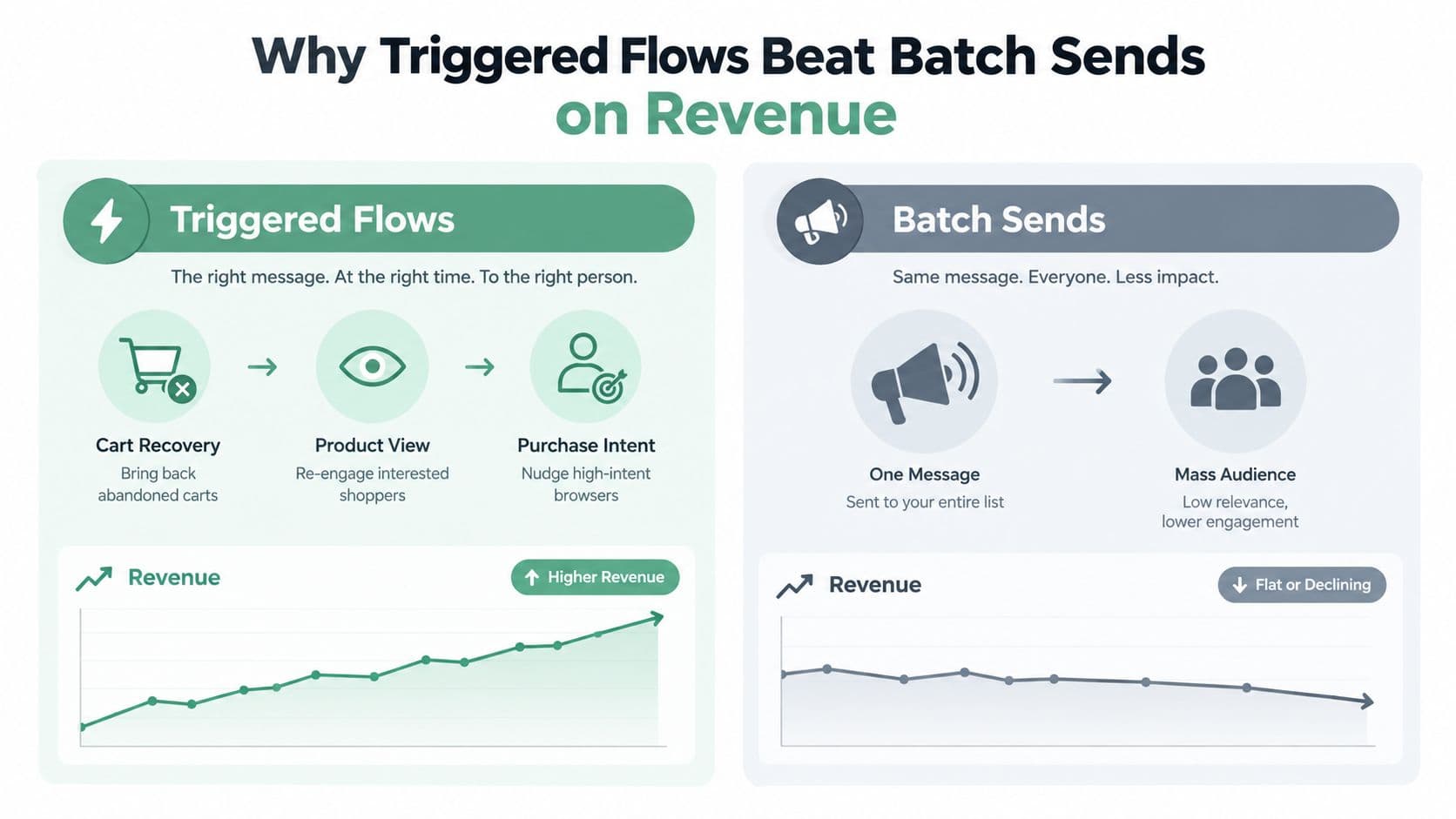
Batch sends distribute one message across a list at a scheduled time. Triggered flows respond to a demonstrated action. That difference changes both relevance and economics.
A shopper who has created a cart has exposed a much stronger signal than a subscriber who remains on a mailing list. A product viewer may need comparison information, while a first-time buyer may need usage guidance. Automation can respond to those conditions while the customer's context is still available.
The benchmark evidence is clear, but it needs to be interpreted carefully. Omnisend's 2025 dataset covered more than20 billion campaign emails sent by more than 27,000 brands and reported$3.41 per automated email sent versus $0.155 for campaign emails, with automated emails converting at1.49% versus 0.08% for campaigns. Those figures come fromOmnisend's ecommerce email benchmarks.
Klaviyo's 2024 benchmark analysis, summarized by SHNO, examinedmore than 325 billion emails. Abandoned cart flows averaged$3.65 revenue per recipient versus $0.11 for standard campaigns, while automated emails generated37% of email-generated sales from only 2% of email volume. Thelifecycle email benchmark summary shows why triggered programs deserve priority.
Revenue attribution still needs skepticism
Attributed revenue isn't automatically incremental revenue. A shopper may have purchased without the reminder, especially when the product already had strong demand. Compare each flow with a holdout or carefully selected baseline, and review:
- Revenue per recipient: How much revenue did each delivered message generate?
- Conversion rate: Did the trigger group complete more purchases?
- Incremental lift: Did the flow change behavior compared with customers who didn't receive it?
- Profit after discount: Did the automation create profitable demand?
- Unsubscribe and complaint signals: Did short-term orders weaken future reach?
Nucleus Research found marketing automation returns$5.44 for every $1 spent, with a payback period under six months, as reported in itsmarketing automation returns analysis. That benchmark makes measurement discipline part of the implementation, not a reporting exercise after launch.
The system should win because it improves timing and relevance. If it only harvests orders that would have happened anyway, or trains customers to wait for discounts, the apparent performance can mislead the P&L.
Designing the Core Lifecycle Flows
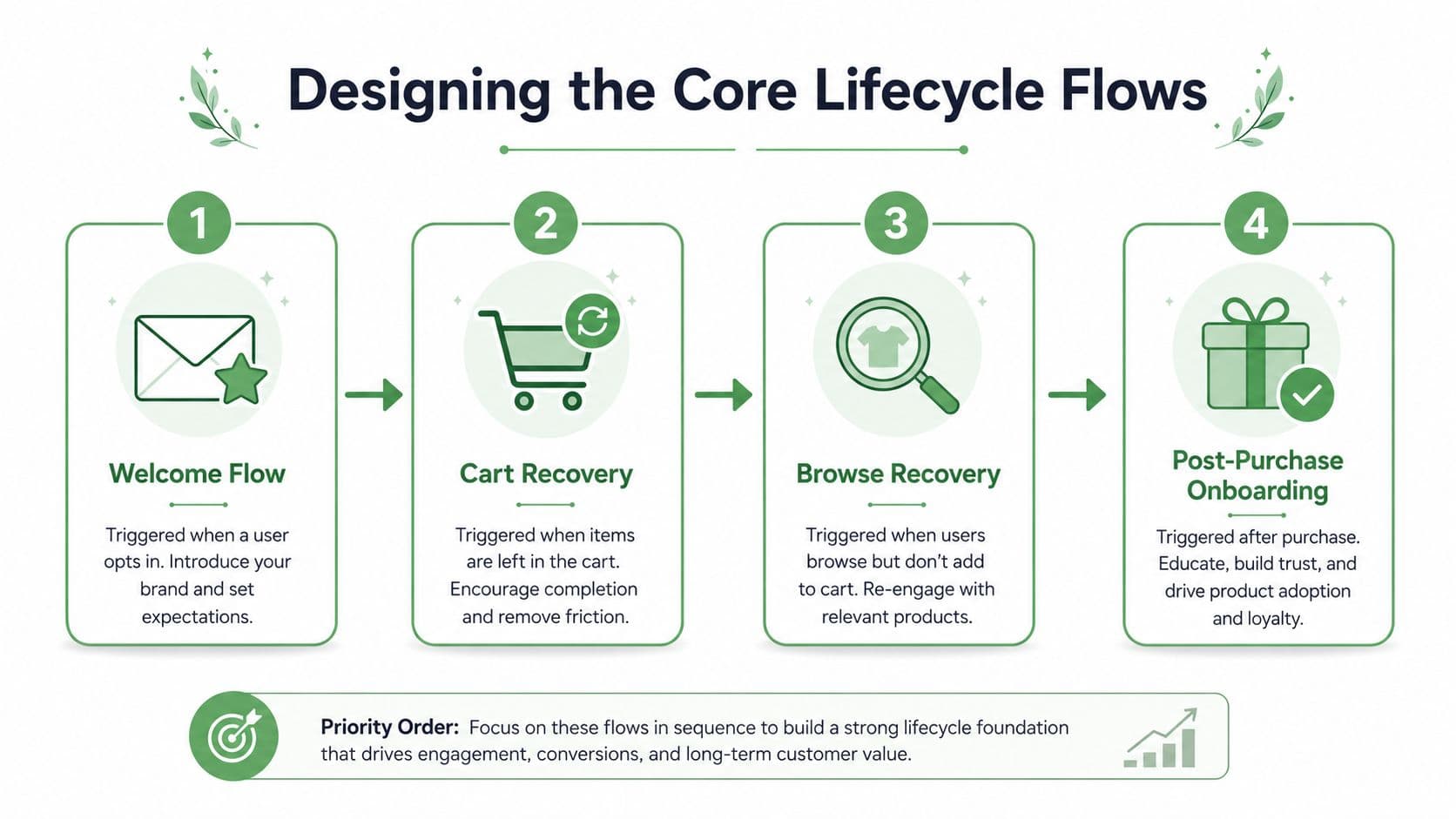
Build the foundation in order. Welcome, cart recovery, browse recovery, and post-purchase onboarding cover the most important early signals without forcing the team to manage a complicated journey map.
Welcome flow
Trigger the journey when a known contact first opts in or creates an account. The opening message should set expectations, explain the brand's value proposition, and direct the subscriber toward a useful action. That action might be product discovery, education, or a first purchase, depending on the customer's context.
Exclude existing customers, recent purchasers, and contacts with unresolved support issues. A new subscriber who already bought shouldn't receive a first-purchase push, and a frustrated customer shouldn't be placed into a promotional sequence while support is still working on the issue.
Cart recovery
Require three conditions before entry: a valid cart, a resolvable identity, and no completed order. Start with a product-specific reminder, then answer the most likely objection, such as delivery expectations, returns, product fit, or checkout friction.
Don't lead with a discount by default. Escalate to one approved incentive only when margin and competitive pressure justify it. Suppress the flow after checkout, a material inventory change, a price change outside the approved threshold, or entry into another active conversion journey.
Browse recovery
Browse recovery needs stricter engagement rules than cart recovery. Focus on recent, meaningful product activity and cap frequency so an incidental product view doesn't create a chase sequence. Product-aware content can be helpful, but irrelevant recommendations make the brand feel like it's following behavior without understanding intent.
Post-purchase onboarding
The post-purchase journey should confirm the order, set delivery expectations, provide setup or usage guidance, and request a review at an appropriate moment. Keep promotional cross-sells separate until the customer has had enough time to experience the product.
For a deeper framework on journey sequencing and customer stages, use Crescade'slifecycle marketing guidance. Every flow should have an exit condition, frequency cap, channel preference, and testable hypothesis before implementation.
Cross-Sell, Replenishment, and Win-Back Sequences
The second layer depends on trustworthy first-party behavior data. If purchase history, delivery status, inventory, and customer identity are inconsistent, recommendations become generic and win-back messages collide with active journeys.
Cross-sell should use the order as its starting signal, then filter complementary products by purchase history, catalog relationship, and inventory. A customer who bought a coffee maker may need filters or beans, while a customer who bought a skincare product may need a compatible refill. The recommendation should explain the relationship rather than present an unrelated bestseller.
Replenishment requires product-specific logic. Order timestamp, expected consumption, subscription status, and repeat-purchase behavior should inform the reminder. A static calendar can work for a simple catalog, but it becomes wasteful when product usage varies or customers reorder at different intervals.
Win-back should separate customer value and recency. A recently lapsed repeat buyer may need a reminder about new products, while a long-dormant customer may require a stronger reason to return. Suppress customers who purchased recently and anyone still active in welcome or cart recovery.
| Sequence | Trigger Condition | First Send Timing | Offer Progression | Suppression Rules |
|---|---|---|---|---|
| Cross-sell | Completed purchase with a relevant complementary SKU | After delivery or product-use context is established | Start with relevance, add an offer only if justified | Suppress unavailable products, open returns, unresolved support issues, and recent repeat purchases |
| Replenishment | Prior purchase plus category-specific consumption signal | Based on order history and expected usage | Reminder first, incentive only when needed | Suppress active subscriptions, recent orders, and products with changed availability |
| Win-back | Previously active customer with no recent purchase | Based on recency and customer value segment | Reminder, then progressively stronger approved offer | Suppress recent purchasers and customers in welcome, cart, or service recovery journeys |
The practical discipline is a suppression matrix. It should answer what happens when a customer qualifies for multiple journeys on the same day. A retention program should feel coordinated, not like several teams are competing for the same inbox.
Crescade'secommerce retention strategy offers useful context for connecting these sequences to broader retention work. The implementation principle is simple: add one sequence, observe its interaction with existing flows, then expand.
Connecting CRM Data So Automation Actually Fires
CRM integration is the connective tissue of lifecycle automation. A polished email cannot compensate for a missing purchase event, a split customer profile, or a segment that updates after the opportunity has passed.
Start with an event taxonomy. Agree on names and required fields for purchase, product viewed, add to cart, checkout started, email engagement, and custom events. Each event should identify the customer, product or order where relevant, timestamp, source, and consent or communication status.
Resolve identity before adding complexity
Identity resolution is a common silent failure. Guest checkout, device changes, and multiple email aliases can create duplicate profiles. Use deterministic matching on available customer identifiers, with order ID as a fallback for transaction reconciliation. Define which system owns the customer record and which system can update lifecycle status.
Segment synchronization should be deliberate. A one-directional CRM-to-ESP sync can reduce conflicting updates, while a webhook is more appropriate for high-value changes that must trigger quickly, such as a VIP tier update. Nightly batch synchronization is risky for time-sensitive cart or browse events because the customer may receive the message after the buying context has faded.
Data rule: Every trigger needs an owner, a source event, a freshness expectation, and a test record.
Browser-side events help describe on-site behavior, while server-side events can provide more durable transaction and order information. Use both where appropriate, then reconcile them so one purchase doesn't create duplicate revenue or restart an abandoned-cart journey.
When a flow mysteriously stops sending, audit it in sequence:
- Event receipt: Did the ESP receive the trigger with the required fields?
- Identity match: Did the event attach to a usable profile?
- Entry rule: Did the profile satisfy every condition?
- Suppression: Was the person excluded by purchase, support, inventory, or frequency logic?
- Delivery: Was the message queued, delivered, and rendered?
- Attribution: Did the order and campaign identifiers persist into analytics?
Teams working across support and marketing may also need tobridge Zendesk with marketing data, so open service issues can suppress promotional journeys. Crescade'sCRM marketing integration approach is relevant when the problem spans event design, lifecycle logic, and reporting rather than a single connector.
Measuring Revenue Per Recipient and Flow Performance
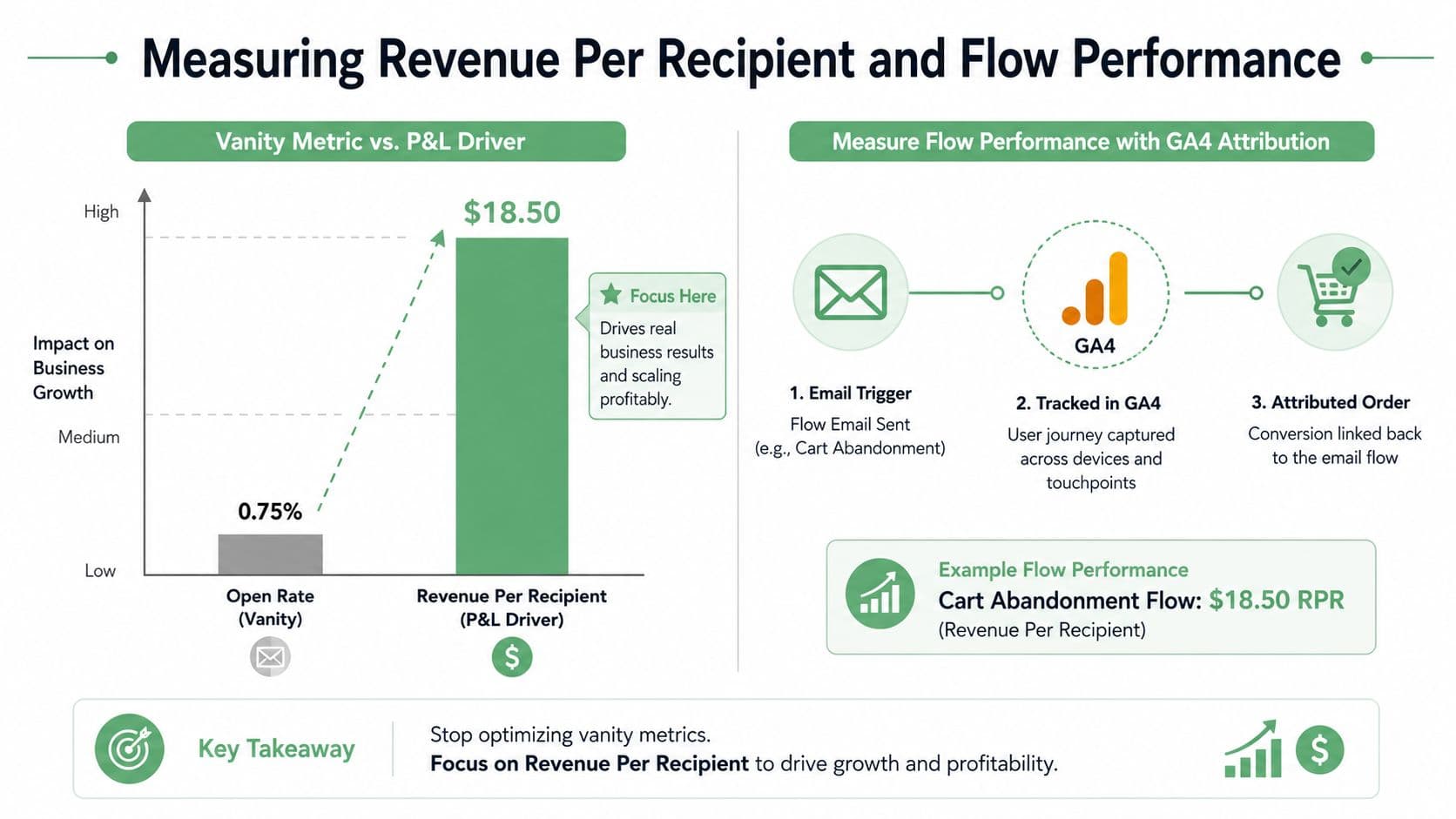
Open rate is useful for diagnosing delivery and subject-line behavior, but it isn't the commercial target.Revenue per recipient connects message volume to the P&L and makes different flows easier to compare.
GA4 includes dedicated ecommerce measurement and an Ecommerce purchases report. Google says ecommerce events let teams quantify product popularity and evaluate how promotions and product placement affect revenue through itsGA4 ecommerce measurement documentation.
Build the dashboard around the flow
Track performance at three levels:
- Sequence: Welcome, cart, browse, post-purchase, replenishment, or win-back.
- Message: The individual email's revenue per recipient, clicks, conversion, and drop-off.
- Segment: New subscriber, first-time buyer, repeat buyer, high-value customer, or lapsed customer.
Use campaign identifiers that survive the journey into GA4 and the order record. If a cart sequence has several reminders, record the assisting role of earlier messages rather than assigning every outcome only to the final click.
Use a 30, 60, and 90-day review cadence
During the first 30 days, focus on trigger volume, deliverability, rendering, broken links, and where recipients leave the flow. Don't overreact to small creative differences while the data path remains unstable.
At 60 days, review revenue per recipient trends, timing, subject-line tests, product content, and offer logic. At 90 days, evaluate cumulative flow revenue share, segment expansion, suppression quality, and whether incremental tests support the attributed revenue.
Stripo's 2026 benchmark summary reports that automated flows generated41% of email-driven revenue from 5.3% of total send volume in a Klaviyo dataset, as described in itsemail automation benchmark summary. Use that kind of comparison as a directional operating signal, not a promise for your store.
Measurement warning: A flow can influence a purchase that arrives through paid search, direct traffic, or another channel. Pair last-click reporting with a holdout or incrementality test before declaring the program finished.
A 90-Day Rollout Plan and What to Do Next
A disciplined rollout keeps automation from outrunning data quality. Work in three blocks, and make each block produce a usable operating baseline.
Days 1 through 30
Launch the welcome, cart abandonment, and browse abandonment flows. Before activation, verify identity resolution, event receipt, order suppression, product data, and GA4 ecommerce tracking. Establish baseline revenue per recipient for each flow and log every exclusion rule.
Days 31 through 60
Add post-purchase onboarding, complementary-product cross-sell, and replenishment logic. Build the first CRM segments around purchase history and customer status, then introduce suppression rules that prevent lifecycle journeys from colliding with batch campaigns.
Days 61 through 90
Launch win-back and lapsed-buyer journeys. Test trigger conditions, message timing, product selection, and incentive progression. Report revenue per recipient by flow, message, and segment, then compare attributed results with a holdout where the audience and economics make that feasible.
The next step isn't buying more tooling. Audit the data layer, choose two revenue-critical triggers, document their entry and exit rules, and ship those journeys before expanding the program. Crescade can support that work as an accountable, AI-assisted growth operations partner, connecting lifecycle strategy, CRM data, analytics, automation, and the decisions that follow from the evidence.
Request a 20-minute audit withCrescade to review your event taxonomy, suppression logic, and highest-intent ecommerce triggers. You'll leave with a practical sequence for fixing the data path, selecting the first flows, and measuring revenue per recipient without relying on open-rate theater.