- ecommerce paid search agency
- paid search management
- Google Ads agency
- ecommerce PPC
- growth operations
How to Choose an Ecommerce Paid Search Agency in 2026
By Crescade · · 16 min read
Learn how to choose an ecommerce paid search agency that improves ROAS, not just spend. Covers service models, deliverables, and evaluation criteria.
Your Google Ads account is spending, the dashboard looks busy, and the agency is reporting clicks, conversion value, and platform ROAS. Yet finance still can't explain why profitable growth isn't showing up in cash flow. That's the situation where choosing anecommerce paid search agency becomes a business decision, not a vendor search.
The right agency won't start with bid changes. It will first establish whether the constraint ismeasurement quality, contribution margin, product-feed economics, or post-click conversion. Google Ads remains a major commercial advertising system, with global PPC spend projected to reach$306 billion in 2026, growing11% year over year according to2026 paid search benchmarks. But more spend won't fix an unreliable purchase signal or a checkout that loses qualified shoppers.
Table of Contents
Service Models and How Agencies Get Paid
Core Deliverables Beyond Campaign Management
- Feed operations determine what can scale
- Measurement should survive platform disagreement
- Creative must connect to economics
Diagnosing the Real Bottleneck Before You Hire
Standalone Paid Search Agency vs Full-Funnel Growth Partner
How to Evaluate Fit, Performance, and Red Flags
Choosing Your Next Step and Working With an Agency
What an Ecommerce Paid Search Agency Actually Does
An ecommerce paid search agency manages paid demand capture across platforms such as Google Ads and Microsoft Advertising. It buys traffic for product, collection, and purpose-built landing pages, then connects that traffic to orders and commercial outcomes. The mandate isn't raw click volume. It's profitable revenue that the business can defend after discounts, fulfillment, returns, and operating costs.
The account work still matters. A capable team maps search intent, separates branded and non-branded demand, structures campaigns around products and categories, tests ad messages, manages audiences, and sets bidding rules. It also monitors budget pacing and auction behavior. Google says Ad Rank thresholds are determined dynamically and can vary with factors such as ad position, location, device, and search topic, so an agency has to manage quality and relevance alongside bids, as explained inGoogle's Ad Rank threshold documentation.
Practical rule: If a pitch only covers keywords, bids, and ad copy, it covers the visible layer of the job, not the economic system underneath it.
The account depends on the catalog
Shopping and product-led campaigns don't operate independently of merchandising. Product titles, descriptions, availability, pricing, identifiers, shipping information, and category mapping influence whether products are eligible and how clearly they match queries. That makes Merchant Center hygiene and feed governance part of paid search management.
Shopping-style campaigns have become central to ecommerce acquisition. One 2026 benchmark reports that Shopping Ads represented76.4% of US retail search ad spend, while another reports Google Shopping generated85.3% of Google Ads clicks for ecommerce, as summarized inecommerce Google Ads benchmarks. These figures don't mean every merchant should shift all budget into Shopping. They do mean an agency that ignores the catalog is ignoring a major auction input.
For a practical overview of how ecommerce PPC is structured,Keywordme's ecommerce PPC guide is a useful reference. In an engagement, expect the agency to connect campaign decisions to product availability, margin tiers, landing-page relevance, and checkout behavior. Crescade'spaid search service reflects this broader operating model by tying account review, search intent, messaging, landing pages, conversion measurement, and reporting together.
The click is only the handoff. The agency should explain what happens after the click, which products receive budget, which conversions count, and how the results reconcile with business revenue.
Service Models and How Agencies Get Paid
Agency pricing changes agency behavior. The most common structures arepercentage of media spend, flat retainer, and hybrid compensation, and each one creates a different answer to the question, “What should be optimized next?”
| Model | Agency Incentive | Merchant Risk | When It Fits |
|---|---|---|---|
| Percentage of spend | Grow and manage the media budget | Fees can rise while marginal efficiency declines | Stable accounts with clear efficiency guardrails |
| Flat retainer | Deliver defined work without a direct spend link | Attention may decline once the account becomes routine | Teams prioritizing predictable costs |
| Hybrid | Balance a base fee with performance compensation | Measurement disputes can become expensive | Merchants with trusted contribution reporting |
A percentage-of-spend model is simple to understand, but it can reward scale even when the next dollar of spend is less profitable. Suppose a merchant spends$50,000 per month and pays a15% management fee, producing$7,500 in fees. That fee rises with the budget whether the added spend improves contribution profit or merely expands attributed revenue.
A flat retainer avoids that direct relationship. A$6,000 retainer plus 3% of tracked revenue would produce roughly$9,000 at the stated current ROAS scenario, and$4,500 if performance drops, based on the engagement example. The structure may align better with efficiency, but only if the team continues to receive meaningful strategic attention as the account matures.
A hybrid model can align incentives most closely with the merchant, but the bonus should be tied toincremental profit or contribution margin, not unqualified platform revenue. Otherwise, the agency can earn more by harvesting branded demand or shifting attribution without creating new demand.
Ask what happens under pressure
Before signing, model the relationship under three conditions:
- Budget reduction: Does the agency maintain senior attention when spend falls?
- Efficiency decline: Can the team recommend cutting spend instead of defending its fee?
- Tracking disagreement: Which source determines revenue, returns, new-customer status, and bonus eligibility?
The contract should define ownership, account access, reporting cadence, testing responsibilities, and exit terms. It should also clarify whether creative production, feed management, landing-page work, and analytics are included or billed separately.
For a broader view of fee structures,Crescade's Google Ads management pricing guide gives buyers a way to compare management scope with compensation design. If you're building the agency's internal operating system, resources onkey features for scaling agency services can also help you assess whether reporting and workflow infrastructure will support the relationship.
Don't choose the cheapest model by default. Choose the model that makes it difficult for both sides to hide deteriorating economics.
Core Deliverables Beyond Campaign Management
Bid management and keyword expansion are baseline services. They don't distinguish a strategic ecommerce partner from a vendor that rearranges account settings and sends a monthly report.
The work falls across four connected areas:feed operations, measurement, creative and landing-page testing, and lifecycle handoff. If the agency owns only the ad account, your team will still be responsible for the dependencies that determine whether the account works.
Feed operations determine what can scale
The agency should review Merchant Center eligibility, product disapprovals, missing attributes, variant relationships, pricing consistency, availability, and shipping information. It should also improve titles and descriptions around real query intent, not stuff them with disconnected terms.
Product grouping should reflect commercial differences. Bestsellers, high-margin items, low-margin items, seasonal products, clearance inventory, and products with limited stock shouldn't automatically compete under the same budget logic. Feed changes also need coordination with merchandising, inventory, and site content.
Measurement should survive platform disagreement
A serious engagement includes conversion architecture, not just a Google Ads tag. The team should inspect GA4 purchase events, enhanced conversions, first-party data flows, order-level revenue, refunds, returns, and deduplication across paid and lifecycle channels.
GA4 uses data-driven attribution by default for reporting, but the model requires at least300 conversions and 3,000 path interactions per 30 days per conversion event. Below that threshold, it falls back to paid-and-organic last click, according toGA4 attribution setup guidance. That difference can materially change how a smaller account interprets channel credit.
The purchase attribution window also matters. Google Analytics guidance states that purchase-related events use a90-day default attribution window, while acquisition events such as first_open and first_visit use30 days, as described inGA4 attribution window guidance. Your agency should document which settings apply before it presents performance conclusions.
Creative must connect to economics
Expect regular responsive search ad testing, product imagery improvements, asset testing, message-to-query alignment, and landing-page experiments. A landing page test should be prioritized by product margin, traffic potential, checkout friction, and customer value, not by internal preference.
The agency should also define the handoff to lifecycle marketing. Paid acquisition creates an expensive first interaction. Email, SMS, cart recovery, browse recovery, post-purchase education, replenishment, and retention flows determine whether the business recovers value after the initial session.
Useecommerce conversion optimization guidance to evaluate whether an agency understands the post-click experience. The strongest partner will make that handoff explicit, with owners, data requirements, and a testing backlog.
Diagnosing the Real Bottleneck Before You Hire
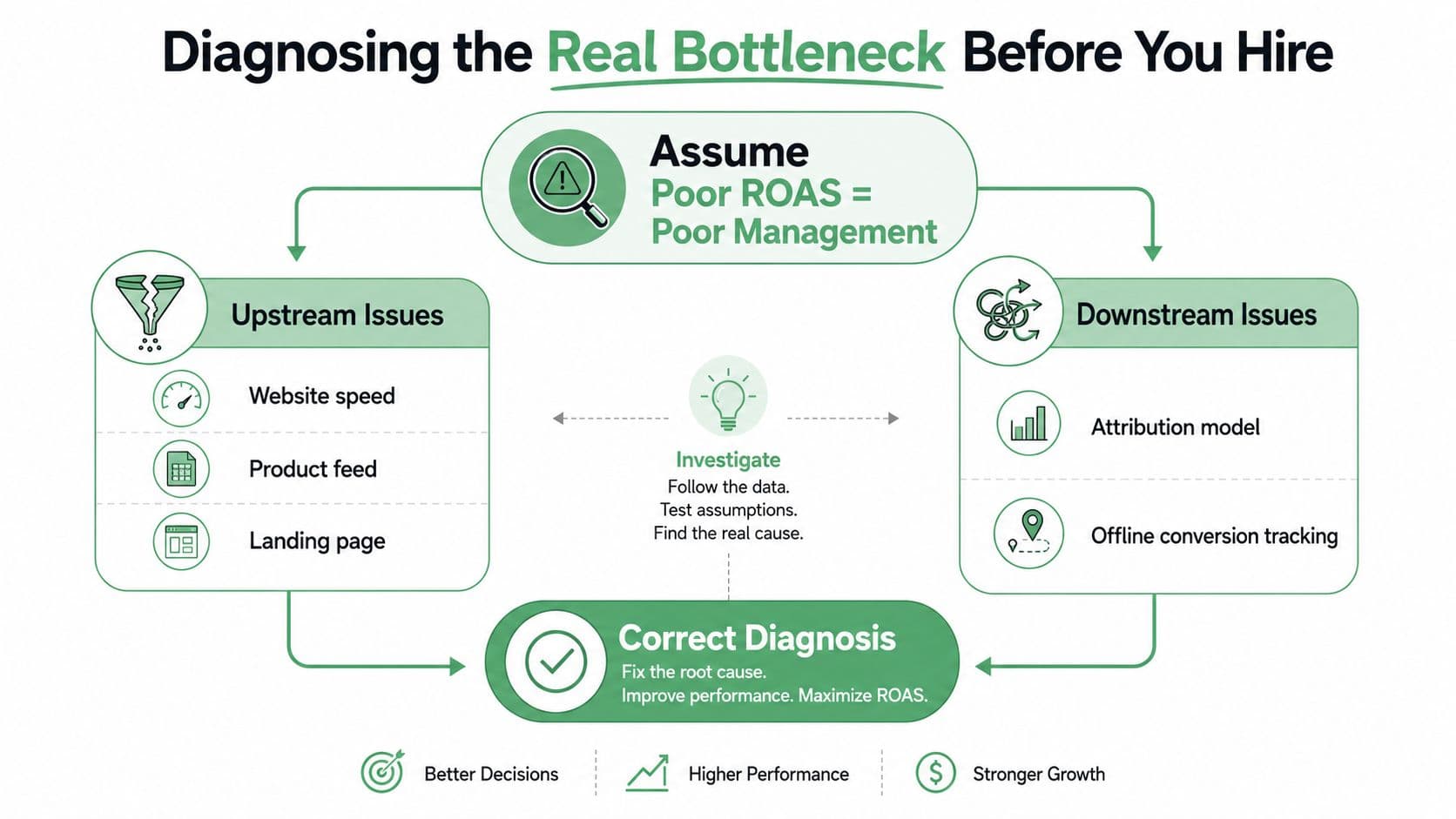
Most merchants assume weak ROAS means weak campaign management. That assumption sends them toward account restructures when the actual problem sits in tracking, product economics, feed quality, or checkout behavior.
Start with the evidence, in this order.
- Validate measurement integrity. Compare Google Ads conversions with GA4 purchase events and order-management-system revenue. Investigate duplicate purchases, missing transactions, refunds, returns, tax and shipping treatment, and differences between platform-reported and finance-reported revenue.
- Calculate contribution by product group. Revenue isn't profit. Isolate product-level contribution after fulfillment, returns, discounts, payment costs, and other variable expenses. A campaign can show acceptable ROAS while concentrating spend on products that don't support acceptable contribution.
- Inspect feed health. Review disapprovals, missing identifiers, incorrect availability, incomplete attributes, variant mapping, title relevance, and price mismatches. If eligible products aren't represented accurately, bidding improvements won't repair the underlying visibility problem.
- Dissect post-click behavior. Compare product-page engagement, add-to-cart activity, checkout initiation, payment errors, and completed purchases by source, device, product type, and landing page. A high-intent click that repeatedly fails at checkout is a conversion problem, not a keyword problem.
Rank the constraint before changing the account
Published 2026 ecommerce benchmarks put Search conversion rates in a broad range, roughly2.5% to 3.5% in one set and2% to 4% in another, depending on definitions and attribution, as summarized inindustry conversion-rate benchmarks. Treat these ranges as orientation, not a target. Your own order data and contribution model should control decisions.
A useful agency brief states the suspected bottleneck, the evidence supporting it, the data still missing, and the decision that will follow. That prevents the first month from becoming a generic audit with no commercial consequence.
The following video provides another visual explanation of root-cause diagnosis:
Don't ask an agency to “improve ROAS” before you agree on which revenue signal and margin definition it will use.
Standalone Paid Search Agency vs Full-Funnel Growth Partner
A standalone paid search agency can be the right choice when your internal team already owns analytics, merchandising, lifecycle, and conversion optimization. It focuses on search execution, campaign pacing, ad testing, and budget allocation, then hands findings to your operators.
A full-funnel growth partner treats paid search as one input in a connected system. It may coordinate paid acquisition with feed optimization, conversion-rate work, lifecycle marketing, analytics, automation, and incrementality testing. The advantage isn't a larger service list. It's fewer accountability gaps between the click and the business result.
| Dimension | Standalone Agency | Full-Funnel Partner |
|---|---|---|
| Primary scope | Paid search execution | Acquisition plus adjacent growth operations |
| Internal requirement | Strong analytics, merchandising, and lifecycle owners | Leaner team that needs integrated ownership |
| Accountability boundary | Usually ends near the paid channel | Extends into conversion, retention, and measurement |
| Cost structure | Focused management fee and internal coordination cost | Broader engagement cost with consolidated ownership |
| Insight speed | Findings require cross-team handoffs | Cross-channel findings can move within one operating cadence |
| Best use case | Clean instrumentation and an experienced growth lead | Fragmented ownership or an unclear primary constraint |
The trade-off is control versus coordination. A specialist may offer deeper channel focus and a narrower cost structure. An integrated partner may surface problems faster because it can connect search performance to landing pages, email recovery, product mix, and analytics without waiting for several teams to respond.
That broader view matters when channel metrics conflict. Reducing branded search can change direct traffic and organic reporting. A promotion can raise conversion while damaging margin. A product-feed change can alter Shopping visibility while merchandising changes inventory priorities. No single ad-account report can resolve those questions.
Match the model to your team
Choose a standalone agency when:
- Your team can own feed and merchandising decisions.
- GA4 and order data reconcile well enough for optimization.
- Lifecycle and CRO owners can act on paid-search findings.
- You need channel depth more than operating-model redesign.
Choose a full-funnel partner when:
- No single person owns the acquisition-to-retention system.
- Paid media, analytics, and lifecycle teams report conflicting numbers.
- Conversion friction is clearly limiting media efficiency.
- You need one decision cadence across acquisition and post-purchase work.
Crescade positions its work as an AI-assisted growth operations system that connects acquisition, conversion, lifecycle marketing, analytics, automation, and AI workflows. That makes it relevant when the paid search bottleneck isn't isolated to Google Ads.
How to Evaluate Fit, Performance, and Red Flags
Evaluate agencies through questions, not polished credentials. The first test is whether the team can explain what it will inspect before making changes.
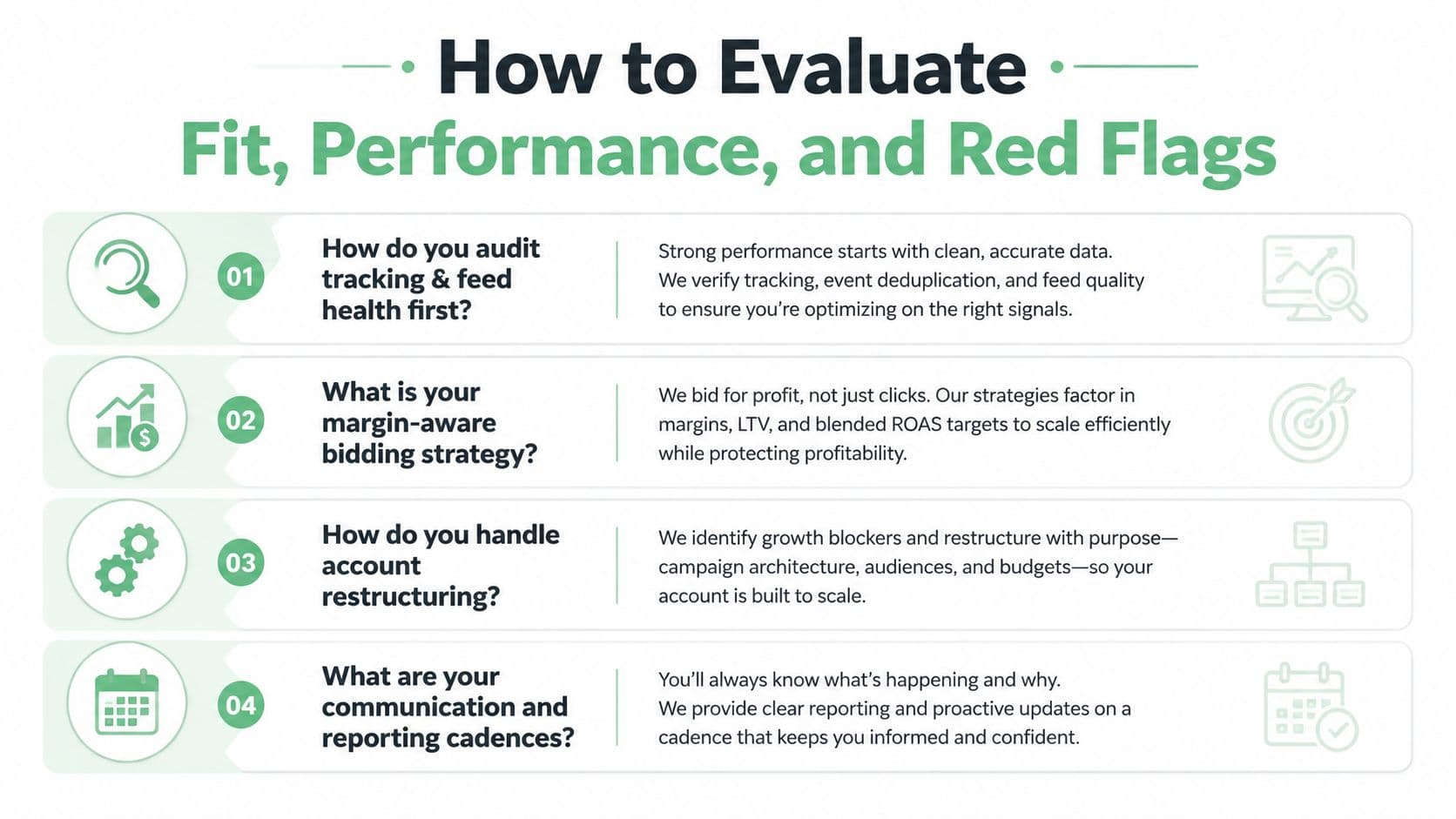
Ask these questions in the first conversation:
- Tracking audit: How will you reconcile Google Ads, GA4, and order-level revenue?
- Feed review: Which Merchant Center issues will you inspect before reallocating budget?
- Margin method: How will product contribution, returns, discounting, and new-customer value affect bidding?
- Account structure: What evidence would justify restructuring, and what would you leave untouched?
- Communication: Who makes decisions, how often do reviews happen, and where do hypotheses live?
- Testing: How will you distinguish a platform-attributed improvement from incremental growth?
An agency that answers with a list of automated rules hasn't answered the question. Automation can execute a decision, but it can't decide whether the business should protect margin, acquire new customers, clear inventory, or reduce spend.
The strongest recommendation an agency can make may be a budget cut. If the team never recommends reducing spend, it may be optimizing its relationship rather than your economics.
Read the reporting for what it omits
Platform ROAS is useful, but it isn't a complete business measure. Ask for contribution ROAS, new-customer rate, feed health, checkout completion by source, and a clear explanation of attribution settings. For a plain-language explanation of the calculation and how benchmark context should be interpreted, review this guide tothe ROAS formula and benchmarks.
Watch for these red flags:
- Spend-linked pricing with no guardrails: The agency earns more as your budget rises, even if marginal returns fall.
- Generic benchmarks: The team can't separate brand, category, product, device, or customer-type performance.
- Unexplained automation: Bidding changes happen without a hypothesis or business rationale.
- Thin reporting: The report contains charts but no decisions, experiments, owners, or next actions.
- No measurement audit: The agency starts optimizing before validating purchase value and data quality.
- No willingness to challenge you: The team accepts every budget request without questioning offer economics or inventory.
Use a short paid audit to test the quality of thinking before committing to a broad mandate. The deliverable should include data gaps, feed issues, account risks, economic assumptions, and a ranked test plan.
Choosing Your Next Step and Working With an Agency
Your next step depends on the bottleneck you found.
If measurement or margin is unreliable, buy an audit before buying campaign management. If feed quality or landing-page conversion is the problem, ask for a diagnostic sprint with named deliverables rather than signing immediately for a long engagement. If the account is healthy but execution is inconsistent, a focused specialist may be enough.
The first30 days should produce operating clarity, not just a new campaign structure. Require access provisioning, conversion and feed audits, a baseline for revenue and contribution margin, and a written hypothesis list ranked by expected business impact. The agency should document what it changed, why it changed it, what it expects to learn, and which result would cause it to reverse course.
Keep strategic decisions close to the business
Delegate account execution, query analysis, feed maintenance, ad testing, budget pacing, and reporting production when the agency has the required access and expertise. Keep pricing strategy, inventory priorities, promotion rules, merchandising direction, and the definition of profitable growth with your internal leadership.
An agency can recommend a product grouping or flag a margin problem. It shouldn't decide which products the business is willing to discount or which customer segments finance considers valuable.
Ecommerce Search benchmarks illustrate why campaign types need separate scrutiny. One 2026 benchmark places Search at about$1.42 CPC, 3.8% CTR, 2.8% conversion rate, and 3.4x ROAS, while Shopping is reported at about$0.68 CPC and 5.1x ROAS, according toecommerce Google Ads benchmark data. Use these figures as directional context only. Your agency should judge each campaign by marginal ROAS, contribution, and incrementality, not by a blended account average.
A paid audit is often smarter than a long contract when annual paid spend is below$2 million. At that scale, a measurement error, weak feed, or poor checkout experience can dominate the account, and a short diagnostic can reveal whether management is even the right purchase.
Crescade helps ecommerce teams connect paid search with conversion optimization, lifecycle marketing, analytics, automation, and AI-assisted growth operations. If you want an outside view of whether your constraint is measurement, feed economics, or post-click conversion, visitCrescade and request a20-minute audit before choosing an agency model.