Google Ads Management Pricing: Models & Ranges

Google Ads management pricing in the U.S. typically runs from roughly$500 to $2,000 per month for many small-to-mid-size accounts and can reach$10,000 to $25,000+ per month for enterprise programs, with most agencies charging either a flat retainer or10% to 20% of monthly ad spend.
That's the number range founders usually want first, but the smarter question is whether the fee covers the work that protects spend and improves conversion quality. A cheap retainer can look fine until the account needs tracking fixes, feed cleanup, reporting, or attribution review, then the full cost shows up in internal time and missed performance.
Table of Contents
- What Google Ads Management Pricing Looks Like in the USWhat the fee is actually buying
- The four models worth comparing
The Four Pricing Models and How Each One Creates Incentives
- Flat retainers reward scope control
- Percentage pricing follows spend, not just effort
- Performance and hybrid pricing need clean attribution
Tiered US Price Ranges by Spend and Complexity
What Most Pricing Quotes Quietly Exclude
A Proposal Evaluation Checklist and Contract Terms That Protect You
Choosing the Right Model for Your Business
- Small accounts under $5,000 in spend
- Mid-market programs from $10,000 to $50,000
- Enterprise programs above $100,000
Negotiation Tactics and Measurement That Tie Fees to Outcomes
Putting It Together and Your Next Step
What Google Ads Management Pricing Looks Like in the US
For most founders, the answer is simple.Small accounts usually sit around $500 to $2,000 per month, while larger, more technical programs can land at$10,000 to $25,000+ per month when the work expands into Shopping, multi-campaign search, feed management, conversion tracking, or CRO support. The fee is the cost of managing the account, not the media budget itself, and that distinction matters more than the headline number. Ranktracker's pricing guide and a 2026 market guide on enterprise pricing both point to the same broad reality, fee levels rise as the operational burden rises.
What the fee is actually buying
A Google Ads manager is not just buying clicks more efficiently. The fee pays forsetup, optimization, reporting, and account management, which means the provider is expected to make judgment calls on structure, search terms, negatives, creative rotation, pacing, and measurement. That is why the same media budget can command very different management prices depending on how many campaigns are in play and how much measurement work sits behind them.
Practical rule: if a proposal does not tell a founder what is inside the fee, it is not a pricing proposal, it is a partially hidden scope sheet.
The four models worth comparing
The market usually usesflat retainers,percentage of ad spend,performance-based pricing, or ahybrid of those structures. Flat retainers help with predictability. Percentage pricing links the fee to spend. Performance-based pricing ties payment to results. Hybrids try to balance baseline work with scale. A founder does not need a new vocabulary lesson, only a clear view of which model creates the right incentives for the account being managed.
| Account size | Flat retainer range | Percentage of spend | Typical fit |
|---|---|---|---|
| Small account | $500 to $2,000 per month | 10% to 20% | Lean lead gen, local services, simple search structure |
| Mid-size account | $1,500 to $5,000 per month | 10% to 20% | Active optimization, growing e-commerce, multi-campaign search |
| Enterprise program | $4,000 to $12,000+ per month | 10% to 20% | Complex tracking, feeds, CRO input, larger reporting load |
That table is the starting point, not the decision. The choice is whether the proposal covers the constraints that are slowing growth.
The Four Pricing Models and How Each One Creates Incentives
Flat retainers reward scope control
Aflat monthly retainer is the cleanest structure when the account has a predictable shape and the founder wants budget certainty. It works best when the work is mostly steady state, meaning campaign maintenance, regular optimization, and reporting. The tradeoff is obvious, the provider is protected from spend swings, so the buyer needs to be sure the retainer includes enough labor to keep the account sharp.
Percentage pricing follows spend, not just effort
Withpercentage of ad spend, the common benchmark is10% to 20% of monthly spend. A$5,000 media budget may carry roughly a$500 to $1,000 management fee, which is usually reasonable when the account is still small enough for the work to be concentrated. A larger program changes the math fast because the fee scales with spend, and that can be good or bad depending on whether the agency is also accountable for conversion quality. ALM Corp's 2026 pricing guide and broader pricing summaries reflect this same range.
A percentage model can be fair when the agency is carrying real optimization load, but it gets sloppy when the only thing growing is the invoice.
Performance and hybrid pricing need clean attribution
Performance-based pricing sounds buyer-friendly because it appears to align payment with outcomes. In practice, it only works when attribution is tight and everyone agrees on what counts as a valid lead or conversion. Otherwise, the account turns into a debate about lead quality, source credit, and who owns the fallout.
Hybrid pricing is often the most practical middle ground. A base retainer covers recurring work, then a variable piece scales with spend or performance. That structure is useful when a founder wants stability without forcing the provider to work under a fee that never changes while the account complexity grows.Crescade's overview of agency pricing models is a useful internal reference for teams comparing retainers, variable fees, and hybrid structures side by side.
Tiered US Price Ranges by Spend and Complexity
The cleanest way to think about Google Ads management pricing is by theoperational load, not just the media budget. A low-spend account with one channel can be harder to manage than a bigger account with disciplined tracking, but spend still acts as a decent proxy for complexity because larger budgets usually bring more campaigns, more conversion paths, and more reporting pressure. That is why market guides consistently show lower tiers around$500 to $2,000 per month, mid-market ranges around$1,500 to $5,000 per month, and enterprise tiers from$4,000 to $12,000+ or even$10,000 to $25,000+ depending on scope. Vendasta's pricing guide and OuterBox's fee breakdown point to the same pattern.
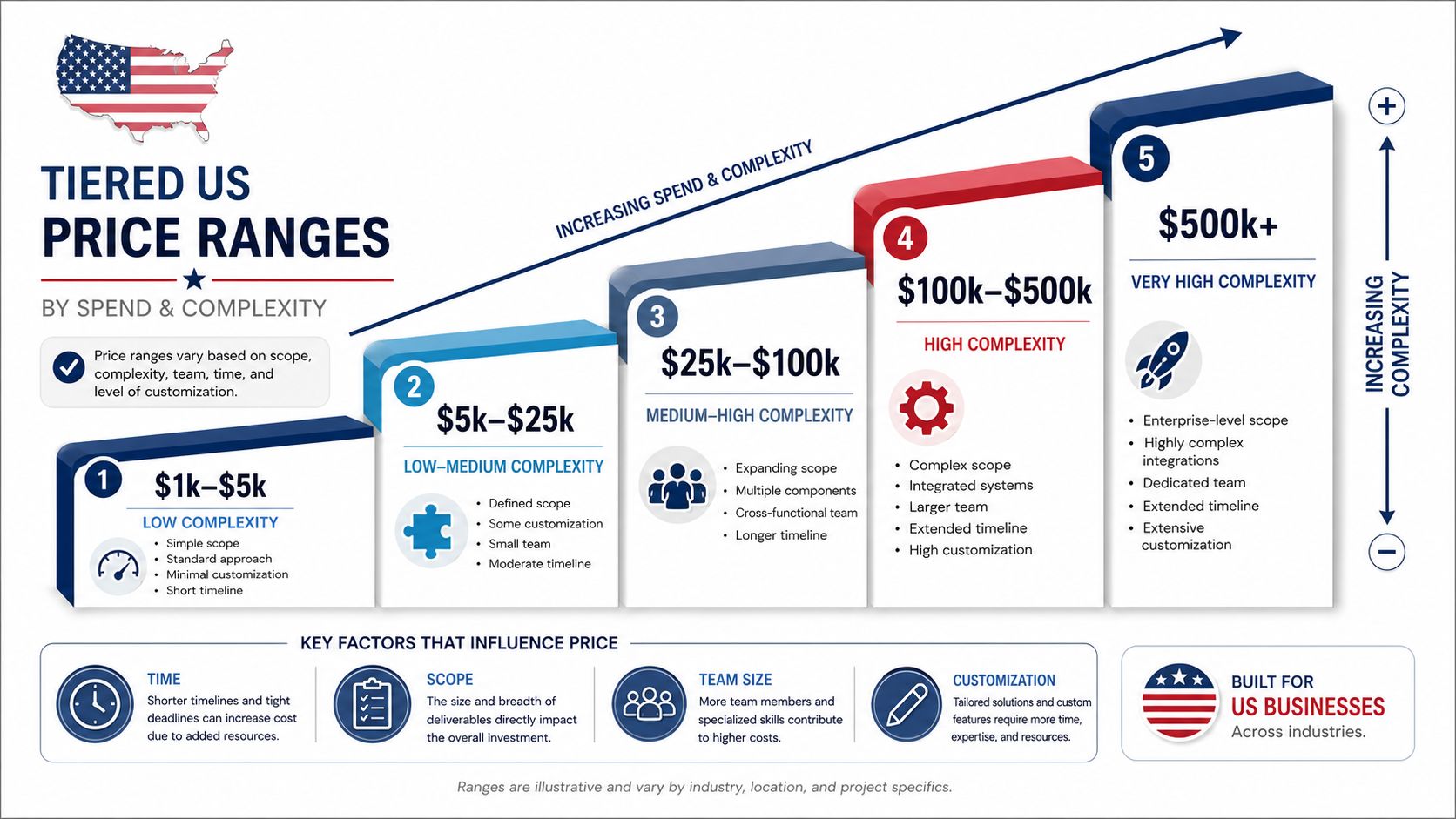
Spend bands and fee bands
| Monthly media spend | Typical management fee | What usually drives the fee |
|---|---|---|
| Under $5,000 | $500 to $2,000 per month | Basic search structure, reporting, optimization |
| $5,000 to $25,000 | $1,500 to $5,000 per month | More campaigns, more search-term work, stronger pacing discipline |
| $25,000 to $100,000 | $4,000 to $12,000 per month | Feed work, cross-campaign management, deeper measurement |
| $100,000+ | $10,000 to $25,000+ per month | Complex tracking, CRO input, reporting to multiple stakeholders |
At the lower end, the work is usually about keeping the account clean and efficient. At the middle tier, the manager spends more time on search term analysis, negative keyword management, budget reallocation, and creative rotation. At the top end, the fee has to cover the coordination burden that comes with multi-campaign programs and more fragile attribution.
Why quality still matters at every tier
The reason management pricing stays high is simple. Clicks and leads still cost meaningful money, so wasted spend hurts. One 2025 benchmark based on more than16,000 campaigns fromApril 2024 through March 2025 reported an average Search CPC of$5.26 and an average CPL of$70.11. AdManage's summary of WordStream and LocaliQ benchmark data shows why buyers care about management quality, because even small efficiency gains matter when every click and lead already has a real cost.
What Most Pricing Quotes Quietly Exclude
The headline retainer rarely tells the whole story. What often gets left out is the work that makes the account measurable and scalable, things likeconversion tracking setup,server-side tagging,feed engineering,landing page or CRO input, andrevenue-based reporting. One pricing guide notes that management may be billed as a flat fee or a percentage of spend, but setup fees, minimums, and add-ons are common enough that the quoted price often understates the operating cost. Yael Consulting's pricing analysis is blunt about this gap.
The hidden work that turns a fee into an operating system
A proposal can look affordable until the buyer asks who owns the measurement stack. If the manager is only touching bids and budgets, the team may still need internal help for tracking QA, analytics, landing page updates, or CRM handoff. That means a$1,500 retainer can become a much larger monthly commitment once specialist support and internal labor are added.
A low retainer is not a bargain if the team still has to patch the measurement holes itself.
Demand the scope before comparing price
A buyer should ask every provider to label each item asincluded,optional add-on, orclient-owned. That list should cover campaign build, conversion tracking, reporting cadence, feed work if applicable, landing page input, and who fixes broken data paths when they fail. If the provider will not commit to that list, the proposal is incomplete.
A good pricing conversation does not start with the retainer. It starts with the question,which growth constraints are inside the fee. If a provider is positioned as an accountable growth partner, the scope should reflect the operational reality of running acquisition, conversion, analytics, and automation as one system.
A Proposal Evaluation Checklist and Contract Terms That Protect You
A strong procurement process is boring on purpose. Compare two or three proposals against the same checklist, then strip out anything that is not comparable. The buyer's job is to separatemandatory work fromadd-ons, because that is where most pricing confusion starts.
What belongs in the scope
Use this checklist and mark each line clearly.
- Tracking ownership: Who implements and QA's conversion tracking, event setup, and attribution checks.
- Reporting cadence: What is delivered monthly, what is reviewed weekly, and who explains changes.
- Feed or catalog work: Whether product feed cleanup, mapping, or ongoing maintenance is included.
- Landing page or CRO input: Whether page recommendations are part of the fee or billed separately.
- Asset ownership: Who owns the account, data, and creative files.
- Handoff rules: What happens when the relationship ends.
Contract terms that actually protect the buyer
The contract should also spell outminimum commitment length,termination notice, and what happens if performance slips. A founder should not sign a long lock-in without a clear escape path, especially if the provider's scope is broad but the measurement standards are vague. If the proposal includes a minimum term, the exit conditions should be just as visible as the fee.
Google's budget mechanics also need to be understood correctly. Google explains that advertisers can setdaily budgets, the average daily spend over a month may exceed or fall below that daily budget by up to2 times on some days, and the monthly charge will not exceed the daily budget multiplied by the average number of days in a month.Google Ads budget guidance matters because pacing disputes often come from misunderstanding this behavior.
A buyer should leave the table with one clean document, not three loosely matched promises.
Choosing the Right Model for Your Business
The right pricing model depends on spend, complexity, and how good the team's measurement already is. A provider can have a fair fee and still be wrong for the business if the incentive structure pushes the wrong behavior.
Small accounts under $5,000 in spend
For a small e-commerce store or local services account, aflat retainer usually makes the most sense. The account is often simple enough that the founder wants predictability, and the provider needs enough room to do real optimization work without chasing a tiny percentage fee that discourages effort. The key question is whether the fee includes tracking, reporting, and basic optimization, not just campaign maintenance.
Mid-market programs from $10,000 to $50,000
For a mid-market B2B or e-commerce program,hybrid pricing often fits best. That structure keeps baseline support predictable while giving the provider room to scale the work as the account becomes more active. It also gives the buyer a better way to judge whether the provider is being paid for real complexity or just higher spend.
Enterprise programs above $100,000
For enterprise accounts, the conversation changes fast. The management fee often needs to reflect multi-campaign execution, feed or product complexity, conversion tracking, and reporting to multiple stakeholders.Crescade's paid search service page is relevant for teams that need paid acquisition tied to measurement and operational discipline rather than disconnected campaign management.
Decision test: if the team cannot measure outcomes cleanly, no pricing model is truly safe, because the fee can't be tied to a result the business can verify.
The best model is the one that matches the account's real complexity and the team's ability to measure it. If attribution is weak, performance-based pricing sounds sharper than it is. If spend is stable, a flat fee can be ideal. If the account is scaling across multiple moving parts, a hybrid usually gives both sides a fairer deal.
Negotiation Tactics and Measurement That Tie Fees to Outcomes
A founder should not haggle over every line item. Start with the question of which growth constraints are inside the fee, then ask the provider to defend the scope with deliverables you can verify. If a quote sits outside common US ranges, the buyer should ask what extra work is included, what is excluded, and which operational problems the fee is meant to solve.
How to push for a cleaner deal
A practical move is a90-day pilot with a clear exit clause. That gives the provider time to prove the operating model without trapping the business in a long contract before the account is understood. It also forces a review of scope, reporting quality, pacing discipline, and whether the team is doing realGrowth Operations work or just keeping campaigns live.
A cleaner deal usually comes from tying the conversation to outcomes the business can verify. If the account is early and tracking is clean, part of the fee can be linked toCPA orROAS. If the account is larger or attribution is messy, keep the performance conversation broader and focus on whether the agency is improving acquisition quality, not just chasing a lower cost number. For founders who want a simple benchmark,our break-even ROAS calculator helps set the floor before anyone argues about incentives.
Build the measurement chain before debating the fee
Google Ads should not be judged on its own. The measurement path needs to connect the ad account toGA4,Google Search Console, and CRM data so the business can see whether spend is creating real pipeline or just low-value leads. Without that chain, the fee debate turns into opinion, because no one can verify whether the work is producing better acquisition.
The strongest teams treat paid acquisition, conversion, lifecycle, analytics, and automation as one operating system. That is the logic behind afull-funnel Growth Operations approach. It gives the buyer a direct way to test whether the management fee is paying for campaign maintenance alone, or for the full set of tracking, reporting, optimization, and operational work that makes the account improve.
Putting It Together and Your Next Step
The decision comes down to three things. First, which pricing model creates the right incentive for the size and complexity of the account. Second, what is inside the fee, especially tracking, reporting, and any conversion or feed work. Third, how the team will measure whether the spend is producing better acquisition quality, not just more activity.
Founders and revenue teams usually get into trouble when they compare retainers without comparing scope. A$1,500 fee can be expensive if it excludes the operational work the business still needs, and a larger fee can be justified if it replaces several disconnected tasks with one accountable growth system. The right answer is not “cheap” or “premium,” it's whether the proposal matches the constraint that is slowing growth.
If the current setup feels fragmented, the next step is to pressure-test the measurement path, the fee structure, and the handoff between acquisition and conversion before signing a new contract.
Crescade helps teams evaluate Google Ads management pricing through a Growth Operations lens, which means the fee is judged against the full system around it, acquisition, conversion, lifecycle, analytics, and automation. If a current proposal feels unclear or under-scoped, visitCrescade to review whether the model, the scope, and the measurement plan fit the business.