- first party data activation
- first party data
- data activation guide
- marketing automation
- revenue analytics
First Party Data Activation Guide That Drives Growth
By Crescade · · 15 min read
Learn first party data activation step by step — collect, unify, and activate data across ads, email, and analytics with governance and measurement.
A major2024 IAB benchmark found that 71% of brands, agencies, and publishers were growing or planning to grow their first-party data sets, compared with41% two years earlier.The benchmark summary points to a clear shift: collecting owned data is no longer the hard part. The hard part is turning consented records into decisions that improve acquisition, conversion, retention, and measurement.
First-party data activation is the operating discipline that closes that gap. It connects customer and business signals to Google Ads, paid social, email, CRM, GA4, automation, and revenue reporting. This guide explains what to activate, how to make the records trustworthy, when server-side measurement is worth the effort, and which metrics show whether the system is producing business value.
Table of Contents
- What First Party Data Activation Really Means
- Collect the Right Signals With Consent Built InBuild a use-case-led collection map
- Separate consent purposes
- Establish naming discipline early
Clean Unify and Resolve Identity Before You Activate
Activate Across Ads Email and Analytics Systems
Measure What Matters and Know When Modeling Works
Make Activation Compound With Governance and Next Steps
What First Party Data Activation Really Means
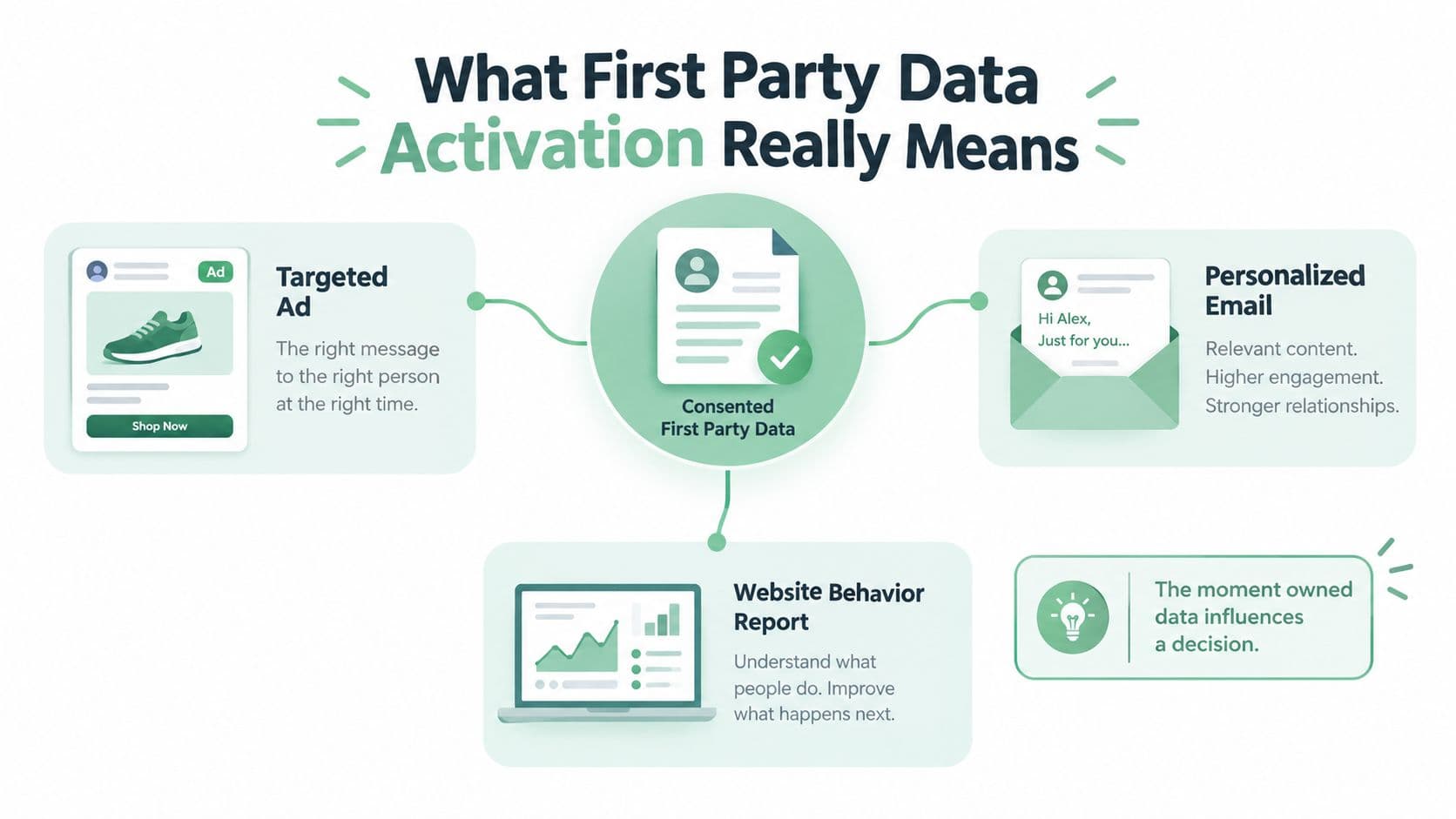
First-party data activation happens whenconsented data your organization collected directly influences a real decision. That decision might be suppressing recent buyers from an acquisition campaign, triggering a lifecycle email after a meaningful product event, personalizing a website experience, or improving how GA4 reports customer behavior.
Storing an email address in a CRM isn't activation. Sending a consented audience to an advertising platform, using purchase status to change a campaign, or connecting a qualified lead event to revenue is activation. The difference is operational. Data stays inert until a system uses it to decide who should see what, when, or how performance should be evaluated.
The 2024 IAB signal matters because it reflects a change in priorities across major advertising markets. Teams are investing inowned audience building, identity resolution, CRM-connected measurement, and replacement strategies for third-party targeting. But the investment only pays off when the records move through a complete flow:
- Collect: Capture useful customer, behavioral, and commercial signals with appropriate consent.
- Clean: Standardize fields, remove duplicates, validate events, and reject unusable records.
- Resolve: Connect email, phone, account, device, and transaction identifiers where permitted.
- Activate: Send audiences and events to the systems that can make decisions.
- Measure: Tie activation to revenue, margin, suppression, and incremental outcomes.
- Govern: Preserve consent state, access controls, retention rules, and auditability.
Google's first-party data guidance includes both customer data, such as email addresses and site visitors, and business data, such asprofit, stock level, margin, and store location. That broader view is useful. A high-value audience isn't defined only by who a person is. It can also reflect whether a product is in stock, whether an account is profitable, or whether a lead has reached a commercial stage.
A practical measurement set should include:
| Metric | What it tells you |
|---|---|
| Activation rate | How much usable owned data reaches a live decision or destination |
| Revenue per activated record | Whether activated profiles produce commercial value |
| Suppression lift | Whether exclusions reduce waste or improve audience efficiency |
| Incremental margin | Whether activation creates profitable additional demand |
Teams working through the broaderbenefits of data-driven marketing should treat activation as a feedback loop, not a one-time integration. For example,collecting first-party data via WiFi can expand the signals available to a business, but those signals still need consent checks, identity rules, a defined use case, and a measurable destination.
Collect the Right Signals With Consent Built In
Start with an inventory, not a new vendor. Most organizations already hold valuable signals across their website, app, checkout, CRM, support tools, booking system, and email platform. The question is which signals can support a decision that matters to the business.
Build a use-case-led collection map
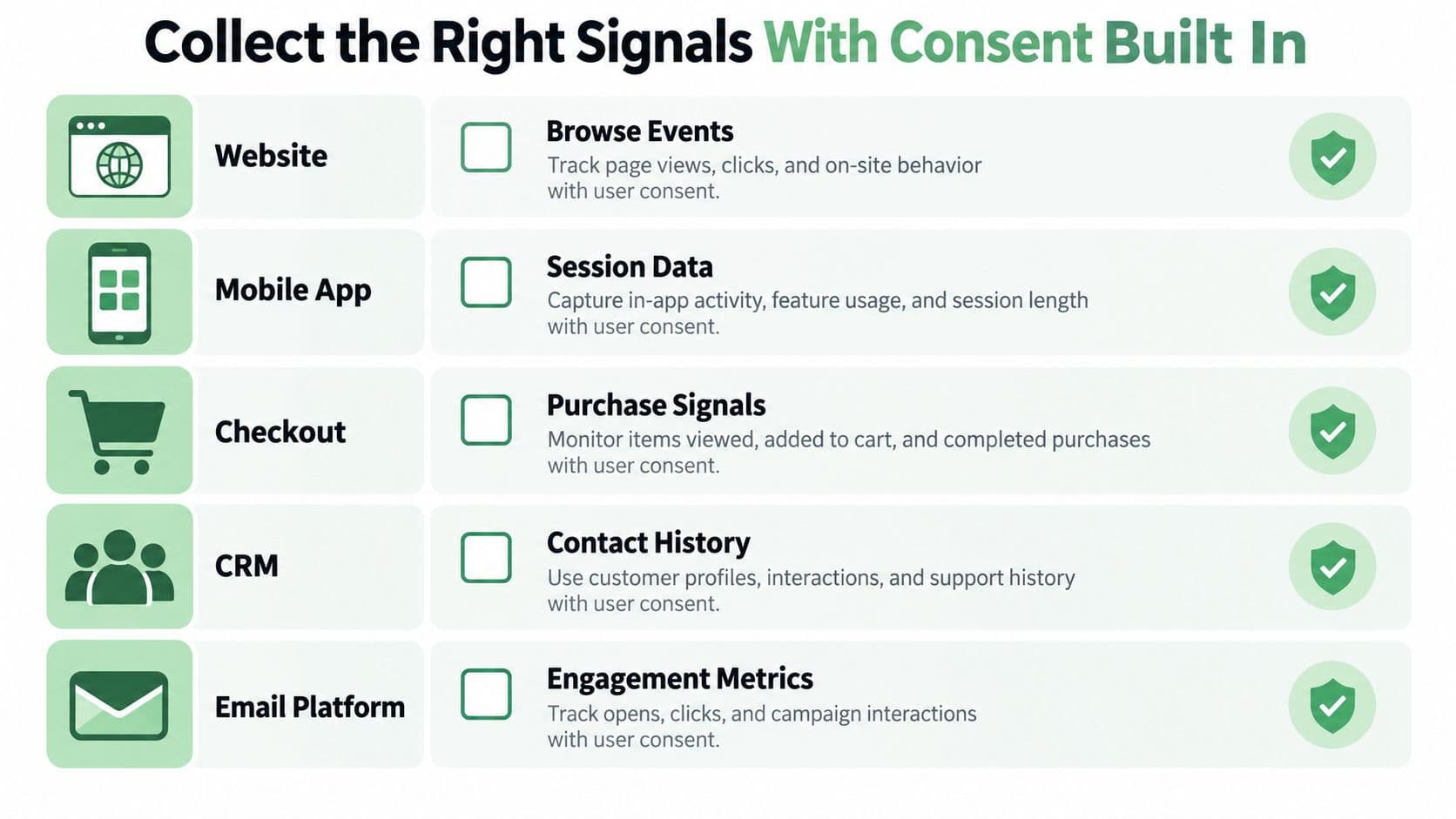
Create a simple inventory with five columns: source, event or attribute, consent requirement, destination, and decision enabled. This forces the team to explain why each field exists.
- Website: page views, product interactions, form submissions, and meaningful engagement events.
- Mobile app: session behavior, account activity, feature usage, and notification preferences.
- Checkout: purchase status, product, order value, subscription state, and refund events.
- CRM: contact history, lifecycle stage, lead qualification, opportunity status, and customer status.
- Email platform: subscription state, campaign engagement, clicks, and lifecycle responses.
- Support and sales: service intent, conversation outcomes, appointment activity, and objections.
- Business systems: margin, stock availability, location, account value, and fulfillment constraints.
Don't capture an event because a tag manager makes it easy. Capture it because a downstream system will use it. Aproduct_view event that never changes targeting, personalization, automation, or reporting adds maintenance without adding operational value.
Separate consent purposes
GA4 consent settings distinguish betweenad_user_data, which controls consent for ads measurement, andad_personalization, which controls consent for ads personalization, as documented inGoogle Analytics consent settings. Those permissions shouldn't be treated as one switch.
A visitor might permit measurement while declining personalized advertising. Your event architecture must preserve that distinction so analytics, remarketing, audience exports, and modeled reporting receive only the permissions they're allowed to use. Write the consent state into the event and profile model, not just into a banner interface.
Consent choices should also persist in first-party storage so the correct state remains available on later page loads, according toGoogle's consent guidance. If a returning visitor's choice disappears, every destination may interpret the same person differently.
Practical rule: Every important event should answer three questions, what happened, who or what does it relate to, and which consent state applied when it happened?
Establish naming discipline early
Use stable event names and explicit parameters. A purchase event should distinguish order ID, product, revenue, currency, customer status, and consent state. A lead event should distinguish form completion from marketing-qualified or sales-accepted status.
Keep an event dictionary that records the owner, definition, required fields, source system, destination, and acceptable values. Event quality beats event volume. A small set of reliable signals can support activation; a large set of ambiguous events creates false audiences and unreliable reporting.
Publish the privacy explanation alongside the collection experience.Crescade's privacy page is a useful reference point for teams reviewing how data practices are presented, although each business needs its own policies and consent experience.
Clean Unify and Resolve Identity Before You Activate
Activation magnifies data quality problems. If one customer appears as three records, a recent buyer may still receive a prospecting ad. If a refunded order remains marked as active revenue, lifecycle automation can send the wrong message. If consent status sits outside the profile, a valid identifier can still become an invalid audience.
The remedy is a deliberate identity workflow.
Deduplicate before matching
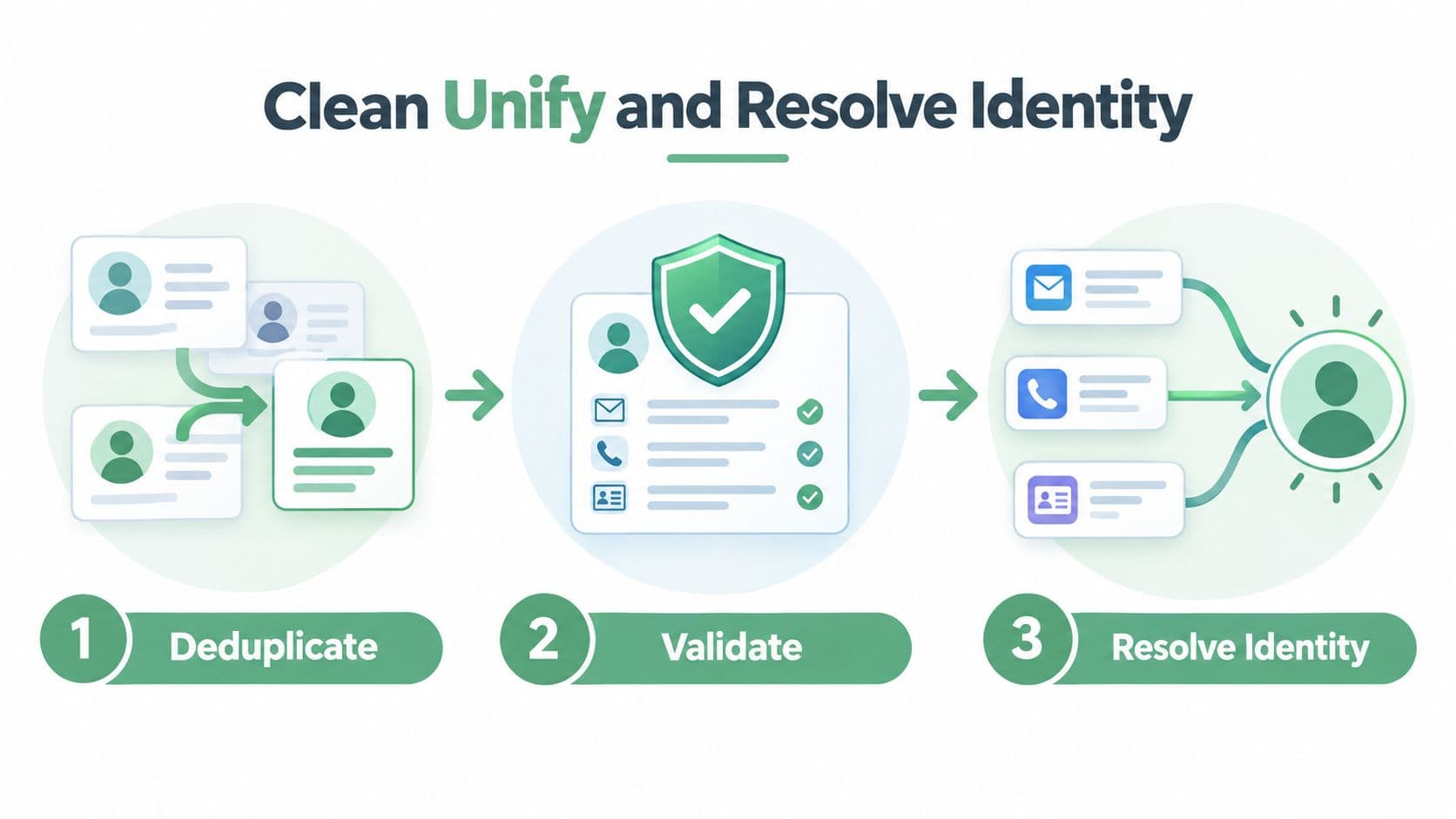
Begin with deterministic fields that your organization controls. Normalize email addresses according to your approved rules, standardize phone formatting, remove whitespace errors, and validate account or order identifiers. Don't merge records solely because names look similar. A false merge can contaminate targeting, reporting, and customer communications.
Use a survivorship rule for conflicting values. For example, the most recently confirmed customer preference may supersede an older value, while a completed transaction should remain tied to its source order record. Every merge should be reversible or traceable.
Validate the record, not just the field
A valid email address isn't proof that the customer record is current. Check whether the profile has a current lifecycle state, a recent consent decision, a known source, and events that conform to the data dictionary.
Build rejection rules for:
- Missing identity: The record can't be linked to an approved person, account, or transaction key.
- Invalid event: Required parameters are absent or use unsupported values.
- Stale status: A customer, subscription, or opportunity state no longer reflects the source system.
- Conflicting consent: Destinations disagree about whether measurement or personalization is permitted.
- Commercial mismatch: Revenue, margin, stock, or order state doesn't reconcile with the business system.
Resolve into a usable profile
Identity resolution should produce a profile that downstream systems can understand. It may include a logged-in user ID, hashed contact identifiers, account relationship, purchase history, consent state, lifecycle stage, and relevant behavioral events. Keep raw identifiers protected and limit exports to what each destination needs.
Business signals belong beside customer signals when they change the decision. A campaign might target customers interested in a category, then exclude products with insufficient stock or prioritize accounts with an appropriate margin profile. This is more useful than building audiences from contact fields alone.
A unified record should answer:
| Profile question | Operational use |
|---|---|
| Who is this? | Match the record to an approved identity |
| What did they do? | Segment by behavior and intent |
| Where are they in the lifecycle? | Trigger or suppress messaging |
| What permission applies? | Control measurement and personalization |
| What business context matters? | Prioritize margin, inventory, or account value |
Resolve identity where your team can govern the rules. That might be a warehouse, CRM, CDP, or another controlled data layer. The right location is less important than having one authoritative model and clear ownership. Teams reviewingCRM and marketing integration should make identity keys, lifecycle fields, and consent synchronization explicit integration requirements.
Use the following video as a practical visual reference for identity resolution workflows, then adapt the approach to your systems and permissions.
Activate Across Ads Email and Analytics Systems
Once profiles are clean and permissioned, start with a use case that can run repeatedly. Don't begin by exporting every audience to every platform. Choose one decision, one owner, one destination, and one feedback event.
A strong first use case is oftensuppression because the decision is clear. Recent purchasers can be excluded from acquisition campaigns, converted leads can be removed from demand-generation sequences, and active customers can receive a different message from prospects. Suppression also exposes data quality quickly. If the exclusion audience doesn't update reliably, the underlying customer and transaction feeds need attention.
Next, connect lifecycle actions. A CRM stage change can trigger a sales or nurture workflow. A product event can change email content. A subscription state can stop promotional messages. Every trigger should include an exit condition, an owner, and a fallback when identity or consent is missing.
Select the first workflow deliberately
| Use Case | System | Effort | Impact Signal |
|---|---|---|---|
| Suppress recent buyers | CRM to Google Ads and paid social | Low | Fewer irrelevant acquisition impressions and cleaner prospect pools |
| Trigger qualified lead follow-up | CRM to email or marketing automation | Medium | Faster movement from qualified event to sales action |
| Build behavior-based audiences | GA4 to advertising platforms | Medium | More relevant targeting based on consented activity |
| Personalize lifecycle messaging | CRM and email platform | Medium | Better message alignment with customer stage |
| Connect revenue events | CRM to GA4 and ad platforms | High | Optimization against qualified business outcomes rather than form fills |
| Use margin or inventory rules | Commerce or business system to media tools | High | Budget decisions reflect commercial constraints |
The systems should share stable audience definitions. If “active customer” means one thing in the CRM and another in paid media, the team can't explain performance. Store segment logic centrally where possible, then distribute the resulting audience or event to destinations.
Configure destinations for action
In Google Ads, use approved customer or conversion signals for targeting, exclusions, and optimization. In paid social, keep audience names tied to business definitions rather than campaign names. In email, pass lifecycle state and recent behavior into templates and automation branches. In GA4, send events with clear parameters and mark only meaningful events as conversions.
Don't overbuild personalization before the basics work. A suppression workflow, a reliable qualified-lead event, and a usable post-purchase sequence usually create more operational value than a complex recommendation system fed by incomplete data.
Crescade can fit where a team needs an accountable, AI-assisted growth operations layer that connects strategy, acquisition, conversion, lifecycle marketing, analytics, automation, and AI workflows. It should be evaluated as one managed operating option among internal ownership, specialist implementation, and a broader agency model. The deciding factor is whether someone will own the audience definitions, QA, launch cadence, and feedback loop after the initial connection.
Measure What Matters and Know When Modeling Works
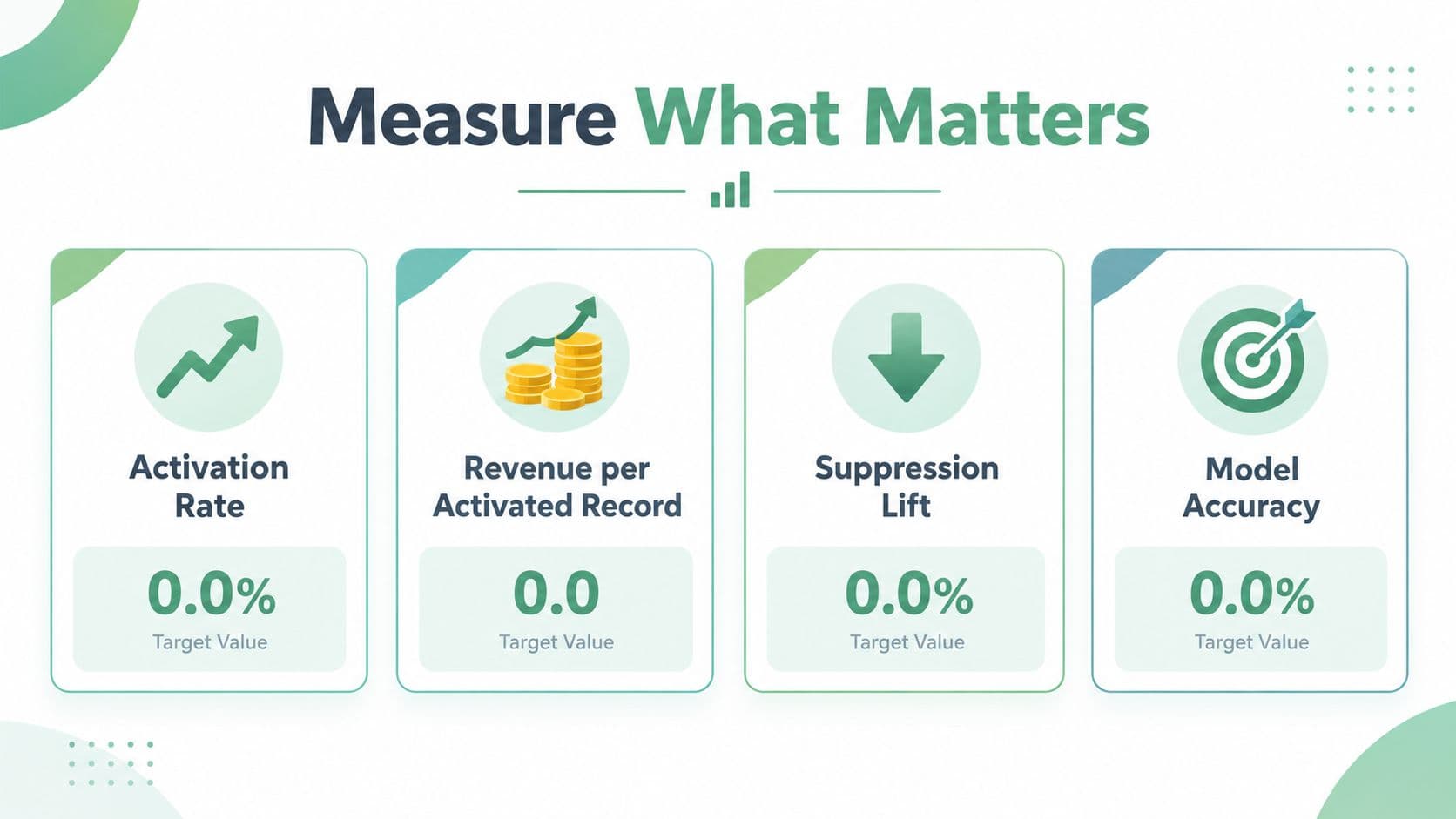
Measurement should prove that activation changes decisions and economics, not merely that records moved between systems. Start with four metrics and define each one before launch.
Activation rate is the share of eligible, consented records that reach the intended destination and can be used for the stated decision.Revenue per activated record connects activated profiles to commercial output.Suppression lift compares the relevant efficiency or outcome with and without an exclusion rule.Incremental margin asks whether the activated workflow created profitable additional business after accounting for costs and commercial constraints.
Track source counts, eligible counts, delivered counts, rejected counts, and destination match or processing status where available. In GA4, validate event receipt, consent parameters, attribution behavior, and conversion definitions. In the CRM, reconcile activated records with lifecycle stage, opportunity status, closed revenue, refunds, and margin data.
Treat measurement recovery as a volume decision
Browser-side pixels can lose30% to 50% of conversions through tracking prevention and consent rejection, according torecent martech coverage. That makes server-side tagging and modeled conversions attractive, but implementation alone doesn't guarantee useful recovery.
One published Google playbook says modeling begins only above roughly1,000 daily non-consenting events for 7 straight days, subject to the required conditions described in the source coverage. Smaller and mid-market teams may not reach that threshold consistently. For them, server-side infrastructure can add cost and complexity without producing the expected modeled reporting benefit.
Use this decision order:
- Verify event architecture: Make sure event names, parameters, timestamps, IDs, revenue, and consent states are correct.
- Check volume eligibility: Determine whether the property consistently meets the relevant conditions for modeling.
- Estimate decision value: Identify whether better measurement would change budget, bidding, channel allocation, or sales follow-up.
- Choose the implementation level: Improve browser-side instrumentation first, add server-side tagging when the business case is clear, and avoid modeling projects that can't influence a decision.
Consent persistence matters here. If the consent state isn't available on later loads, analytics and advertising destinations can't reliably apply the intended permissions. Measurement and personalization must remain separate because permission for one doesn't automatically establish permission for the other.
A buyer-scoring workflow can provide a useful comparison for teams deciding how to connect behavioral signals with commercial readiness. Thebuyer scoring engine project by Internal Systems illustrates the type of operational thinking required, but the scoring rules, data inputs, and governance still need to match your own business.
The strongest measurement system creates a closed loop. A qualified lead becomes a CRM event, the event reaches the appropriate analytics and advertising systems, revenue and margin return to the reporting layer, and the next audience or budget decision uses that evidence.
Make Activation Compound With Governance and Next Steps
Durable first-party data activation needs a small operating system, not a large committee. Assign owners for consent, identity rules, event definitions, destination configuration, audience QA, and revenue reconciliation. Document what each audience means, who can access it, how long it remains usable, and what happens when consent changes.
Review the system on a fixed cadence. Check activation rate, rejected records, stale profiles, audience freshness, revenue per activated record, suppression behavior, and incremental margin. When a metric changes, trace the cause through collection, identity, destination delivery, campaign logic, and business outcomes instead of jumping straight to a new tool.
Use a simple operating loop:
- Signal: Identify the customer or business signal that can improve a decision.
- Build: Define the event, consent rule, identity logic, and destination.
- Launch: Put one workflow into production with clear ownership.
- Learn: Compare delivery, audience behavior, revenue, and margin.
- Compound: Feed the evidence into the next campaign, lifecycle rule, or measurement improvement.
Avoid activating records with unclear consent, duplicating the same audience under different names, and treating every CRM field as targeting material. Don't build server-side infrastructure to compensate for broken event definitions. Fix the source, preserve permission state, and make the next decision more reliable.
Crescade helps growth teams connect first-party data activation with paid acquisition, conversion optimization, lifecycle marketing, CRM, analytics, automation, and AI-assisted production.Request a 20-minute audit to identify the highest-value activation constraint, validate your measurement path, and leave with a practical next workflow to build.