- real estate lead generation
- real estate marketing
- lead generation agency
- b2b lead generation
- growth marketing
Real Estate Lead Generation Agency: Grow Your Business
By Crescade · · 13 min read
Unlock growth with a real estate lead generation agency. Learn about their services, effective strategies, and how to choose the ideal partner for your 2026

Your team is probably not short on inquiries. It's short onprofitable conversations. Online forms, portal contacts, and paid campaigns can fill a CRM quickly, yet many leads never receive a timely response, never get qualified, or never enter a follow-up sequence. A capablereal estate lead generation agency fixes that operating gap by connecting acquisition, qualification, CRM routing, lifecycle marketing, and revenue measurement. The decision isn't only whether to buy more leads. It's whether a partner can improve the economics from the first click to the closing.
Table of Contents
- What a Real Estate Lead Generation Agency Actually Does
- Core Services Driving Property SalesPaid acquisition creates immediate demand
- SEO and content build owned demand
- Lifecycle marketing converts delayed demand
Evaluating the Right Channel Mix
- Search captures intent
- Paid social expands the audience
- SEO, email, and direct outreach compound differently
The Critical Lead Qualification and Handoff Process
- Qualification starts before sales contact
- Speed matters, but ownership matters too
- Closed-loop measurement changes the agency relationship
Navigating Compliance and RegulationsHow to Choose the Right Agency Partner
What a Real Estate Lead Generation Agency Actually Does
A lead generation agency for real estate should do more than deliver names and email addresses. It should build a repeatable system for attracting the right buyers, sellers, investors, or property prospects, then determine who deserves immediate attention and who needs continued nurturing.
The distinction matters becausedigital channels account for 65% of all U.S. real estate leads, while the national average lead-to-close rate across all sources is only2–5%, according toindustry lead generation benchmarks. Traffic is available. The difficult work is converting that traffic into qualified opportunities without allowing acquisition costs, response delays, or poor handoffs to erase the value.
Practical rule: Judge an agency by cost per qualified opportunity and cost per closing, not by lead volume alone.
A strong partner starts with the commercial model. What property types matter? Which locations and audiences are viable? Does the team need immediate buyer demand, seller conversations, investor inquiries, or a balanced pipeline? Those answers shape the channel mix, landing pages, forms, scoring rules, and CRM workflow.
The agency then connects four operating layers:
- Acquisition: Paid search, paid social, SEO, content, local search, and conversion-focused landing pages.
- Qualification: Required fields, behavioral signals, lead scoring, conversational intake, and human review.
- Handoff: CRM routing, ownership rules, alerts, appointment workflows, and sales follow-up.
- Measurement: Source-level attribution tied to qualified opportunities, appointments, and closed revenue.
This is why adata-driven marketing agency evaluates the funnel as a connected system rather than treating advertising, content, and sales operations as separate projects. A usefulproven system to generate leads can support acquisition, but the operating model determines whether those leads become usable pipeline.
The best agencies also make trade-offs explicit. Paid media can produce demand quickly, but it requires disciplined qualification and feedback. SEO and community content can compound more slowly, but they help reduce dependence on rented audiences. Lifecycle marketing protects the investment in leads that aren't ready today.
Core Services Driving Property Sales
A practical real estate lead generation program usually rests on three connected pillars. Each has a different job, and none should be evaluated in isolation.
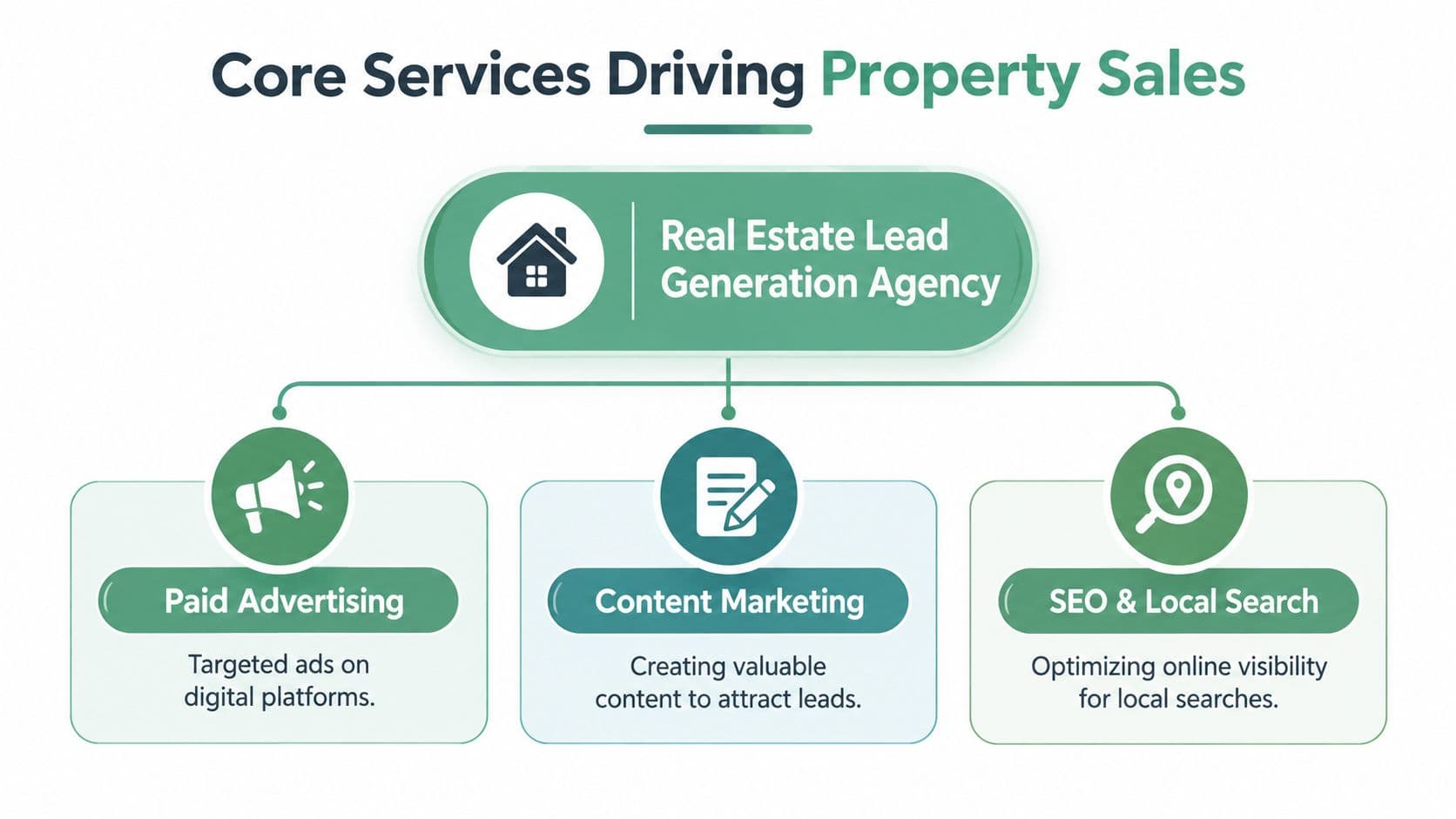
Paid acquisition creates immediate demand
Paid search captures people already expressing intent through queries such as property searches, valuation requests, or location-specific questions. Paid social can create demand among audiences who may not be searching yet, using property themes, educational offers, and retargeting to build familiarity.
The agency's work should include campaign structure, audience design, creative testing, landing-page alignment, budget controls, and negative-keyword management where appropriate. The important question isn't whether an ad generated a form fill. It's whether the resulting contact matched the intended market and progressed through the CRM.
Paid acquisition works best when the message continues after the click. A campaign for sellers needs a different intake path from one for buyers, and both need routing rules that reflect urgency, location, property type, and readiness.
SEO and content build owned demand
Organic growth serves prospects who are researching before they're ready to speak with an agent. Useful content might address neighborhood decisions, valuation questions, financing preparation, property investment considerations, or the practical steps in a transaction.
SEO isn't a substitute for sales follow-up. It's a way to create durable discovery and capture first-party demand through pages that answer specific questions. Local search adds another layer, especially when the business serves defined markets and needs visibility around service areas, neighborhoods, and property categories.
The strongest programs connect content to conversion paths. An article should lead to a relevant valuation tool, consultation request, market update, or property inquiry, rather than ending with a generic contact page.
Lifecycle marketing converts delayed demand
Real estate prospects often need time, education, and repeated contact before they're ready to transact. One published workflow recommends an immediateDay 0 response, followed by12 to 15 emails spread across a year, with re-engagement triggered after60 days without an open or click, as described in thislong-term real estate lead nurture workflow.
That sequence shouldn't be copied blindly. It should reflect source, intent, property interest, and the prospect's stage. A high-intent inquiry may need rapid human contact, while an early-stage buyer may respond better to educational content and relevant listings.
A useful lifecycle system includes:
- Immediate confirmation and expectation setting.
- Source and campaign tagging.
- Segmentation by buyer, seller, investor, or property interest.
- Automated education and re-engagement.
- Sales tasks triggered by meaningful behavior.
- Feedback from sales outcomes into future targeting.
This is whereeffective real estate lead generation becomes an operating discipline rather than a collection of campaigns. Acquisition fills the pipeline, content earns attention, and lifecycle marketing gives the team a structured way to stay present until timing changes.
Evaluating the Right Channel Mix
There isn't one universally superior channel. The right mix depends onmarket, property type, audience intent, sales capacity, and tolerance for delayed conversion.
Google Ads is often the clearest starting point for demand already in motion. A real estate benchmark reports an averagecost per click of $2.53 and an averageconversion rate of 3.3%, according toGoogle Ads real estate benchmarks. Those figures don't establish profitability. They show why landing-page quality, qualification, and CRM follow-up can matter more than reducing bids alone.
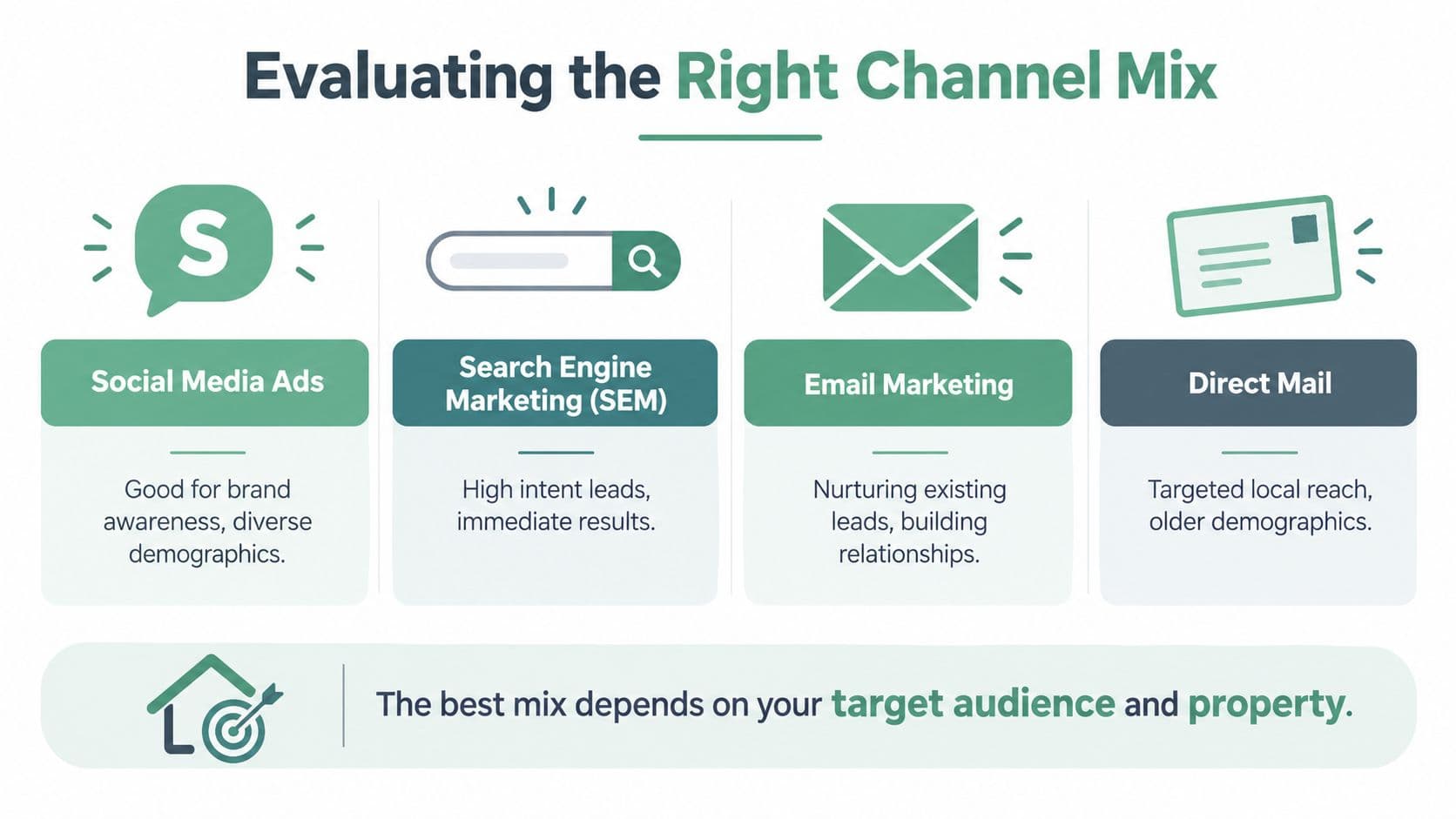
Search captures intent
Search campaigns should separate branded, nonbranded, local, property-specific, and informational intent where the account structure supports it. Someone requesting a valuation is different from someone researching neighborhoods, and the landing experience should reflect that difference.
A capable agency also connects keyword and ad data to downstream outcomes. If one campaign creates many forms but few qualified opportunities, the answer may be tighter targeting, stronger qualification, a different offer, or a revised sales handoff. Lowering CPC doesn't solve a weak post-click experience.
Paid social expands the audience
Facebook and Instagram can support property discovery, seller education, retargeting, and market awareness. These channels are useful when the audience isn't actively searching, but they tend to require stronger creative, clearer segmentation, and more patient nurture than high-intent search.
The trade-off is volume versus immediate readiness. Social campaigns can introduce a prospect earlier in the decision cycle, so the CRM must preserve context and deliver relevant follow-up instead of treating every contact as a ready appointment.
SEO, email, and direct outreach compound differently
Local SEO creates an owned discovery asset. Email helps the team continue conversations with known contacts. Direct mail can support geographic focus and reinforce brand recognition in selected areas. Each channel should have a defined role, a measurable conversion action, and a realistic time horizon.
Thedemand generation channel framework is useful when a team needs to compare channels by intent, control, speed, and follow-up burden. A balanced portfolio usually combines immediate acquisition with owned audience development, because relying exclusively on portals or paid media leaves the business exposed to rising costs and limited control.
The right channel mix is the one your sales team can respond to, qualify, and learn from consistently.
The Critical Lead Qualification and Handoff Process
Most lead generation programs lose value after the form submission. A prospect enters the database, an automated notification fires, and nobody can clearly explain what happens next. That's an operations problem, not a traffic problem.
Lead quality varies sharply by source. Referral leads can convert at15–25%, while internet leads from portals and paid advertising often convert at only1–4%, according to areal estate conversion benchmark. The gap makes source-level attribution and qualification essential.
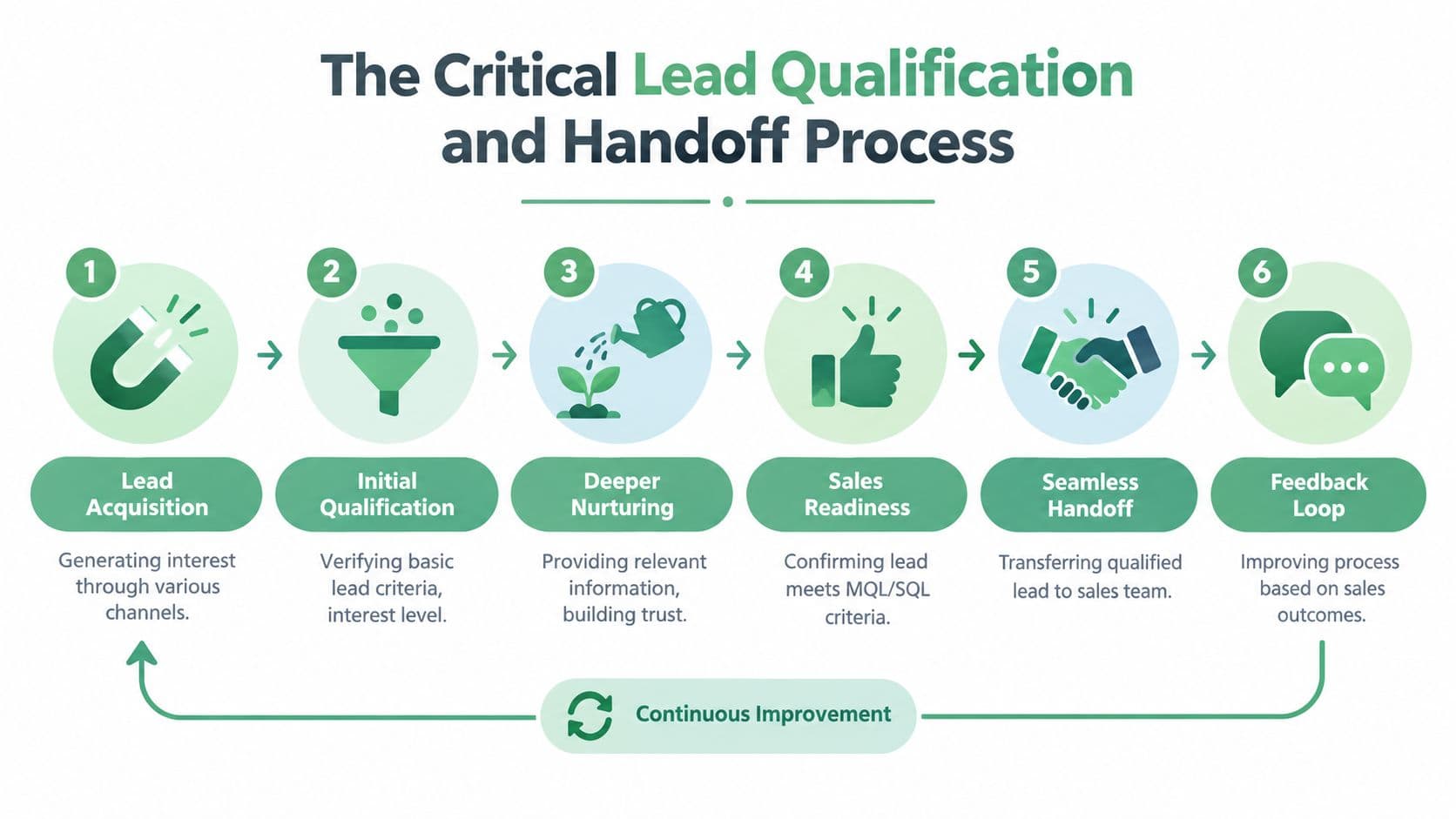
Qualification starts before sales contact
A useful intake process collects enough information to determine relevance without creating unnecessary friction. Depending on the business model, that may include location, property type, timeline, budget range, financing status, reason for inquiry, and preferred contact method.
Lead scoring should combine explicit information with behavior. A prospect who requests a valuation, returns to a property page, or responds to a follow-up message may deserve different treatment from someone who downloads a general guide. Scoring shouldn't replace human judgment. It should help the team prioritize limited sales capacity.
A practical routing model might look like this:
| Signal | Operational response |
|---|---|
| Immediate transaction intent | Alert the assigned representative and create a same-day task |
| Defined location and property need | Route by territory or specialization |
| Early-stage research | Place into an educational nurture sequence |
| Missing or unclear information | Trigger conversational qualification |
| No engagement after follow-up | Move into re-engagement rather than deleting |
Speed matters, but ownership matters too
Leads contacted within5 minutes are 21 times more likely to be qualified, according tolead response benchmark data. Automation can send an immediate acknowledgment, ask the next relevant question, and notify the right person. It can't compensate for unclear ownership, unworked tasks, or a sales team that doesn't trust the lead context.
The handoff should include source, campaign, submitted information, qualification status, conversation history, next action, and owner. CRM integration should prevent duplicate records, preserve attribution, and make sales outcomes available to marketing.
Watch this workflow for a practical view of qualification and handoff:
Closed-loop measurement changes the agency relationship
Google Ads should be measured through conversion actions, not clicks alone. A currentGoogle Ads lead tracking guide describes using website, Google Analytics, or imported-data conversion actions, linking GA4 with Google Ads, importing GA4 events, and feeding CRM or offline close data back into the ad platform.
That feedback allows the agency to optimize toward outcomes the business values. Crescade'slead qualification marketing approach reflects this broader operating model, where acquisition, scoring, routing, automation, and revenue feedback work together.
Navigating Compliance and Regulations
Real estate marketing requires more than persuasive creative and efficient targeting. Consent, outreach practices, data handling, advertising disclosures, and co-marketing arrangements can create legal and reputational exposure when teams treat them as afterthoughts.
RESPA may be relevant to certain referral, settlement-service, and co-marketing arrangements. The TCPA can affect calls, texts, and automated outreach. These areas are fact-specific, change over time, and depend on the parties, channel, consent language, and jurisdiction. This article isn't legal advice, so involve qualified counsel before launching a workflow that creates regulatory obligations.
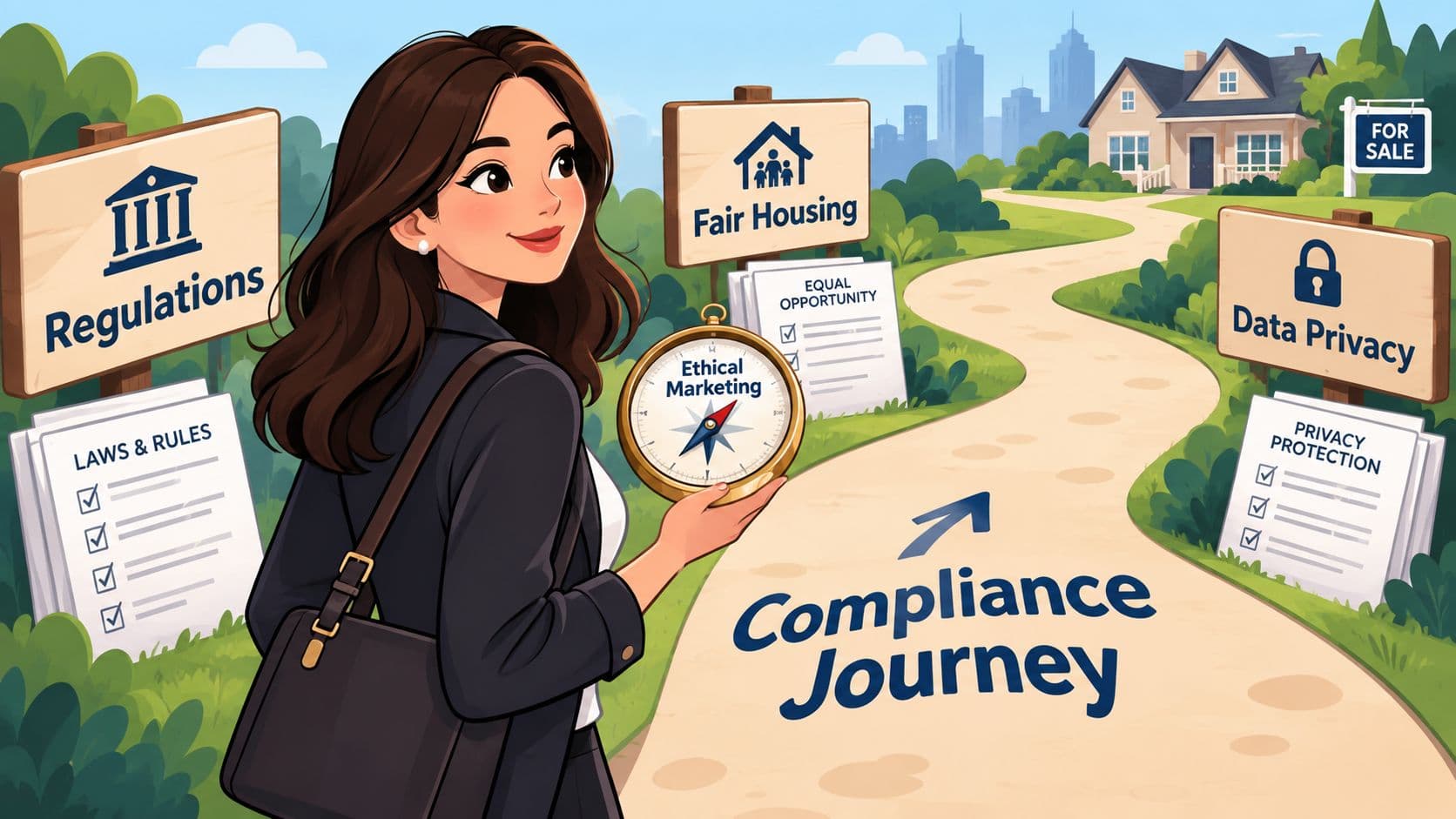
An agency should be able to show how it handles:
- Consent language: Forms should explain what the prospect is agreeing to and how the team may contact them.
- Suppression rules: Workflows should respect do-not-call requirements and internal opt-out requests.
- Recordkeeping: The CRM should preserve consent, source, timestamps, and communication history.
- Vendor controls: Agencies should clarify which platforms process data and how access is managed.
- Creative review: Ads and landing pages should be checked for misleading claims, unclear terms, or unsupported representations.
- Escalation: The team should know when to pause a campaign and seek legal guidance.
The right partner won't promise that a marketing system eliminates risk. It will document responsibilities, surface questions early, and make compliance review part of campaign operations rather than a final checkbox.
How to Choose the Right Agency Partner
Use the agency interview to test operating depth, not presentation quality. A polished media plan is easy to produce. A reliable path from inquiry to qualified opportunity requires clear ownership, usable data, and a feedback process that survives campaign changes.
A useful benchmark is a30% lead qualification rate, meaning1 in every 3 leads spoken to should be qualified, according toreal estate agent performance metrics. Treat it as a discussion point, not a universal promise. Ask how the agency defines “qualified,” which sources are included, and whether the figure refers to contacted leads or all captured leads.
Questions that expose operating quality
- Ask about source economics: Can the agency report cost per lead, cost per qualified opportunity, appointment rate, and closed revenue by source?
- Ask about response workflows: What happens immediately after a form submission, and who owns the next action?
- Ask about CRM integration: Can the system route, deduplicate, tag, score, and return sales outcomes to marketing platforms?
- Ask about nurture design: How are buyer, seller, investor, and early-stage contacts separated?
- Ask about creative testing: What changes when a campaign generates volume but poor qualification?
- Ask about data ownership: Can your team retain access to audiences, CRM records, analytics, and campaign history?
- Ask about reporting cadence: Which decisions will the team make from the reporting, rather than reviewing dashboards?
- Ask about market fit: Has the agency worked with comparable property types, territories, sales cycles, and team structures?
The strongest partner will also identify whatnot to scale. If the sales team can't follow up, a larger budget may only create more leakage. If attribution is incomplete, an apparently efficient channel may be receiving credit for leads that never progress.
Crescade positions its work as anAI-assisted growth operations system, connecting paid acquisition, SEO, conversion optimization, lifecycle marketing, analytics, automation, and CRM workflows. AI can accelerate research, production, routing, and analysis, but people still set strategy, approve budgets, review creative, and decide what ships.
Start by documenting your current funnel from first touch through CRM disposition. Then ask each candidate to identify the largest constraint, define the measurement path, and explain the first operational changes they'd make.
Crescade can help connect real estate acquisition, lead qualification, CRM routing, lifecycle follow-up, and revenue measurement into one accountable operating system. VisitCrescade to discuss the funnel constraint you need to solve first and request a 20-minute audit.