Revenue Attribution Models Compared for Growth Teams
You're reviewing three reports before approving next quarter's budget. Google Ads credits paid search, GA4 tells a different story, and the CRM shows sales activity that neither platform can see. The problem usually isn't that one dashboard is broken. It's thatrevenue attribution models answer different questions, use different data, and assign credit under different rules.
The right choice depends on the decision you're making. Last-touch can support fast conversion optimization, multi-touch can expose contribution across a longer journey, algorithmic attribution can estimate credit from observed paths, and marketing mix modeling can support broader budget allocation. None is a universal source of truth. A defensible revenue measurement system starts with data quality, then uses the model that matches the decision, and finally validates important budget choices with incrementality testing or MMM.
Table of Contents
How Revenue Attribution Works Across the Customer Journey
Detailed Comparison of Last Touch Multi Touch Algorithmic and MMM
- Revenue Attribution Models Compared by Decision Criteria
- Algorithmic attribution and MMM answer different questions
What Happens to Credit When You Change the Model
Which Revenue Attribution Model Fits Your Growth Stage and Sales Cycle
How to Implement Revenue Attribution Without Breaking Trust in Data
Choosing and Governing the Right Revenue Attribution Model
Why Revenue Attribution Models Decide Where Growth Budget Goes
Revenue attribution models determine how your team interprets the path from marketing interaction to closed revenue. That interpretation affects which channels receive more budget, which campaigns get paused, and whether acquisition, SEO, lifecycle marketing, or sales activity appears to be creating demand.
The disagreement is familiar. A paid social campaign introduces an account, organic search helps several stakeholders research the category, an email sequence brings one contact back, and a sales representative creates the opportunity. The final conversion may occur through branded search. A last-touch report will favor branded search, while a broader model may assign meaningful credit to the earlier interactions.
That doesn't mean the models are contradicting reality. They're applying different definitions of contribution to the same customer path.
Practical rule: Treat attribution as a decision system, not as a scoreboard for proving that one team deserves credit.
The central tradeoff
Growth-stage teams typically balance four tensions:
- Speed versus completeness: Simple models are easier to operate, while broader models require more connected data.
- Observed contribution versus causal impact: Attribution describes what happened along tracked paths. It doesn't automatically prove what would have happened without a channel.
- Single-touch clarity versus journey coverage: First-touch and last-touch reports are easy to explain but discard much of the path.
- Platform convenience versus cross-channel governance: Advertising platforms can optimize their own environments, but revenue teams need a consistent view across paid media, organic search, CRM, and lifecycle activity.
Google Analytics 4 changed the default measurement environment by replacing Universal Analytics' session-based framework with an event-based model. Google also made data-driven attribution the default reporting model for key events, where credit is distributed using data from each event rather than a fixed rule such as last click. TheGoogle Analytics attribution documentation explains attribution as assigning credit to ads, clicks, and other factors along a user's path.
That shift matters because a default setting can become a budget policy. If the team treats the default report as objective truth, it may change spending without examining whether the underlying path is complete.
For a broader perspective on how measurement supports revenue decisions, Wonderment Apps' resource onboosting revenue with AI is useful context. AI can speed analysis and production, but it still needs reliable event, CRM, and revenue data to produce decisions worth trusting.
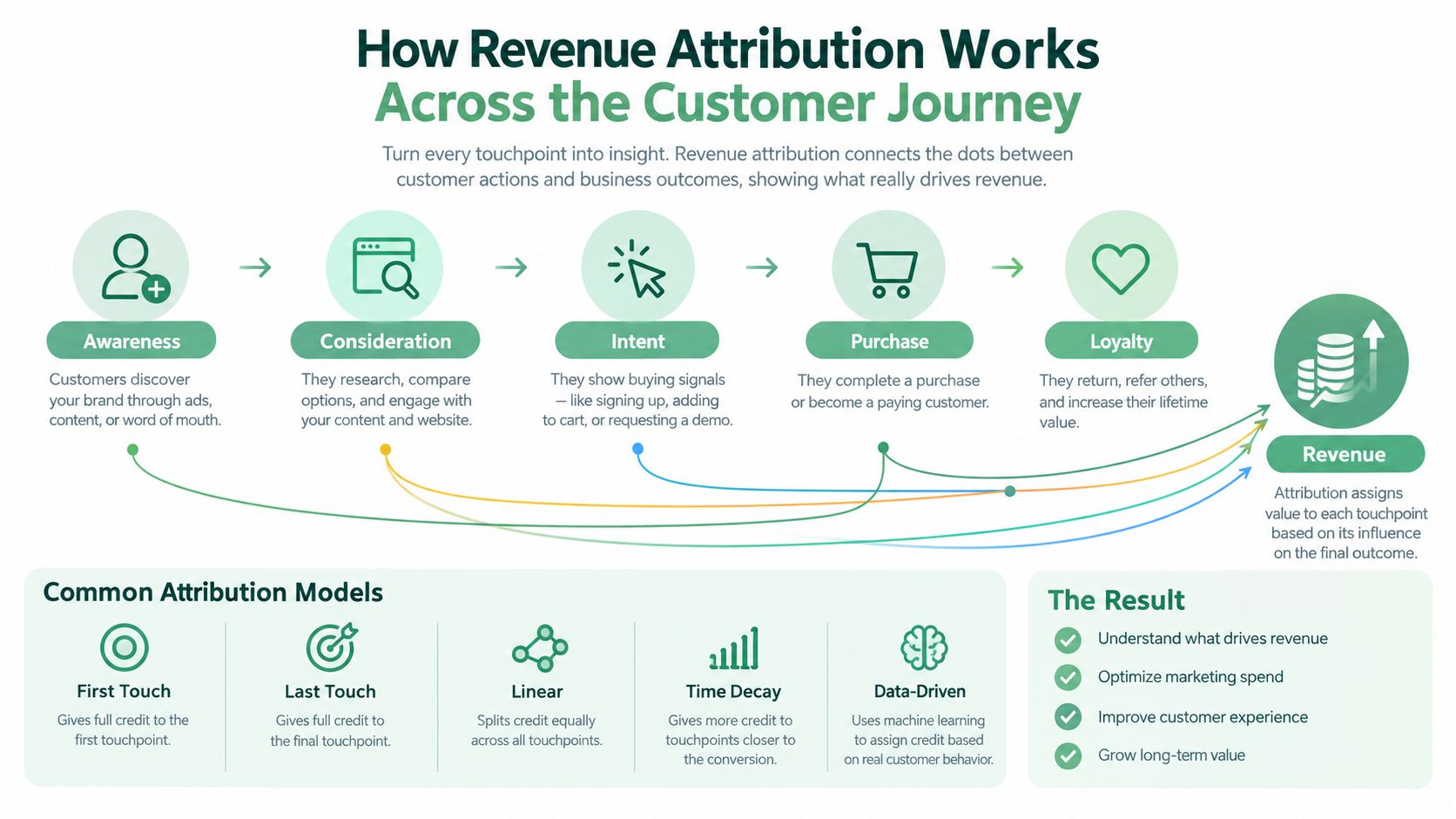
How Revenue Attribution Works Across the Customer Journey
Revenue attribution begins with a conversion or revenue event and works backward through the interactions associated with it. The system may capture an ad click, organic visit, content interaction, form submission, email engagement, product event, sales activity, or CRM stage change. A model then applies a credit rule to the touchpoints it can identify.
Start with the path, not the formula
A useful implementation sequence looks like this:
- Define the business outcome. Decide whether you're measuring a purchase, qualified pipeline, opportunity creation, renewal, or closed revenue.
- Collect touchpoints. Connect advertising, analytics, marketing automation, product events, and CRM activity where the journey requires them.
- Resolve identity. Associate anonymous activity with a known person, account, or transaction when the available data supports that connection.
- Apply the credit logic. The selected model assigns all or part of the outcome to eligible interactions.
- Compare the output with operational reality. Check whether the report includes sales conversations, multiple contacts, offline activity, and lifecycle interactions that materially influenced the decision.
Revenue attribution isn't the same as channel performance. A channel can appear in many conversion paths without causing those conversions. Branded search is a common example because people who already know a company may use it immediately before converting. The report can accurately show visibility at the end of the path while still overstating incremental influence.
Lookback windows shape the answer
A lookback window controls how far back a touchpoint remains eligible for credit. In GA4, the default window is90 days for most conversion events, with60-day and 30-day options, while acquisition events use a separate30-day default. These settings are documented inSearch Engine Land's GA4 attribution guide.
A short window can exclude early education and demand creation. A longer window can include interactions that are less relevant to the eventual decision. The correct setting should reflect the buying cycle and the question being answered, not a preference for a larger or smaller channel footprint.
Teams also need to distinguish a missing touchpoint from a low-value touchpoint. If only one person from an account is in the CRM, sales activity isn't logged, or marketing and CRM systems aren't properly synced, the model calculates from an incomplete path. TheCrescade guide to marketing channel attribution offers additional context on connecting channel activity to revenue analysis.
Kagool'sguide to analytics outcomes is relevant for the same reason. Analytics becomes operationally useful when teams connect measurement to business outcomes rather than treating reports as isolated marketing artifacts.
Detailed Comparison of Last Touch Multi Touch Algorithmic and MMM
The most useful comparison asks what each model can support, where it can mislead, and what data it needs. Model names matter less than the decision attached to them.
Revenue Attribution Models Compared by Decision Criteria
| Model | Credit Logic | Strengths | Limitations | Best For |
|---|---|---|---|---|
| First-touch | Assigns all credit to the earliest eligible interaction | Clear view of demand introduction and acquisition entry points | Ignores later influence and conversion mechanics | Top-of-funnel source analysis |
| Last-touch | Assigns all credit to the final eligible interaction | Fast, simple, and useful for conversion-path optimization | Overlooks awareness, education, and nurture | Bottom-funnel optimization |
| Linear multi-touch | Splits credit evenly across eligible touchpoints | Includes the full observed path without complex weighting | Treats low- and high-intent interactions alike | Baseline journey reporting |
| U-shaped multi-touch | Gives greater weight to first and last touchpoints, with the remainder distributed across middle interactions | Highlights entry and conversion moments | Assumes those moments matter most | Inbound funnels with meaningful lead creation |
| Algorithmic or data-driven | Uses observed conversion history to estimate touchpoint contribution | Adapts credit to available path data and can compare with fixed rules | Depends on sufficient, representative, and connected data | In-flight channel optimization |
| Marketing mix modeling | Estimates channel contribution from aggregated business and marketing inputs | Supports strategic allocation across visible and less-visible activity | Less granular for individual user paths and requires disciplined inputs | Budget planning and portfolio decisions |
First-touch is useful when the question is, “Which channel introduces demand?” Last-touch answers, “What immediately preceded the conversion?” Both are easy to communicate, which is why teams often retain them even after adopting broader measurement.
Linear attribution avoids making a strong weighting claim. It distributes credit evenly across all touchpoints, making it a reasonable baseline when the team wants journey coverage but lacks confidence in a more opinionated formula. The U-shaped model puts more emphasis on the beginning and end of the journey, while spreading the remainder across the middle.
The simplest model is often the easiest to govern, but the easiest model to govern isn't automatically the best model for allocation.
Algorithmic attribution and MMM answer different questions
Google Ads and GA4 support data-driven attribution. Google Ads describes the model as using conversion data to estimate the contribution of each ad interaction across the path rather than applying a fixed first-click or last-click rule. Itsdata-driven attribution documentation also explains the role of conversion history in the calculation.
Google Ads provides a model comparison report, which helps teams see how credit shifts between last click and data-driven attribution. That's valuable for optimization, but it still analyzes observed interactions. It doesn't establish that a channel caused the outcome.
MMM operates at a more aggregated level and is better suited to strategic allocation. Incrementality testing can provide stronger causal evidence for a specific channel or intervention, while attribution is generally faster for in-flight decisions. The practical answer isn't choosing one method forever. It's assigning each method a defined job.
For marketplace or retail teams managing sponsored media, a specializedSponsored Ads management platform may help organize channel-level execution. It shouldn't replace revenue governance across the full customer journey.
What Happens to Credit When You Change the Model
A model change can rewrite the apparent economics of a channel without changing a single campaign, customer, or order. That's why teams should expect movement rather than interpret every reallocation as evidence that the new model has discovered a hidden truth.
An independent revenue-attribution comparison used a100-order ecommerce path set to show the effect. Under last-click attribution, branded search received credit for32 orders. Under GA4 data-driven attribution, that fell to14 orders, and under incrementality testing it fell to6 orders. Meta paid social moved in the opposite direction, from18 orders under last click to31 under GA4 data-driven attribution and38 under incrementality testing. The figures are reported in theMetricuno revenue attribution comparison.
Read shifts as diagnostic signals
The example doesn't prove that paid social caused every order or that branded search caused none. It shows that the model determines which part of the path receives recognition.
Use a reallocation report to ask better questions:
- Why does branded search appear so often at the end? Check whether earlier demand-generation activity is creating the search behavior.
- Why does paid social gain credit under broader methods? Examine whether it introduces or influences users who later convert through search or direct activity.
- Which touchpoints are absent? Compare platform paths with CRM records, sales notes, lifecycle events, and account-level activity.
- What decision is the report supporting? A channel that looks strong for immediate conversion may not deserve more budget if its incremental contribution is weak.
GA4's lookback settings add another layer. With a90-day default for most conversion events, earlier interactions may remain eligible than they would under a shorter configuration, while acquisition events use a30-day default. The settings should be documented alongside model changes so stakeholders know whether a credit shift came from weighting, eligibility, or data coverage.
The video below provides a visual companion to the model-selection discussion.
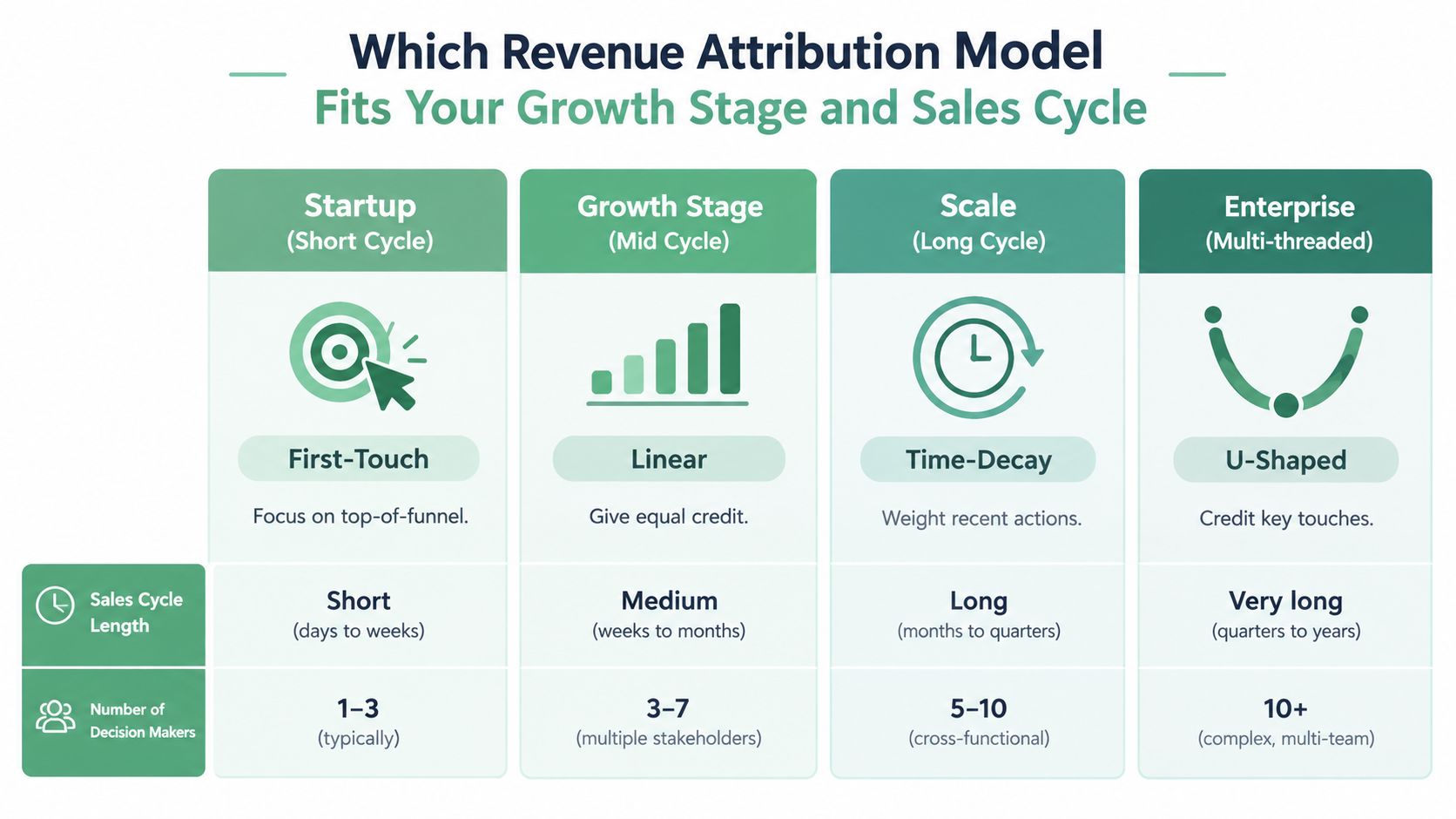
Which Revenue Attribution Model Fits Your Growth Stage and Sales Cycle
The right model follows the buying process. A short ecommerce journey with one identifiable buyer creates different measurement needs from a B2B sale involving multiple contacts, sales activity, and a long evaluation period.
Ecommerce and DTC
For ecommerce, last-touch can remain useful for rapid conversion optimization. It can help a team evaluate the interaction closest to purchase, such as a product page, retargeting ad, or branded search visit. The limitation is that it may favor channels that capture existing intent rather than create it.
A practical setup keeps last-touch for fast operational decisions but adds a broader view for acquisition planning. Compare how paid social, SEO, email, and branded search appear under different rules before shifting budget. If a channel consistently appears early or in the middle of paths, last-touch alone won't show that contribution.
B2B SaaS and services
B2B teams need account-aware measurement. One contact's activity rarely represents every interaction in a buying committee, and sales calls, direct messages, meetings, and offline conversations may not appear in marketing analytics.
Start with a model the team can operate consistently, then expand only when contact coverage and activity logging support it. Linear attribution can provide a neutral baseline across known touches. U-shaped or W-shaped logic can help emphasize meaningful milestones, but those milestones must be defined consistently in the CRM.
Hybrid funnels
Hybrid businesses combine paid acquisition, organic search, lifecycle programs, product activity, and sales. They often need several lenses rather than one report. Last-touch can support weekly optimization, data-driven attribution can inform channel contribution where tracking is sufficient, and MMM or incrementality testing can challenge platform-reported credit during major budget decisions.
Adoption reflects this mixed reality. A 2026 industry summary reported that multi-touch attribution usage reached47%, up from31% in 2023, while MMM rose to26% from9% over the same period. The same summary reported last-touch usage at41%, showing that hybrid measurement stacks remain common. These figures come fromDigital Applied's 2026 attribution summary.
A separate 2026 benchmark summary reported that76% of B2B marketers used some form of multi-touch attribution, up from56% in 2020, while22% of organizations still relied exclusively on last-click attribution. That context supports a practical conclusion: last-click isn't obsolete, but it's increasingly inadequate as the only governance layer.
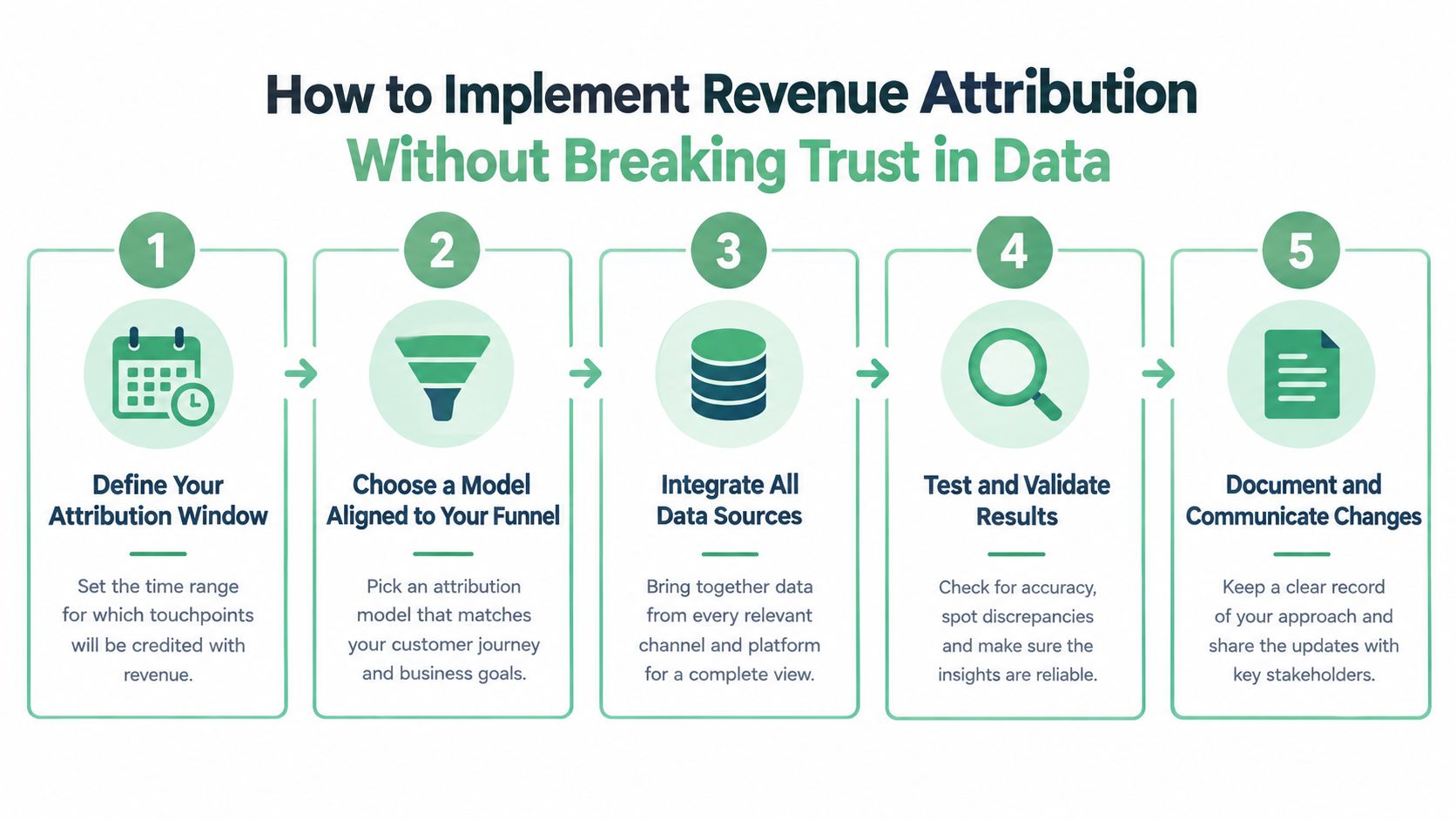
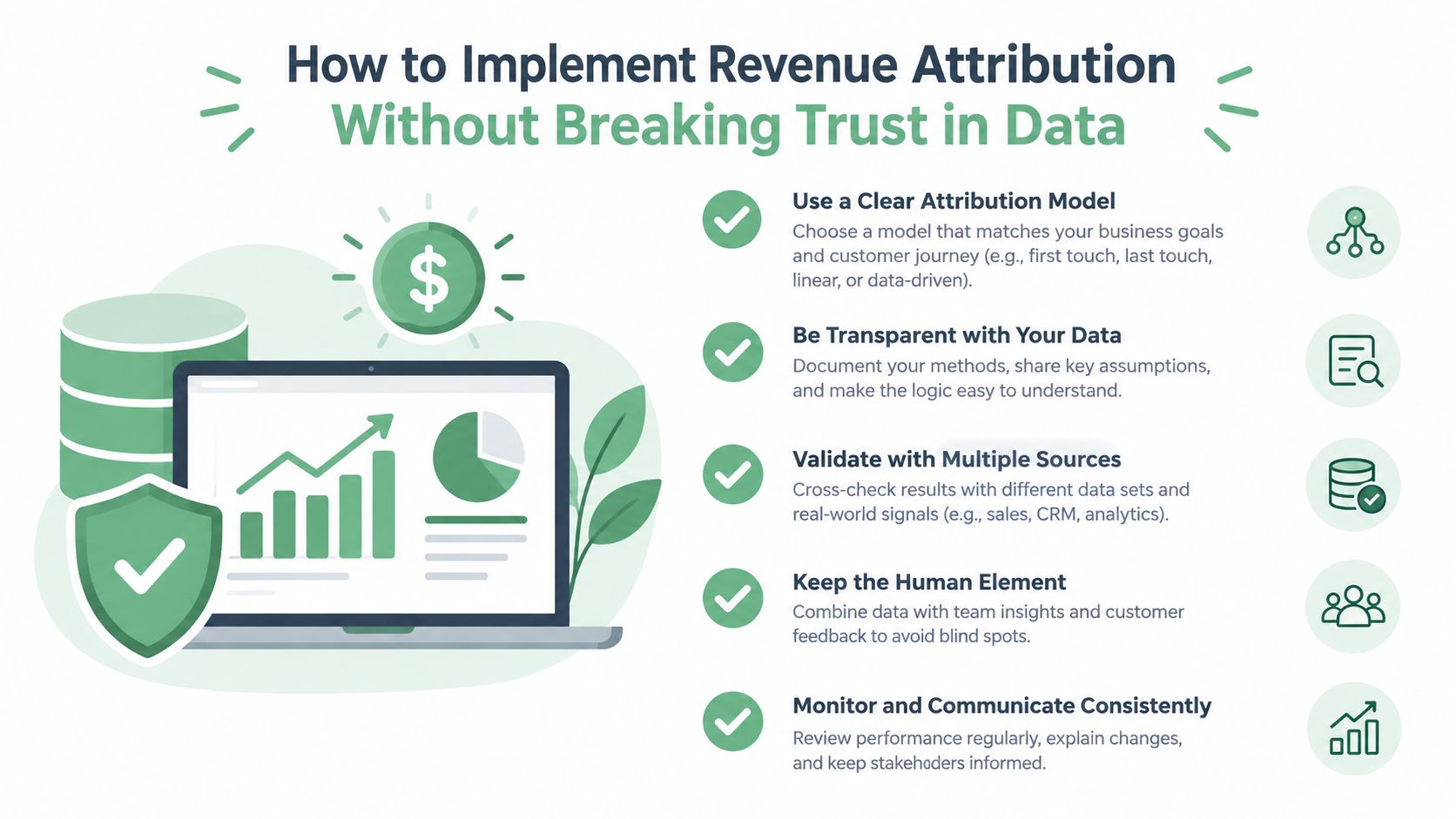
How to Implement Revenue Attribution Without Breaking Trust in Data
Implementation should begin with the path your systems can observe. Changing the weighting formula before fixing missing contacts, unlogged sales activity, or broken CRM synchronization creates a more refined report of the same incomplete journey.
Audit the input data
Check contact coverage at the account level, not just whether a lead exists. Review whether sales representatives log calls, meetings, and other meaningful interactions. Confirm that marketing automation, analytics, advertising platforms, and the CRM share the identifiers and stage definitions required to connect activity with revenue.
Then test a sample of closed paths manually. Don't ask whether the model's output looks plausible in aggregate. Ask whether the underlying records include the interactions your sales and marketing teams know occurred.
Configure and document the model
Set the GA4 lookback window based on the conversion and buying cycle. Record the selected model, eligible events, identity rules, and reporting scope. In Google Ads, use data-driven attribution where the conversion history and tracking coverage support it, then inspect the model comparison report before using the output for budget changes.
A model isn't governed until people know which report answers which question. Define one view for rapid campaign optimization, another for pipeline or revenue analysis, and a separate process for causal validation.
Validate before rollout
Compare attribution output with CRM revenue, sales feedback, cohort behavior, and controlled tests where practical. If attribution says a channel is influential but an incrementality test doesn't support that conclusion, don't average the results into a vague compromise. Investigate whether the difference comes from selection bias, missing activity, channel overlap, or a measurement-window mismatch.
Data-quality rule: Fix missing journey evidence before refining credit weights.
Teams evaluating their broader stack can use Crescade's overview ofmarketing measurement tools as a starting point for mapping analytics, CRM, advertising, and reporting requirements. The tool choice matters less than whether the systems preserve the touchpoints needed for the decision.
Finally, publish a change log. When the model, window, identity logic, or revenue definition changes, annotate the reporting period. Otherwise, executives may interpret a measurement change as a market or campaign change.
Choosing and Governing the Right Revenue Attribution Model
Choose the model by decision type, not by the desire to find one correct number.
Use last-touch or first-touch when the question is narrow and operational. Use linear or position-based multi-touch when the team needs a transparent view of a known journey. Use algorithmic attribution for faster, in-flight optimization when conversion data is sufficiently connected. Use incrementality testing for causal questions and MMM for strategic portfolio allocation.
This is a triangulation stack, not a competition. Attribution is useful because it's timely and touchpoint-specific. Incrementality tests are valuable because they challenge correlation with controlled comparisons. MMM helps leadership evaluate broader allocation, including activity that user-level tracking can't fully observe.
Governance should assign an owner, define the revenue event, document lookback windows, and require data-quality checks before budget decisions. When sales activity and marketing activity live in separate systems, a reliableCRM and marketing integration becomes a measurement prerequisite rather than a back-office convenience.
Crescades role is relevant when the issue spans acquisition, conversion, lifecycle, analytics, automation, and CRM operations. As an AI-assisted growth operations partner, Crescade can help connect those workflows while keeping people responsible for strategy, budgets, and what ships.
The practical test is simple: can your team explain what the number means, what it leaves out, and which decision it is allowed to influence? If not, the next investment shouldn't be a more complex model. It should be a measurement audit.
If your reports disagree,Request a 20-minute audit with Crescade to map your revenue paths, identify missing touchpoint data, and separate fast optimization signals from decisions that need incrementality or MMM validation. You'll leave with a prioritized measurement plan tied to the acquisition, lifecycle, CRM, and analytics decisions your team needs to make.