- answer engine optimization
- AEO strategy
- AI search citations
- zero-click SEO
- growth operations
Answer Engine Optimization Strategy for Growth Teams
By Crescade · · 15 min read
Build a measurable answer engine optimization strategy that earns AI citations, improves zero-click visibility, and connects content to pipeline outcomes.
Google searches in the U.S. ended without a click60.45% of the time in 2024, rising to68.01% during the first four months of 2026, according to SparkToro's analysis of Similarweb clickstream data. When Google AI Overviews appeared, the average zero-click rate reached83%, compared with roughly60% for traditional queries without AI Overviews. An effectiveanswer engine optimization strategy therefore has to optimize for more than rankings and sessions. It must help AI systems understand, trust, summarize, and cite your content, then connect that visibility to qualified demand and revenue.
Table of Contents
- Why Answer Engine Optimization Now Demands a New Playbook
- Restructuring Priority Pages for Answer ExtractabilityA page-level rewrite pattern
Reinforcing Content with Schema and Trust Signals
Winning Citations Without Big Brand Authority
Measuring Answer Engine Performance Beyond Rankings
Your 30-Day Answer Engine Optimization Rollout
Why Answer Engine Optimization Now Demands a New Playbook
Traditional SEO assumes a user moves from a search result to a website. Answer engines often synthesize the response inside the search experience, so a brand can influence evaluation or earn a citation without generating a session. Growth teams must therefore separate visibility from traffic when forecasting acquisition and judging content ROI.
Answer engine optimization, or AEO, structures content so AI-powered systems can extract, trust, and cite it as a direct answer. The target is not only the page. It is also the definition, comparison, claim, process, or data point an answer engine may reuse.RankEngine for answer engine optimization offers useful context on the shift from conventional results to direct answers.
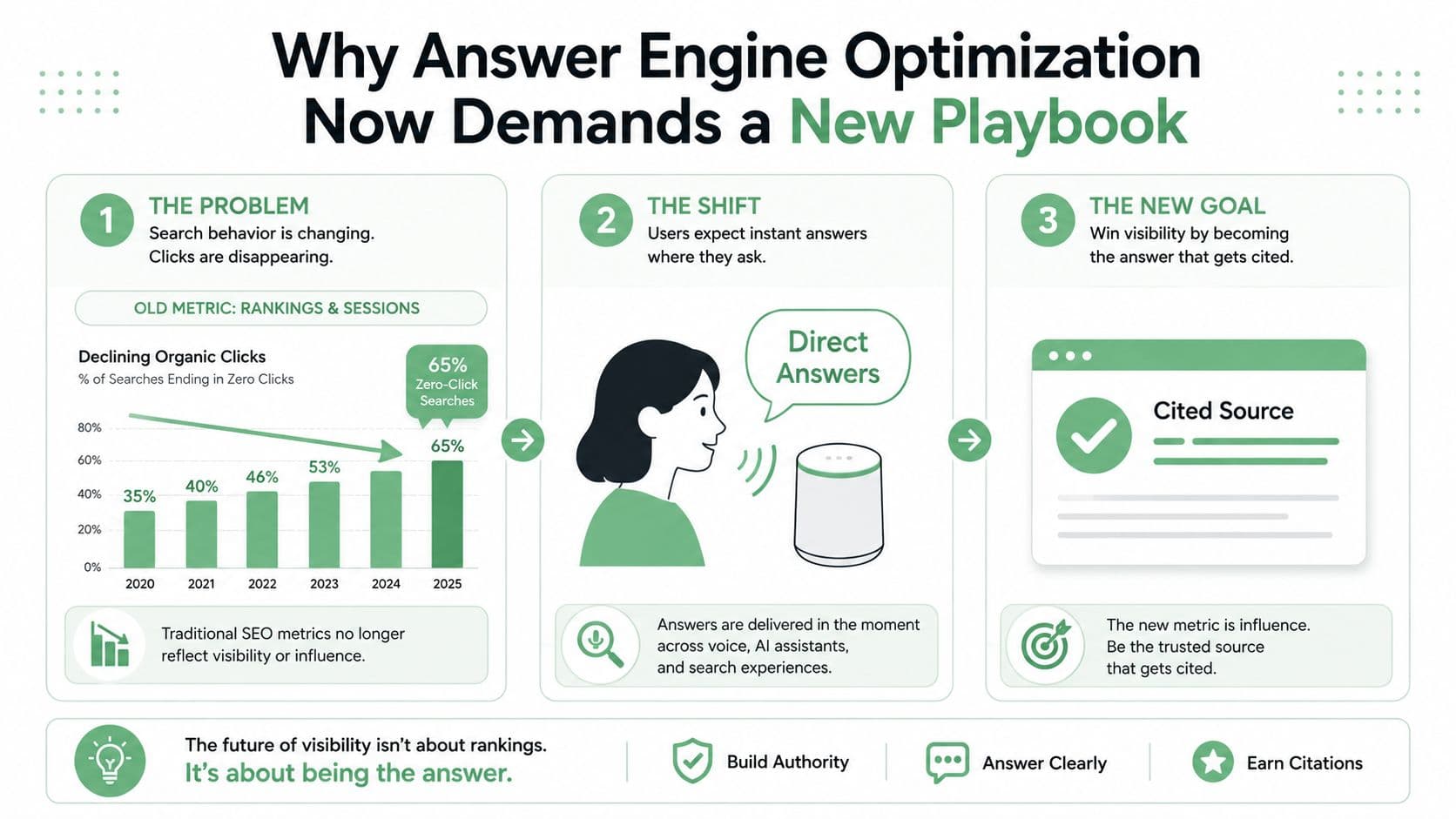
AI-generated answer layers inside search created the measurement gap. One cited industry study reported Google AI Overviews on6.5% of U.S. desktop queries in January 2025 and13.1% by March 2025, according toWorkshop Digital's review of the trend. The same coverage cited Pew Research findings that clicks from traditional results fell from15% to 8% when an AI summary appeared.
Measure the visibility unit as a mention, citation, or attributed answer, then connect it to downstream demand.
SEO still supplies retrieval conditions. Independent AI Overview research found that52% of cited sources also ranked in Google's top 10 for the query, as reported bySurfer's study of AI Overview citations. Technical accessibility, useful content, and authority remain relevant. AEO adds extractability and requires teams to test whether those signals produce citations, not merely rankings.
For acquisition teams, the implications are practical:
- Forecasting: Organic sessions can understate the reach of content that earns zero-click visibility.
- Attribution: Someone may encounter a brand in an AI answer, then return through direct traffic or a branded search.
- Content ROI: A cited page with fewer clicks may still affect consideration. CRM data and assisted-conversion analysis must test that assumption.
- Editorial priorities: Improve authoritative pages with weak answer structure before increasing publishing volume.
A practicalAI SEO workflow should connect query research, page revisions, schema implementation, citation monitoring, and revenue analysis. Without that operating layer, AEO becomes a set of formatting tactics instead of a measurable growth program.
Restructuring Priority Pages for Answer Extractability
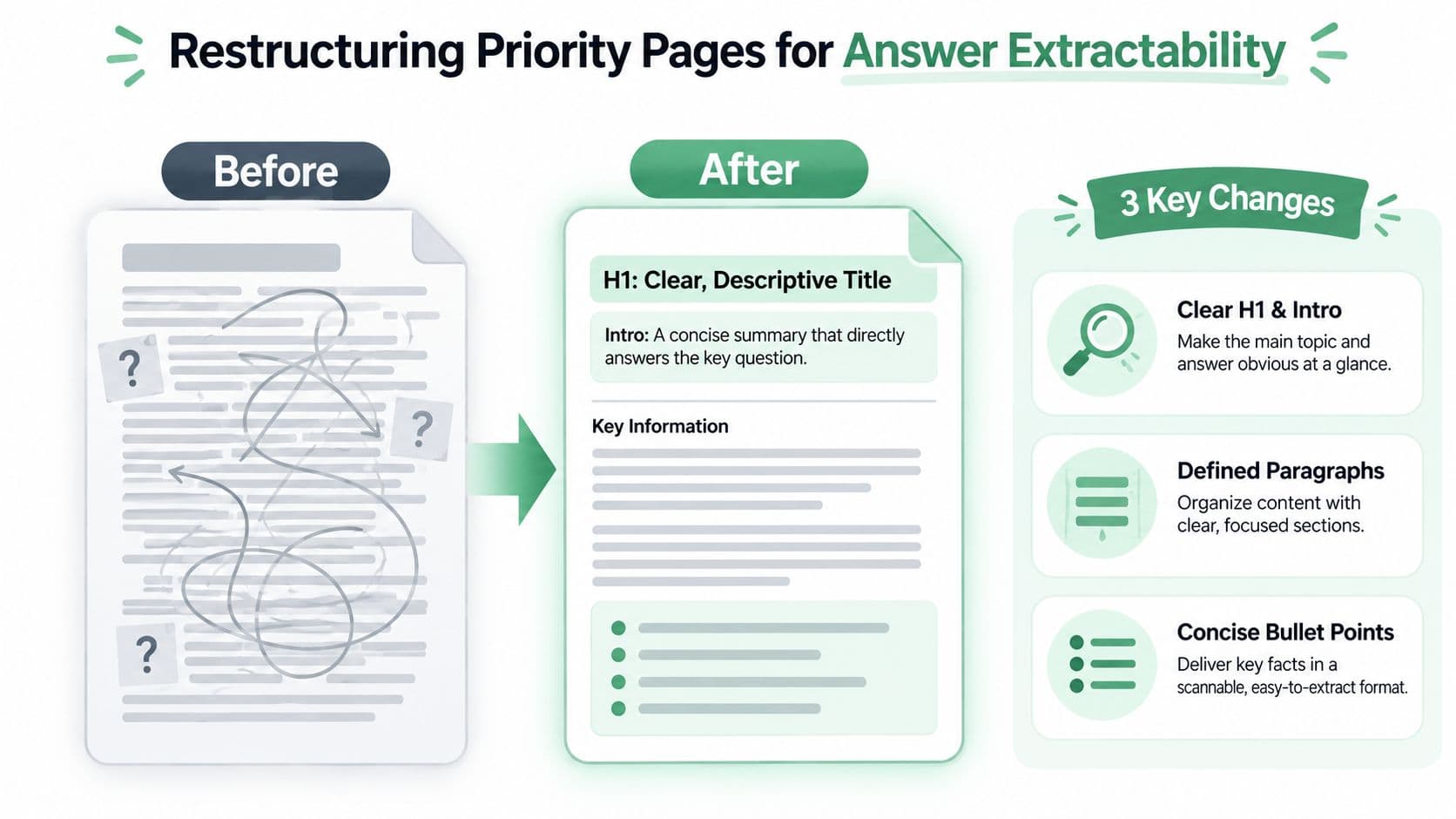
The fastest AEO gains usually come from restructuring pages that already have relevant authority, rather than publishing thin answer pages at scale. Open each priority page with a direct answer of30 to 60 words, use question-based headings, define terms consistently, and place supporting evidence immediately after each important claim. This structure also makes citation impact easier to inspect, because teams can identify which passage an answer engine may have selected.
Start with pages that attract impressions for high-intent queries, rank for related questions, earn internal links, or support a commercial decision. Export query and page data from Google Search Console, then find pages where impressions exist but the content takes too long to answer the underlying question. Record the current page, target query, answer passage, and later citation status so a rewrite can be evaluated against more than ranking movement.
A page-level rewrite pattern
A typical B2B product page often begins with positioning language:
“Modern revenue teams need a flexible platform that brings data, collaboration, and automation together so they can make better decisions.”
That supports brand tone, but it does not answer a user's question clearly. A more extractable opening is explicit:
“A revenue operations platform connects marketing, sales, and customer data so teams can manage pipeline, attribution, and lifecycle workflows in one operating system. It's most useful when disconnected tools make ownership, reporting, or lead handoffs difficult.”
The second version gives an answer engine a complete unit. It names the category, explains the function, and identifies the decision context without requiring surrounding copy.
Use this page template:
- Direct answer: Place the core response immediately below the H1 or relevant question heading.
- Definition: State what the product, process, or category is in plain language.
- Decision criteria: Explain when the approach fits and where it falls short.
- Evidence: Add primary-source citations, verifiable claims, documentation, or clearly attributed data.
- Structured detail: Use bullets, comparison tables, and short procedural steps.
- Commercial context: Explain implementation considerations, costs qualitatively, or integration requirements without burying the answer.
- FAQ coverage: Address adjacent questions that sales and support teams hear repeatedly.
Question-based headings create semantic boundaries. “What does revenue attribution measure?” is easier to interpret than “A better way to measure growth.” Keep paragraphs short enough for a passage to stand alone, while preserving a coherent argument for human readers. A page made of disconnected fragments may be easy to extract but difficult to trust or use.
One independent AEO guide reports that AI-surfaced URLs average1,064 days old, versus1,432 days for traditional search results, suggesting that authority and structure matter alongside freshness.Frase's complete AEO guide also recommends placing a statistic every150 to 200 words and citing primary sources. Treat these as editorial checks, not a reason to insert irrelevant numbers.
Use the same terminology throughout the page. If the opening says “lead qualification,” do not alternate among “prospect scoring,” “lead evaluation,” and “pipeline filtering” unless the relationship is defined. Consistent entities help readers and machines understand the page, while a recorded baseline lets growth teams connect structural changes with later citations rather than assuming every visibility gain came from the rewrite.
Reinforcing Content with Schema and Trust Signals
Schema and trust signals work best as a reinforcement layer, not as a substitute for useful writing. Structured data clarifies what a page represents, while authorship, citations, entity definitions, and transparent updates give answer engines reasons to treat its claims as attributable and reliable.
Match schema to the page
Choose markup that reflects the page's actual purpose:
- Article schema: Clarifies authorship, headline, publication context, and article identity.
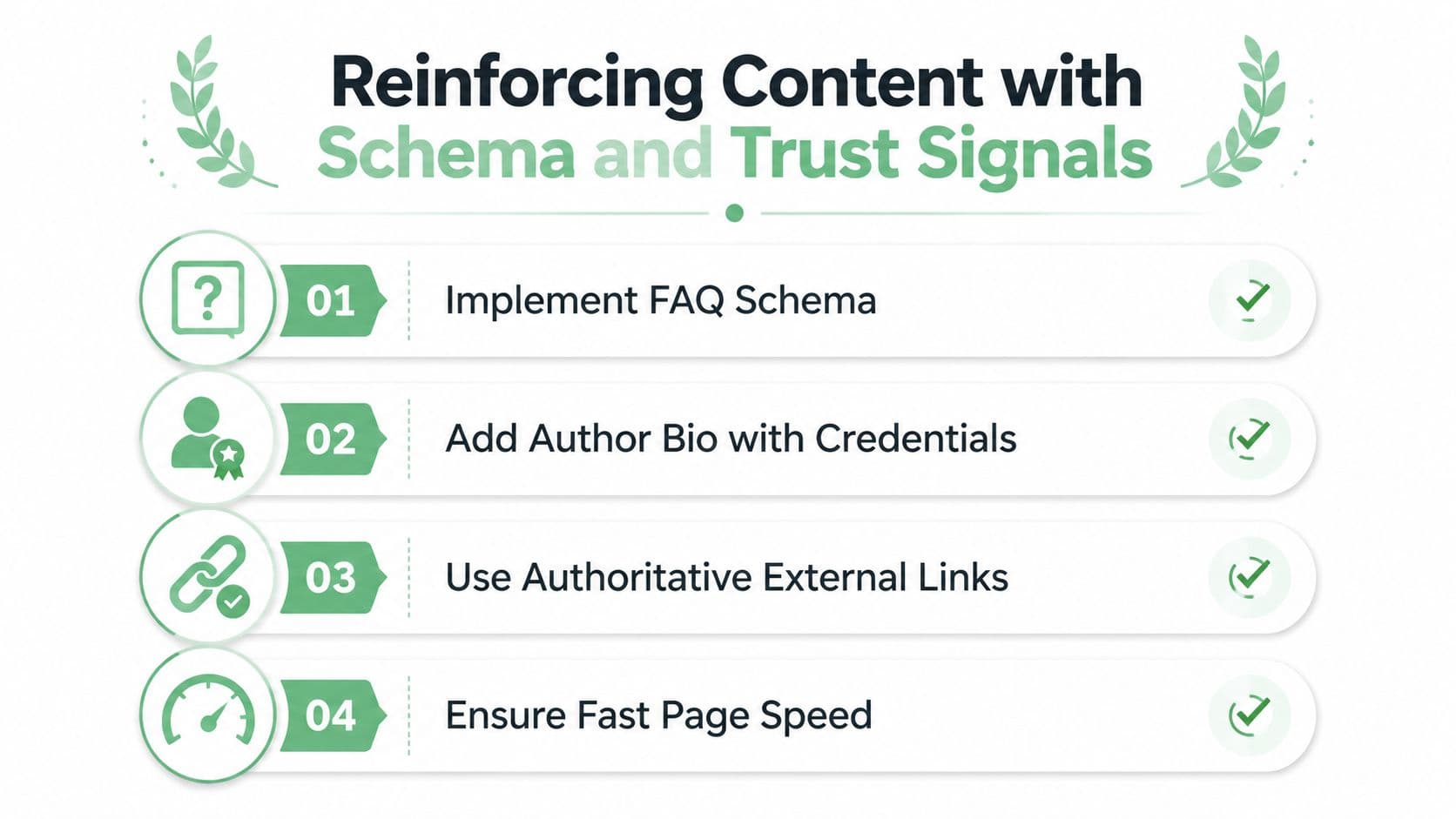
- FAQ schema: Marks genuine question-and-answer content that appears on the page.
- HowTo schema: Describes a real sequence of steps for completing a task.
- Organization schema: Connects the company name with its identity and relevant organizational details.
Don't add FAQ markup to every page just because it exists. If the visible content doesn't contain the marked-up questions and answers, the technical layer creates ambiguity rather than trust. Validate the implementation and keep the markup synchronized with editorial changes.
Make every page attributable
A citation-friendly page should tell the reader, and the answer engine, who is responsible for the information. Use a clear author byline, a relevant bio, an editorial or update date when appropriate, and links to primary documentation or research. Define specialized terms when they first appear, then use the same entity names throughout the page.
TheFrase guide recommends citing primary sources and inserting verifiable statistics at regular intervals. That approach matters because unsupported assertions are difficult for an answer engine to validate and difficult for a buyer to trust.
A useful trust audit asks:
- Identity: Is the author or organization clearly identified?
- Evidence: Can a reader trace important claims to a primary source?
- Consistency: Does the page use stable terminology for products, categories, and people?
- Context: Does the content explain limitations, alternatives, and conditions?
- Maintenance: Are outdated references removed when the page is revised?
Internal links also reinforce topical relationships. A page about lead qualification should connect to related pages on lifecycle stages, CRM processes, and revenue analytics, using descriptive anchors that explain the relationship. The practical guidance inCrescade's internal linking guide is relevant here because internal architecture helps users and crawlers understand how individual answer units fit into a broader subject.
Schema won't rescue vague content. A fast page won't compensate for unsubstantiated claims. Treat the technical layer as a way to make strong information easier to interpret, not as a shortcut around editorial quality.
Winning Citations Without Big Brand Authority
Smaller brands face a real disadvantage in AI search because answer systems can favor familiar entities and widely referenced sources. The response isn't to publish endless generic FAQs. It's to decide whether the current constraint is answer structure or external authority, then invest accordingly.
Start with a citation-gap review. Query the commercial and informational questions that matter to your pipeline, record which brands and domains appear, and classify the winning sources. If competitors have clearer answers but comparable topical relevance, restructure your pages first. If they have stronger source coverage, recognizable authors, and repeated third-party references, more on-site publishing alone probably won't close the gap.

Use a constraint-based decision
Prioritizepage restructuring when:
- Your pages already receive relevant impressions.
- The content answers the question, but the answer is buried.
- Headings, definitions, and evidence are inconsistent.
- Competitors win mainly through clearer formatting.
Prioritizeauthority building when:
- Your brand is absent from relevant answers despite having useful content.
- External sources rarely mention your organization or subject expertise.
- Competitors are repeatedly cited because they own original research, commentary, or trusted coverage.
- Your pages make broad claims without distinctive evidence.
Authority building doesn't mean chasing links indiscriminately. Build source-worthy assets, contribute informed commentary to relevant publications, clarify the people and entities behind your expertise, and develop a narrow topic area where your organization can offer original insight. Earned media and third-party references can make a well-structured page more credible, but they can't replace a direct answer.
Research on generative engine optimization found that simple optimization changes improved visibility byup to 40% in experiments on commercial generative engines, according to theGEO paper. That result supports testing structural changes, but it doesn't justify assuming that formatting alone will overcome a major authority gap. The same research emphasizes justification quality and earned authority.
For a practical iteration process,NanoPIM's guidance on an iteration workflow for AI search offers a useful complement to one-time optimization. Publish a focused improvement, observe where citations appear or fail, compare the sources that win, and update the page or authority plan based on evidence.
Decision rule: If the answer is good but hidden, restructure it. If the answer is clear but untrusted, build the evidence and source coverage around it.
Measuring Answer Engine Performance Beyond Rankings
AEO measurement needs three connected views. Google Search Console shows query exposure and search behavior, GA4 shows observable visits and engagement, and CRM data shows whether AI-influenced visibility contributes to qualified pipeline. None of these systems alone proves citation impact.
Build the reporting layer
Track a fixed set of target questions, test them consistently across the answer engines relevant to your audience, and record citations, brand mentions, competitors, and answer accuracy. Manual review remains valuable because a citation can be technically present while the surrounding answer misrepresents your company.
Use Google Search Console to monitor:
- Impressions and clicks for question-led queries.
- Changes in page and query combinations after restructuring.
- Branded versus non-branded demand.
- Featured snippet presence where it applies.
- Pages that gain visibility without a corresponding click increase.
Use GA4 to identify referral traffic from AI platforms where referrers are available. Then connect those sessions to CRM records, opportunity stages, lead quality, and assisted conversions. A user who sees a citation and later returns through a direct visit may not be captured by last-click reporting, which is whymulti-touch attribution principles matter.
Separate visibility from business impact
Citation presence is an early indicator, not a revenue outcome. Compare citation changes with non-branded impressions, direct traffic, branded search behavior, returning-user activity, form submissions, qualified leads, and opportunity progression. Also annotate launches, seasonal demand, pricing changes, public relations activity, and major site changes so the team doesn't credit AEO for every movement in the funnel.
| Metric | Data Source | What It Tells You |
|---|---|---|
| Citation share | Manual testing or AI visibility monitoring | How often your content appears relative to competing sources |
| Brand mentions inside AI responses | Manual testing and monitoring logs | Whether answer engines associate your brand with priority topics |
| Featured snippet presence | Google Search Console and search review | Whether your page earns a prominent conventional answer surface |
| AI referral traffic | GA4 | Whether cited visibility produces identifiable visits |
| Assisted conversions from AI-influenced sessions | GA4 and CRM | Whether AI exposure participates in a path to qualified action |
A benchmark set for B2B teams reports a3.2% citation rate, a127% average lift in AI search visibility,4.3 times more citations per piece, and12 days average time to first citation for optimized content, according toThe Cube Research's benchmark. The same source reports a34% improvement in AI response accuracy with structured data and23% higher marketing-qualified lead rates among companies using AEO strategies. Treat these as external benchmarks, not forecasts for your business.
The weekly question should be simple: did the team earn more relevant visibility, and did that visibility improve the quality or progression of demand?
Your 30-Day Answer Engine Optimization Rollout
A useful first month should produce evidence, not a large publishing backlog. Start with pages that combine existing authority, commercial relevance, and a visible answer gap. Delay expansion until the initial test shows whether structural improvements change citations, qualified engagement, or both.
Week one
Audit your highest-value pages in Google Search Console and your analytics platform. Select pages that receive relevant impressions, support important buying questions, or influence lead qualification. For each page, document the current answer, heading structure, source quality, author information, schema status, internal links, and whether competitors appear in AI responses.
Week two
Restructure the top five priority pages. Put a direct answer near the top, convert vague headings into user questions, separate mixed topics into clear sections, and add tables or bullets where comparison or process detail benefits from structured presentation. Keep the original strategic positioning where it helps conversion, but remove introductory copy that delays the answer.
Week three
Implement the schema that matches each page, then review authorship, primary-source citations, entity definitions, update notes, and internal linking. Test whether the visible content and structured data agree. For broader monitoring ideas,Surnex's AI Overview optimization insights can help teams think about citation visibility as an ongoing process rather than a one-time launch task.
Week four
Create a dashboard that joins four layers:
- Search exposure: Impressions, clicks, query type, and page changes from Google Search Console.
- AI visibility: Citations, brand mentions, competitor presence, and answer accuracy from a repeatable testing log.
- Behavior: AI referral sessions, returning visits, and conversion events in GA4.
- Revenue: Lead qualification, opportunity creation, pipeline progression, and assisted influence in the CRM.
Review the baseline and the first post-change observations without overclaiming causation. Expand only when the pages show a credible improvement in answer visibility or business-relevant behavior. If citations rise but qualified demand doesn't move, investigate query selection, message alignment, conversion paths, and brand authority before scaling content production.
A focused audit is the practical next step for teams that don't know whether their constraint is structure, authority, or measurement.
Crescade connects SEO, acquisition, conversion, lifecycle marketing, analytics, automation, and AI-assisted growth operations into one accountable system. VisitCrescade to request a 20-minute audit of your answer engine readiness, priority pages, and measurement path.