- full funnel marketing
- growth operations
- funnel optimization
- marketing measurement
- demand generation
Full Funnel Marketing: A Growth Operations Framework
By Crescade · · 16 min read
Build a full funnel marketing system that connects acquisition, conversion, and retention. Learn channel mapping, measurement, and optimization cadence.
Most full funnel marketing advice gets the order wrong. Teams are told to add awareness, then consideration, then retargeting, as if assembling more channels automatically creates better growth. In practice,full funnel marketing only works when the team can prove how upper-funnel activity changes downstream outcomes, because otherwise it turns into a pile of disconnected tactics with no decision rule.
That distinction matters for founders and revenue leaders. The question isn't whether a brand should “do the whole funnel,” it's whether the organization can connect shared data, a single revenue goal, and a repeatable optimization cadence across acquisition, conversion, and retention. If it can't, the first fix is usually conversion and measurement discipline, not more awareness spend. For a practical baseline on that side of the work, Crescade's guide onhow to measure marketing performance is the right place to start.
Table of Contents
The Data Behind Coordinated Funnel Strategies
Mapping Channels to Funnel Stages
Stage-Specific KPIs That Prevent Misread Optimization
Attribution Approaches for Privacy-Constrained Environments
Coordinated Campaigns From Acquisition to Retention
Optimization Cadence and Decision Rules
Why Full Funnel Marketing Fails Without Measurement
The most common mistake is treatingfull funnel marketing like a channel checklist. Awareness gets a blog, consideration gets email, conversion gets retargeting, and retention gets a lifecycle sequence. That can look complete on paper, while still leaving the team unable to answer a basic question, which stage is constraining revenue?
A funnel only becomes useful when the business can connect data across stages and tie the work to one revenue goal. Without that link, the strategy becomes disconnected activity. One team celebrates traffic, another celebrates leads, and sales still sees weak qualification. That is why recent guidance increasingly recommends fixing conversion readiness before scaling awareness, because if the bottom of the funnel is leaky, more top-of-funnel volume just increases waste.
Practical rule: if the team can't trace an upper-funnel campaign to downstream movement in GA4 or CRM data, that campaign is a brand bet, not a measured growth bet.
Readiness is mostly operational. The organization needs clean stage definitions, a shared handoff between marketing and sales, and enough tracking discipline to see where prospects stall. If those pieces don't exist, “full funnel” becomes a label for activity instead of a system for decision making.
What readiness actually looks like
A team is closer to full funnel execution when it can answer these questions without guesswork:
- Who owns stage definitions: Marketing, sales, and lifecycle teams agree on what counts as awareness, qualified interest, opportunity, and customer.
- Where the handoff breaks: The team can see where leads stall, not just where traffic enters.
- Which stage is tested first: The order of work follows the constraint, not the loudest channel request.
- Whether one revenue goal exists: Separate vanity metrics don't drive separate operating plans.
That's why Crescade'scross-channel marketing strategy matters in practice. The point isn't to add more media. It's to connect the parts that are usually managed separately so the team can make one decision at a time, based on one view of performance.
The Data Behind Coordinated Funnel Strategies
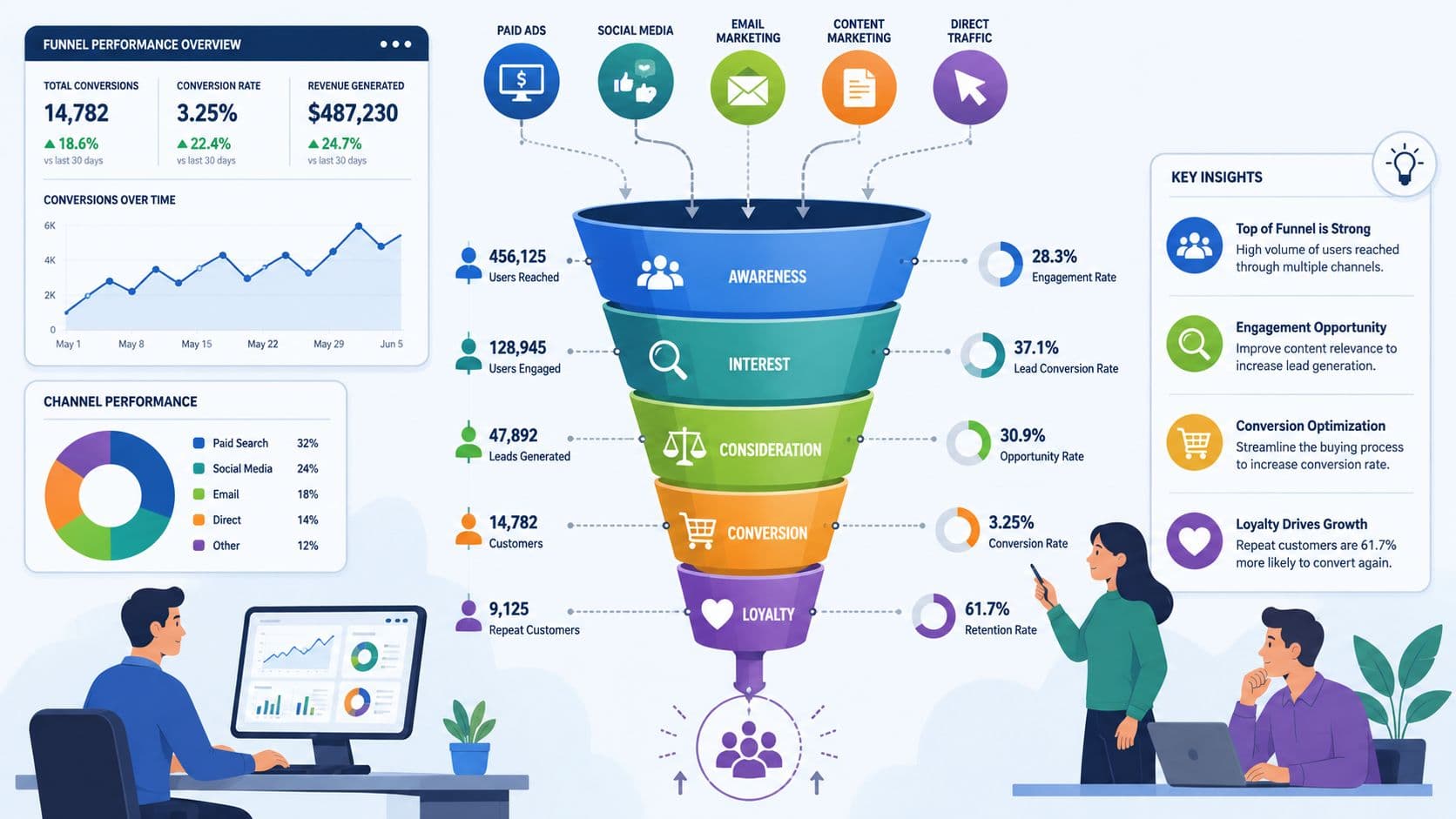
The strongest case forfull funnel marketing is empirical. A Google and Nielsen meta-analysis found that full-funnel strategies delivered up to45% higher ROI and7% higher offline sales than campaigns focused on a single purchase stage, based on more than1,300 campaigns across20 CPG brands. The lift came from coordination across stages, not from a single channel tactic (Google full-funnel marketing strategy).
Google also reported a second pattern that matters for operators. Brands mainly investing in the middle of the funnel saw52% more incremental sales when they added upper- or lower-funnel tactics, while brands focused mostly on upper-funnel tactics gained20% more incremental sales when they added middle- or lower-funnel tactics with Google Ads. The trade-off is straightforward, a single-stage strategy leaves money on the table because each stage strengthens the next one (Google full-funnel marketing strategy).
What the numbers mean for operators
The operational takeaway is simple.Full funnel marketing works as a measurement and coordination system, awareness improves consideration, consideration improves conversion, and conversion data feeds the next round of targeting and creative decisions.
That also explains why a full-funnel plan should never be judged on one campaign report. An upper-funnel launch can look weak if the team only watches immediate conversions, while a bottom-funnel push can look efficient until it starves the pipeline later. The better read is staged and cumulative, so the team can see where one investment changes the next step in the journey.
A campaign should be evaluated on the stage it influences most, then on the stage it helps next. If the team skips that second check, it is easy to mistake short-term clicks for durable demand.
The benchmark data in the brief points to the same operational problem. Average funnel conversion rates are commonly reported around3–5%, only32% of businesses have a clearly defined funnel, and businesses with a documented funnel generate2.3x more ROI than those without one (sales funnel statistics). In B2B, visitor-to-lead conversion averages about2.3%, and only13–15% of those leads become sales-qualified opportunities. The main leak is usually not the first click, it is the transition from interest to qualification.
Mapping Channels to Funnel Stages
Channel mapping works best when it follows buyer behavior, not a rigid media taxonomy. The same channel can play two different roles depending on whether the business is B2B or e-commerce, whether the buyer is early in research, or whether they've already shown intent. The mistake is assuming every top-of-funnel activity is demand generation. Some of it is discovery, some of it is qualification, and some of it is just noise.
Start with the buyer's question
The cleanest way to map a channel is to ask what the buyer is trying to solve at that moment. In B2B, search often serves discovery and problem framing, while the same search behavior in e-commerce may be closer to product comparison or purchase readiness. In practice, that means a single channel can support awareness one week and conversion the next, depending on the query, creative, and landing page.
That's where the internal logic of the funnel matters more than the channel label. A blog post can attract unfamiliar visitors, but it can also move a known prospect toward a demo if the page is structured to answer objections and route them to the right next step. A retargeting ad can capture demand, but it can also act as a reminder after a pricing-page visit.
Channel-to-Stage Mapping Examples
| Channel | B2B Primary Stage | E-commerce Primary Stage | Key Measurement |
|---|---|---|---|
| SEO content | Awareness, consideration | Awareness, consideration | Qualified traffic, intent signals |
| Search ads | Consideration, conversion | Conversion | Cost per incremental conversion, drop-off |
| Social content | Awareness | Awareness, consideration | Incremental reach to ICP, frequency |
| Retargeting | Conversion, retention | Conversion, retention | Funnel drop-off, repeat purchase signal |
| Email nurture | Consideration, conversion | Consideration, retention | Qualified engagement, handoff quality |
| Landing pages | Conversion | Conversion | Completion rate, friction points |
The table is a starting point, not a universal rulebook. A long-form article on a pain point may sit in awareness for one business and consideration for another. An abandoned-cart sequence is almost always bottom-funnel in e-commerce, while a post-demo sequence in B2B usually plays both conversion and qualification support.
The channel matters less than the job it's doing. If the team can't name the buyer question behind the message, the mapping is probably too abstract to operate.
For teams using Crescade'swhat is multi-touch attribution perspective, this mapping becomes even more important. Attribution only works when the stage design is clear enough to interpret what the touchpoint is supposed to accomplish.
Stage-Specific KPIs That Prevent Misread Optimization
Single-metric reporting breaks full-funnel work fast. A team can make awareness look efficient by chasing clicks, make conversion look inefficient by judging it against reach, or make retention look weak by comparing it to acquisition cost. Good programs get misread that way, then underfunded before anyone notices the measurement problem.
Match the metric to the stage
A better measurement system gives each stage its own job.Awareness is better evaluated with incremental reach to the ICP and frequency, because the question is whether the right people saw the message often enough to remember it.Consideration is better judged with qualified traffic and intent signals, because the team needs to know whether interest is deepening rather than just broadening.Conversion belongs with cost per incremental conversion and funnel drop-off, because the issue is efficiency at the point of decision.
Revenue needs pipeline, win rate, and payback period.Retention needs churn and expansion. Then unit economics close withLTV:CAC and contribution margin, which forces the team to connect acquisition quality to downstream value instead of celebrating cheap leads that never become profitable customers.
Practical rule: if a channel report doesn't show where the next constraint sits, A channel report that doesn't show the next constraint is a vanity snapshot, not a decision document.
Why this structure changes the conversation
This structure stops a familiar mistake. Top-of-funnel optimization often gets treated as demand generation when the actual problem is down-funnel conversion or retention efficiency. A campaign can grow qualified reach and still fail because the landing page is weak, the handoff is slow, or the follow-up sequence never closes the gap.
That matters in B2B, where the gap between visitor and sales-qualified opportunity is often wider than teams expect. As noted earlier, lead-to-opportunity conversion can be far lower than leaders assume, which means the team should inspect lead quality, routing, and qualification criteria before it assumes the market is weak.
A well-structured KPI tree also helps leaders avoid false debates. Marketing can show whether awareness is expanding qualified reach, sales can show where opportunity quality drops, and lifecycle can show whether retention is improving payback. That gives the team one operating picture instead of three competing scorecards.
Teams using amulti-touch attribution framework need this clarity even more. Attribution only helps when stage design is specific enough to show what each touchpoint is supposed to do.
Attribution Approaches for Privacy-Constrained Environments
Path-based attribution looked precise because it showed the order of touchpoints. In privacy-constrained environments, that precision can be deceptive. A chain of clicks still tells a useful story, but budget decisions require evidence of causality, not a clean-looking trail.
Compare the methods by the question they answer
Multi-touch attribution still has value when an organization needs a directional view of how channels and campaigns participate in a journey. Modern MTA models use large-scale signals and machine learning, which makes them more useful than last-click reporting for many teams, but they still struggle to prove what would have happened without the spend. Amulti-touch attribution framework helps teams interpret participation across the journey without pretending it settles incrementality on its own.
Randomized tests answer a narrower but stronger question. They help establish whether a change caused a change, which makes them useful for specific campaign decisions, especially when the team wants to isolate one tactic's incremental effect.
Marketing mix modeling is gaining attention because it estimates incremental impact across channels and long-term sales effects at a level that path-based systems cannot match in constrained environments. OneAdExchanger analysis of full-funnel omnichannel measurement makes that trade-off clear. MMM is especially useful when teams need a broader budget view and cannot rely on user-level tracking alone.
How to use them together
The strongest teams do not choose one method and stop there. They use MTA for operational visibility, tests to validate specific changes, and MMM to guide allocation at the system level. Used together, the three methods reduce the risk of treating correlation as causation.
Correlation can help a team prioritize. It cannot justify a budget shift by itself.
Crescade's approach to measurement fits this reality because the job is to line up shared data, a single revenue goal, and a decision rule that can survive channel noise. Full-funnel measurement should be judged against what the organization can prove, not what attribution would like to prove.
Coordinated Campaigns From Acquisition to Retention
A coordinated funnel doesn't begin with a media plan. It begins with a sequence of decisions. A B2B team launches an educational article on a core problem, then watches which topics pull qualified traffic, which pages lead to deeper engagement, and which visits eventually trigger a form fill or demo request. An e-commerce team might use the same logic with product education, then intent capture, then post-purchase sequencing.
A realistic B2B path
A strong B2B launch often starts with SEO content that answers a specific operational problem. The next step is not a hard sell, it's a follow-up asset that captures interest, such as a checklist, comparison page, or webinar registration. If the contact shows deeper intent, the conversion stage should shift to a high-friction action only when the evidence says they're ready.
What matters is the handoff. Google Ads can capture demand, SEO can create it, landing pages can qualify it, CRM handoff can route it, and lifecycle follow-up can keep it warm. When those pieces are separated, the team keeps guessing which one failed. When they're connected, the constraint becomes visible.
A realistic e-commerce path
E-commerce works differently, but the operating logic is the same. A discovery touch can introduce the product category, a consideration touch can answer comparison questions, and a conversion touch can reduce friction at checkout. After the sale, the retention sequence should use purchase behavior to decide whether the next step is replenishment, cross-sell, or loyalty.
The point where full-funnel work becomes measurable instead of theoretical. The team is not just asking whether a campaign got attention. It's asking whether the launch produced evidence that improved the next decision. That's the standard Crescade uses in its own growth operations model, where each launch is expected to generate the signal for the next one.
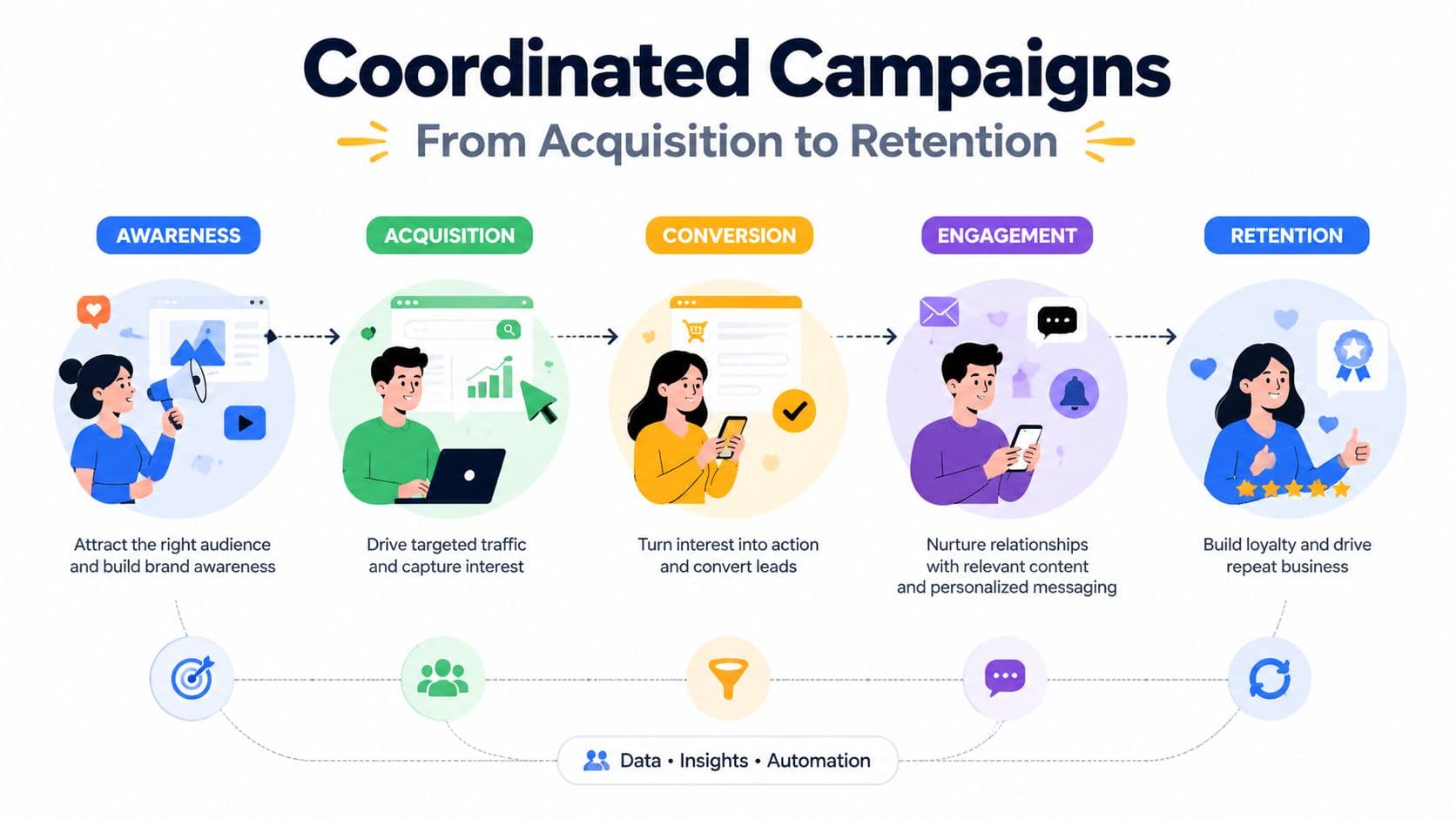
A practical campaign sequence usually looks like this:
- Awareness asset: Educate the market around one narrow problem, not the whole category.
- Consideration asset: Answer objections and qualify interest through deeper content or capture offers.
- Conversion asset: Reduce friction with a clear next step and direct follow-up.
- Retention asset: Use post-purchase or post-sale behavior to decide whether follow-up should focus on adoption, expansion, or repeat purchase.
If the sequence works, the team learns which stage needs the next round of investment. If it doesn't, the failure point is usually obvious enough to fix without rebuilding the whole program.
Optimization Cadence and Decision Rules
Full funnel marketing gets messy when optimization happens reactively. Teams tweak ads midweek, rewrite landing pages without enough traffic, and scale awareness before conversion is stable. A better cadence starts with the constraint and then decides how fast to move.
Fix the bottleneck first
The first decision rule is simple. If conversion is broken, don't scale awareness yet. More traffic only magnifies a weak offer, unclear handoff, or slow follow-up. If retention is weak, don't overinvest in acquisition until the economics of keeping customers make sense.
The second rule is about validation. Upper-funnel work should be judged by whether it increases qualified demand, not just by whether traffic rises. If the extra traffic doesn't move qualified engagement, downstream conversion, or brand search behavior in a meaningful way, the team may be buying volume instead of demand.
Use a repeatable cadence
A practical operating rhythm usually runs like this:
- Diagnose monthly. Review where the funnel leaks, with stage-specific KPIs rather than a single blended number.
- Test quarterly. Use one major change at a time when possible, so the team can read the result without noise.
- Reallocate after proof. Shift budget only after the team can show that the test changed downstream behavior, not just top-line activity.
- Document the rule. Record what triggered the change, what evidence supported it, and what outcome mattered.
That cadence prevents the team from confusing motion with progress. It also helps founders and CMOs know when they're ready to expand into new stages. If the business can't define the constraint, can't measure the handoff, or can't explain the downstream effect of an upper-funnel action, the system needs more discipline before it needs more spend.
Practical rule: sequence the work by constraint. Build the operating proof first, then scale the stages that actually compound.
Crescade helps teams do exactly that through conversion rate optimization, lifecycle marketing, analytics, and AI-assisted growth operations. If the current funnel is producing traffic without revenue clarity,Crescade can help identify the constraint, connect the data, and build a more accountable full-funnel system.
Request a 20-minute audit if the goal is to find the stage that's limiting growth and fix it with cleaner measurement, stronger conversion, and tighter lifecycle follow-up. Crescade works with e-commerce teams, B2B service companies, and property and investment platforms to connect acquisition, CRO, lifecycle, analytics, automation, and AI into one managed growth system. VisitCrescade to see how a full-funnel operating model can turn scattered campaigns into a repeatable revenue process.