- google ads management
- paid search
- ppc strategy
- conversion tracking
- google ads audit
Google Ads Management: A Practical Operating Playbook
By Crescade · · 15 min read
A practitioner's guide to Google Ads management covering account structure, bidding, creative testing, offline conversion import, and reporting.
Your dashboard can look fine while paid search starves the pipeline. CTR holds up, CPC drifts down, Quality Score sits in the green, and the report still doesn't answer the only question that matters, are those clicks creating qualified revenue or just tidy looking activity? That's whyGoogle Ads management has to start with measurement integrity, then move to bids, creative, and scale.
Most accounts don't fail because someone picked the wrong bid strategy. They fail because the signals feeding the strategy are incomplete, delayed, or disconnected from CRM reality. If the website says one thing, GA4 says another, and the sales team closes deals in a separate system, the platform will optimize toward the easiest visible action, not the best business outcome.
Google's own systems make that distinction clear.Quality Score is a keyword-level diagnostic on a1 to 10 scale, based on expected clickthrough rate, ad relevance, and landing page experience, and Google says it isnot an auction input. Ad eligibility and position are driven byAd Rank, which Google says is based on bid, ad quality, and the expected impact of assets and other formats, while change history gives teams a way to connect edits to impressions, clicks, conversions, CTR, and cost inside the account itself, which is exactly why modern management is continuous measurement, not one-time setup (Google Ads change history and Quality Score guidance,Ad Rank overview,Quality Score definition).
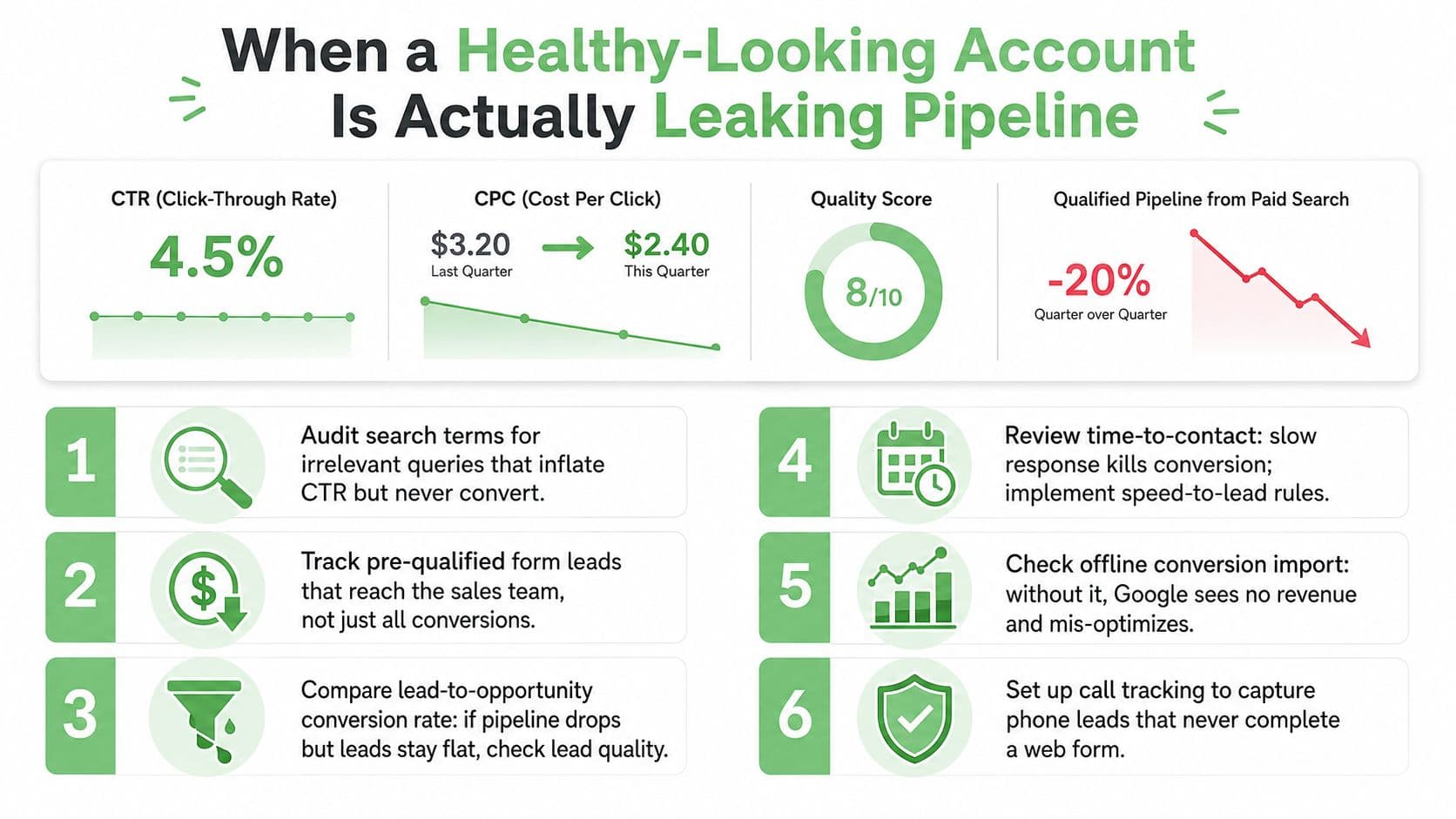
A useful audit starts with the search terms, then moves to lead quality and offline revenue. If you want a structured starting point, thepay per click audit guide is a solid companion to this way of thinking, because the work is less about tweaking bids and more about finding where the account's measurement story breaks.
Table of Contents
Structuring the Account Around Intent Instead of Keywords
Choosing a Bidding Strategy That Matches Your Signal Quality
Running Creative Tests That Survive Statistical Reality
Linking GA4 and Importing Offline Conversions Correctly
Building Reports That Drive Decisions Rather Than Filler Slides
The Operating Cadence That Compounds Into Better Decisions
When a Healthy-Looking Account Is Actually Leaking Pipeline
The cleanest-looking dashboard I've seen can still hide a broken growth system. The account shows steady CTR, lower CPC, and a respectable Quality Score, but the sales team keeps saying the leads aren't landing, the pipeline is flat, and the “good” traffic isn't converting into revenue. That gap is usually where the work starts.
The leaks that green dashboards miss
The first leak isconversion tracking that stops at the form fill. A lead submit is not the same thing as a qualified opportunity, and it definitely isn't closed revenue. If the account optimizes to raw website conversions, it'll keep rewarding whatever produces the easiest submissions, even when those leads never make it to sales.
The second leak islead volume without lead quality. A campaign can look efficient on paper because it's producing a lot of cheap actions, but if the CRM shows weak qualification or slow handoff, the business still loses. The platform doesn't know which submissions were junk unless you teach it through better conversion architecture.
The third leak isbrand and non-brand blending. When those buckets live together, branded demand can mask weak prospecting, and prospecting can look better than it really is because it borrows brand trust. That's how teams keep funding the wrong side of the account.
Practical rule: If revenue is missing, don't start by changing bids. Start by tracing whether the conversion event is the same one sales actually cares about.
A matureGoogle Ads management process treats the account as a measurement system before it treats it as a media buy. That means validating what counts, what gets imported, and what the bidding algorithm is learning from. Crescade's Google Ads management and paid search services fit into that kind of operating model when the question isn't “can we run ads,” but “can we make the data trustworthy enough to scale them.”
The rest of the playbook is the fix for that exact failure mode.
Structuring the Account Around Intent Instead of Keywords
A Google Ads account that looks tidy can still leak pipeline if it is built around keywords instead of intent. When the structure is loose, bidding learns from mixed signals, reporting gets murky, and every cleanup turns into guesswork. When the structure reflects intent, the account is easier to read, easier to hand off, and harder to break when someone new steps in.
Why intent beats keyword sorting
A legacy build usually starts as a keyword warehouse. Forty ad groups get packed into one campaign, sorted by match type or by whatever the last operator thought was organized, and the result looks neat while behaving inconsistently. Ads and negatives start competing with each other, and the search term report becomes a cleanup queue instead of a decision tool.
An intent-segmented build works differently. Campaigns are split by funnel stage and user intent, such as problem-aware, solution-aware, brand, and competitor. Inside those campaigns, ad groups stay tightly themed, negatives are kept at the ad-group level, and naming conventions still make sense when the original builder is gone.
That structure helps both people and machines. Humans can see where budget goes, and automated bidding gets cleaner input because each campaign has a clearer job. If you want a practical reference forcutting ad waste with negative keywords, it shows why negatives are not just hygiene. They are one of the main controls that stop intent from getting blurred.
| Dimension | Legacy Keyword-Sorted Build | Intent-Segmented Build |
|---|---|---|
| Campaign logic | Sorted by match type or old naming habits | Sorted by funnel stage and user intent |
| Ad groups | Mixed themes, too many keywords per group | Single-theme ad groups with tight themes |
| Negatives | Added late, often inconsistently | Maintained at the ad-group and campaign level |
| Reporting | Hard to read by intent or business objective | Easier to analyze by audience need and stage |
| Handoff | Breaks when one person leaves | Survives team changes more cleanly |
The rule is simple. Structure should make the next decision obvious.
Choosing a Bidding Strategy That Matches Your Signal Quality
Bidding strategy is downstream of signal quality. If the data is shaky, automation will magnify the mess. If the data is trustworthy, bids become a lever instead of a gamble.
Match the strategy to the maturity of the account
Manual CPC still has a place when pixels, conversion definitions, or offline imports are being validated. It gives you control while you sort out whether the account is counting the right thing. It's slower, but that's often a good trade when the signal is not yet reliable.
Maximize Conversions is usually the right ramp-up strategy once the account can produce consistent conversion data, but before value-based optimization is trustworthy.tCPA makes sense once volume is stable enough that the system can work toward a cost ceiling without chasing noise.tROAS only makes sense when revenue values are tied back to closed deals, not just lead fills, because value bidding is only as smart as the values you feed it.
| Strategy | Minimum Conversions/Month | Best-Fit Account Stage | Key Risk |
|---|---|---|---|
| Manual CPC | Low volume or unverified tracking | Measurement validation and early rebuilds | Slower scaling, more operator effort |
| Maximize Conversions | Stable conversion signal | Learning ramp and volume growth | Can optimize toward low-quality conversions |
| tCPA | Consistent volume and clean conversion definitions | Maturing lead-gen accounts | Chasing cost efficiency at the expense of lead quality |
| tROAS | Reliable revenue values from closed deals | Value-based scaling | Misleading if values are tied to form fills instead of revenue |
Guardrails matter more than the strategy label. Conversion lag needs to be accounted for, especially when deals close after the click window that the platform sees first. Portfolio bid strategies can help with pacing across multiple campaigns, but I still override Google's recommendations when the imported signal doesn't reflect sales reality or when a campaign is carrying a special role that the system can't infer.
Crescade'sbreak-even ROAS calculator is a practical complement here when you need to decide whether a value-based strategy is even justified by the business model.
Practical rule: Don't move to a more advanced bid strategy until the conversion signal you're feeding it is the signal you'd be comfortable defending in a revenue meeting.
Running Creative Tests That Survive Statistical Reality
Creative testing gets sloppy fast. Teams swap headlines because they “feel better,” judge ads by one week of CTR, then call the winner without enough conversion volume to trust the result. That's not testing, it's decoration with a spreadsheet attached.
What a real test looks like
Start with one conversion event and enough baseline volume to spot a meaningful change in a short window. If you can't reasonably see a difference in 7 to 14 days, the test is probably too small to tell you anything useful. In that case, the micro-test doesn't protect you from bad decisions, it just gives them a polished interface.
For Responsive Search Ads, the setup should be disciplined. Write8 to 10 distinct headlines across four intent angles, add4 descriptions, and leave pinning off unless there's a hard reason to constrain combinations. The point is to let the auction assemble enough combinations for you to learn which messages hold up under pressure, not to force the ad into a static layout that hides weak copy.
| Signal Observed | Threshold | Action |
|---|---|---|
| Asset appears in top combinations often | Above expected share | Keep it |
| One component underperforms repeatedly | Clear weakness across review cycles | Iterate that single component |
| No combination beats control in two review windows | Consistent underperformance | Kill the ad |
| Enough volume to evaluate a test | At least 30 conversions per arm | Promote a winner only then |
Ad Strength should guide the conversation, not settle it. A high Ad Strength score doesn't mean the ad will win in the auction, and a middling score doesn't automatically mean the ad is weak. The decision rule is whether the asset appears in strong combinations, whether one element is dragging the whole unit down, and whether the control is still better after enough review cycles.
For teams that want a tighter testing rhythm, Crescade'sguide to A/B testing in marketing is a useful companion, because the same discipline applies whether you're testing search ads, landing pages, or lifecycle messages.
Keep one variable moving at a time. When you rotate headlines, don't also change the CTA, the landing page, and the offer.
Linking GA4 and Importing Offline Conversions Correctly
Most Google Ads accounts aren't really optimizing on revenue, they're optimizing on the closest thing they can see. That's usually a website action, and it's often the wrong one. If the conversion closes in a CRM, the account needs a bridge from click to closed deal, not just a form confirmation.
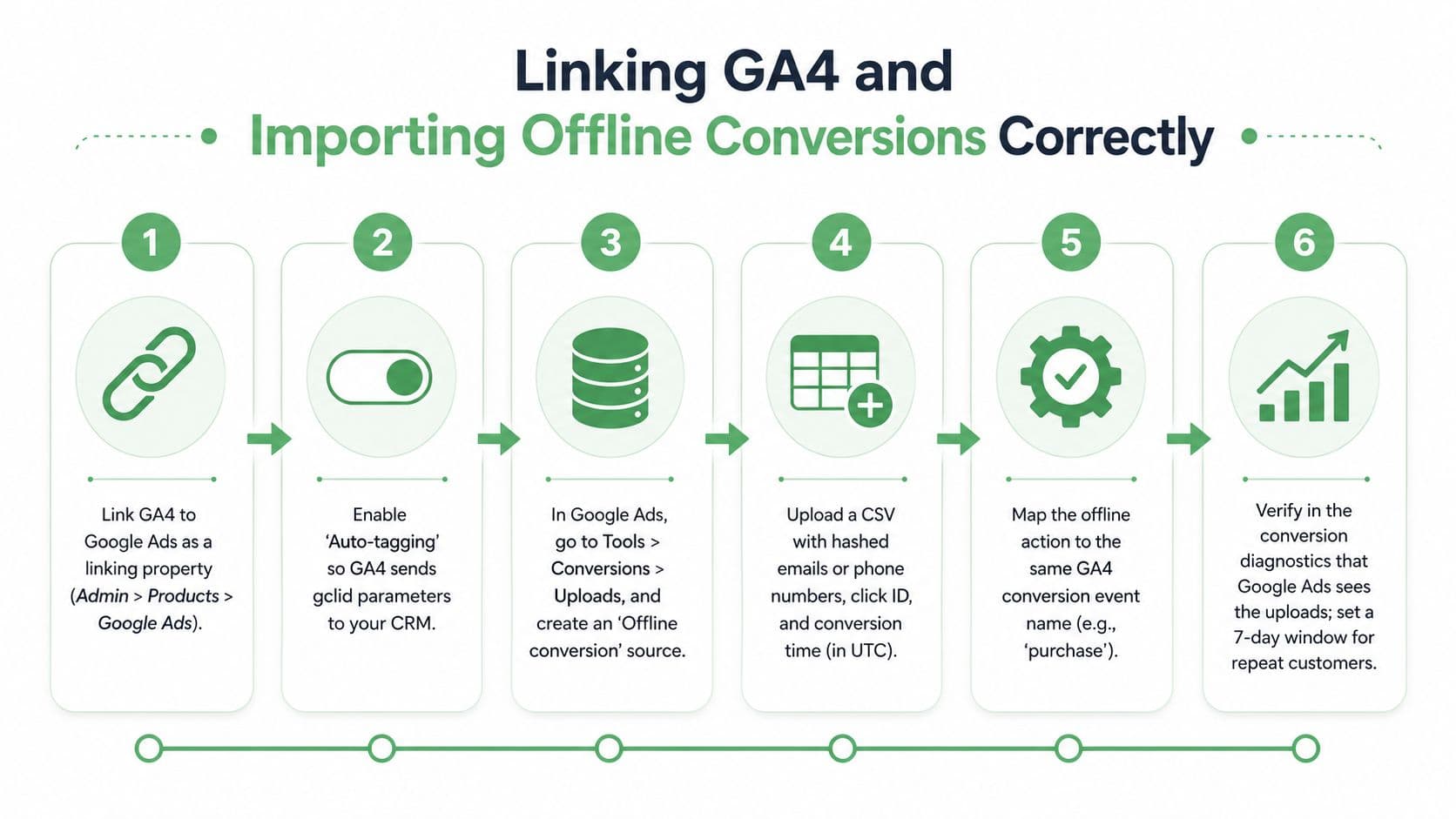
Build the measurement path before scaling spend
Start by linkingGA4 to Google Ads through the product linking flow in Google Analytics Admin and Google Ads, then import GA4 conversions into Google Ads only after you've confirmed the event names and deduplication logic are clean (GA4 and Google Ads linking). That protects you from counting the same lead twice and keeps the bidding signal closer to the actual event you want the system to value.
From there, build the offline import path. Google'sEnhanced conversions for web can supplement existing tags with securely sent hashed first-party data and improve modelability in a privacy-safe way, which helps increase observable data when the browser signal is incomplete (Enhanced conversions). For the actual import, use the Google Ads API or a scheduled CRM workflow, and map a stable click ID or hashed identifier plus a conversion name, timestamp, and value.
Practical rule: If your CRM and Google Ads disagree, trust neither until you've checked event definitions, deduplication, and the import window.
A7 to 30 day import window is the practical range for late-closing deals, especially when the sales cycle isn't immediate. Use the actual deal revenue as the conversion value when you want value-based bidding to reflect economics instead of lead vanity. Then validate weekly that imported counts line up with CRM stage movement closely enough that the bidding system is learning from something real.
For teams building the workflow from scratch, Otter A/B'sguide to building tests with GA4 is a helpful reference, and Crescade'sGoogle Analytics goals guidance is relevant when you're deciding which events deserve to become optimization signals.
The hard truth is that better bidding can't rescue broken attribution. Reliable imports come first, then automation gets a signal worth trusting.
Building Reports That Drive Decisions Rather Than Filler Slides
A report should answer one decision question, or it shouldn't exist. If the stakeholder can't tell whether the report means “increase budget,” “pause this campaign,” or “fix the landing page,” the report is just formatted noise.
Start from the decision, not the dashboard
For a paid media lead, the weekly operating report should be built around spend, qualified pipeline produced, CPA versus target, and search impression share lost to budget. Those metrics matter because they tell you whether the account is buying enough demand, at the right cost, and whether budget limits are suppressing growth. If there's one anomaly, call it out and say what changed.
Separateleading indicators fromlagging indicators. Leading indicators include CTR, Quality Score movement, asset approval rates, and offline conversion lag. Lagging indicators include closed-won revenue, ROAS, and pipeline-to-spend ratio. Mixing them in one undifferentiated block makes it too easy to overreact to noise or ignore the signal that should have changed the plan.
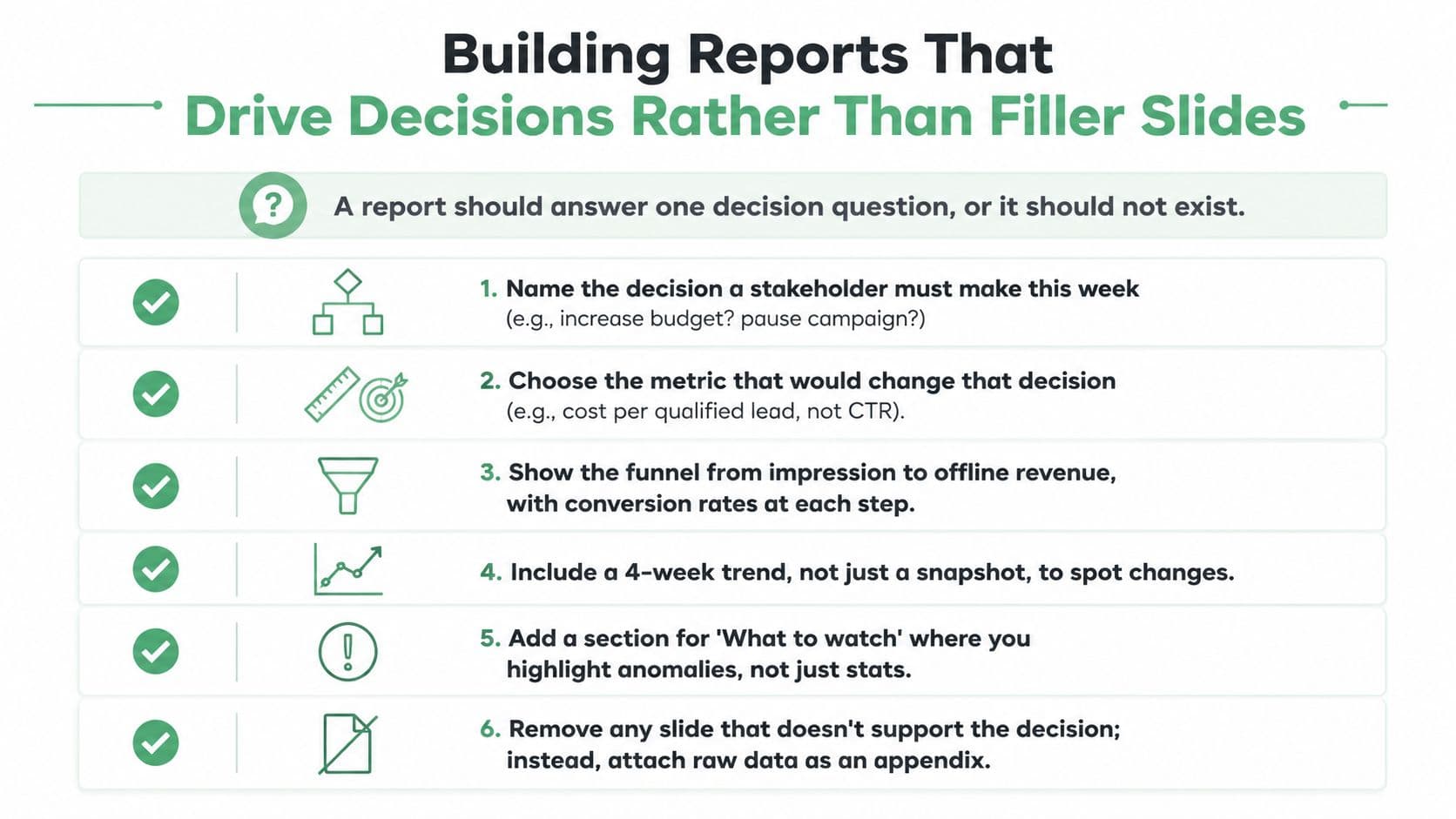
A usable weekly cadence often looks like a short Looker Studio or Google Ads snapshot with one line at the bottom that says what changes this week. That line matters because it forces ownership. The report stops being a status artifact and becomes an operating one.
If the report needs another page, it should usually be an appendix, not a summary. If it needs another metric, it should probably answer a different decision question. That's where teams create filler slides, and filler slides are how important problems get buried under presentation polish.
The Operating Cadence That Compounds Into Better Decisions
GoodGoogle Ads management compounds only when decisions are written down. If the team changes bids on Tuesday, edits creative on Wednesday, and forgets why by Friday, the account never becomes easier to run. It just becomes harder to explain.
A weekly rhythm that survives handoff
A practical cadence starts with aMonday data integrity check. That's where someone verifies GA4, Google Ads, and CRM handoffs before making any spend decisions. Tuesday becomes thebid and budget review, where the operator adjusts pacing only after the signal checks out.
Wednesday is forcreative iteration, not random copy swaps. Thursday is forexperiment launch, which keeps tests moving without mixing them into budget conversations. Friday is the stakeholder recap, where the team documents what changed, what was learned, and what gets revisited next week.
The artifacts matter as much as the meetings.
- One-page dashboard: Tracks spend, qualified pipeline, and the main anomaly.
- Change log: Records what was changed, by whom, and why.
- Test backlog: Lists the next hypotheses so work doesn't depend on memory.
- Decision note: Captures the one action the team is taking next.
When these artifacts exist, the cadence still works when the operator is on vacation. When they don't, every week starts from zero, and the same debates keep coming back.
Pick the weakest signal in your stack this week, whether that's conversion tracking, offline imports, or reporting quality, and block30 minutes to fix it before any new campaign work begins. That single correction usually does more for account performance than another round of bid tweaks.
Crescade helps teams connect paid acquisition, analytics, conversion, lifecycle, and automation into one accountable operating system. If your Google Ads work is being judged on clicks while revenue closes elsewhere, visitCrescade to talk through the measurement gaps, bid logic, and reporting structure that need to be fixed before scaling spend.