Marketing Automation for B2B That Converts Leads
Your CRM shows hundreds of new leads, paid campaigns are generating form fills, and marketing reports healthy engagement. Sales sees something else: slow handoffs, incomplete context, and leads that don't match the buying profile.Marketing automation for B2B solves that gap when it operates as a revenue system for acquisition, qualification, lifecycle management, and measurement, not as a collection of email sequences.
The decision isn't whether to automate. Most B2B teams are already moving in that direction. The decision iswhat to automate, when to route work to people, and how to prove that automated journeys influence pipeline. The practical path starts with clean definitions and CRM data, then connects routing, scoring, nurture, acquisition, and revenue analytics around one operating model.
Table of Contents
Prerequisites Before You Build Any Flow
Designing Lead Routing Nurture and Scoring That Sales Trusts
Connecting Automation to Your CRM and Acquisition Stack
Testing Measuring and Improving Performance Over Time
Putting Your B2B Automation Plan Into Action
What Marketing Automation for B2B Actually Solves
B2B automation becomes valuable when it coordinates work that otherwise falls between teams. A prospect submits a high-intent form, but the record lacks company context. A content lead receives the same follow-up as a demo request. A sales representative gets an alert without knowing why the lead qualified. An opportunity goes quiet, yet the prospect remains in a generic top-of-funnel sequence.
Those aren't email problems. They'reprocess, ownership, and data problems.
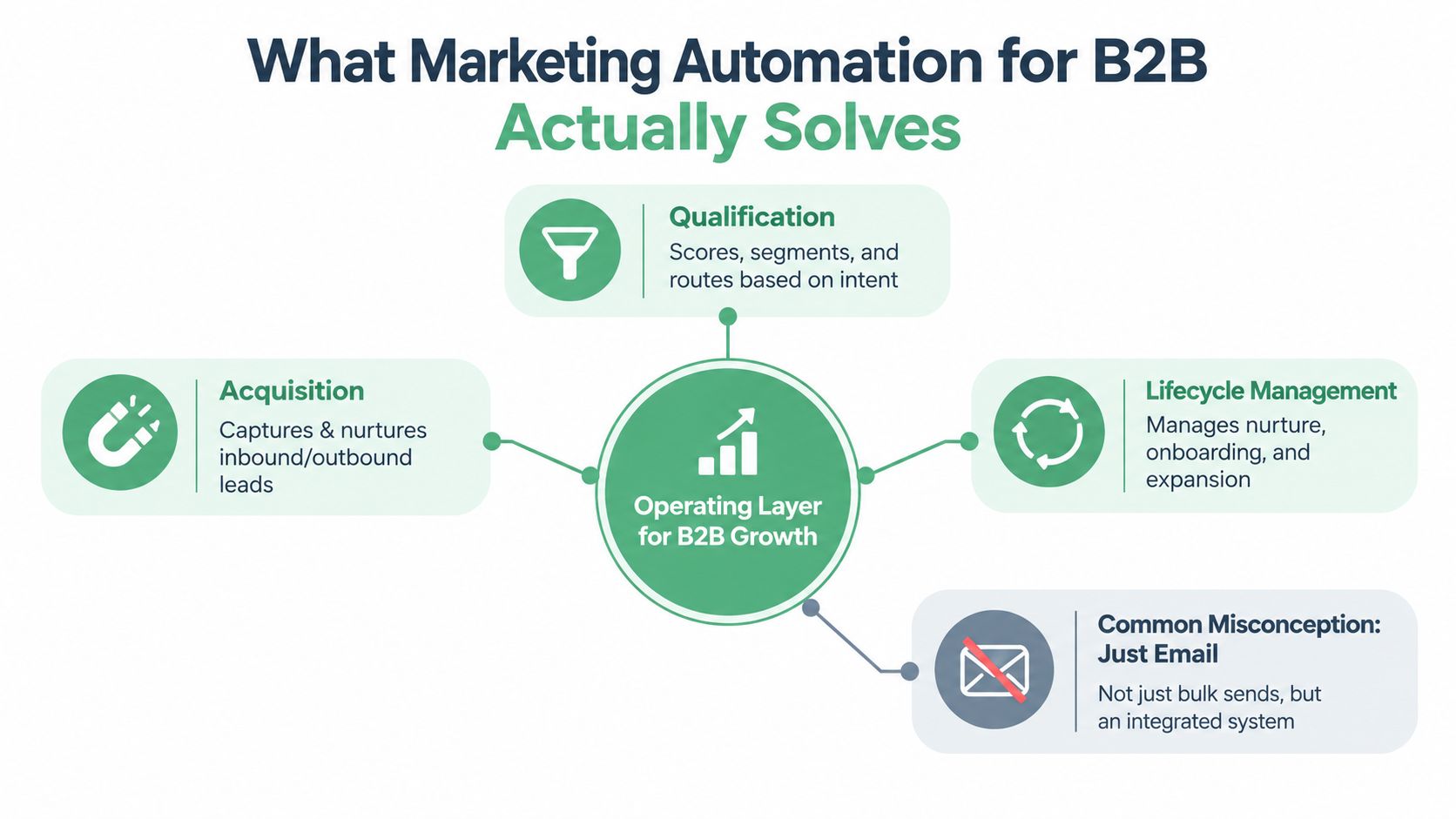
Marketing automation for B2B should provide an operating layer across three connected jobs:
- Acquisition: Capture source, campaign, content, and first-party behavior when a contact enters the funnel.
- Qualification: Combine fit and intent, apply agreed rules, and route the right records to the right owner.
- Lifecycle management: Adapt communication as a prospect moves from education to evaluation, opportunity management, onboarding, retention, or expansion.
Econsultancy'sState of B2B Marketing Automation report found that53% of surveyed B2B organizations were already using marketing automation, while37% planned to implement it. Together,90% were either active or on the adoption path, a strong indication that automation had become foundational infrastructure rather than a side experiment. The same report found that organizations identified as Leaders were24% more likely than peers to say they were currently using marketing automation.
That maturity gap matters. A platform doesn't create operational discipline by itself. If your team hasn't agreed on lifecycle stages, ownership, qualification, and rejection handling, automation moves bad records faster.
Automate the repeatable, preserve the judgment
Automation is well suited to deterministic work. It can assign an owner by territory, start a nurture path after a content conversion, update a lifecycle field, suppress an opportunity from prospecting messages, or notify sales when a defined threshold is reached.
It shouldn't make unsupported decisions about a complex buying committee or replace a meaningful sales conversation. Human judgment remains important when context is incomplete, multiple stakeholders are involved, or the account's timing doesn't fit a rigid rule.
Practical rule: Automate the handoff mechanics, not the relationship.
Expect a setup period before judging results. One independent benchmark summary reports amedian time-to-value of 4.7 months for a new marketing automation platform. That doesn't mean every implementation follows the same schedule, but it does make one point clear: deployment isn't instant ROI. Instrument the funnel first, then assess cohort progression from response to MQL to opportunity.
If your team has leaky handoffs, inconsistent lead definitions, and disconnected CRM stages, start with the operating model. If those foundations are sound and repetitive work is consuming time, automation can scale the process without turning every interaction into a generic blast. Teams looking for practical safeguards can also reviewhow to avoid spam with Eludic automation, especially before expanding triggered communication.
Prerequisites Before You Build Any Flow
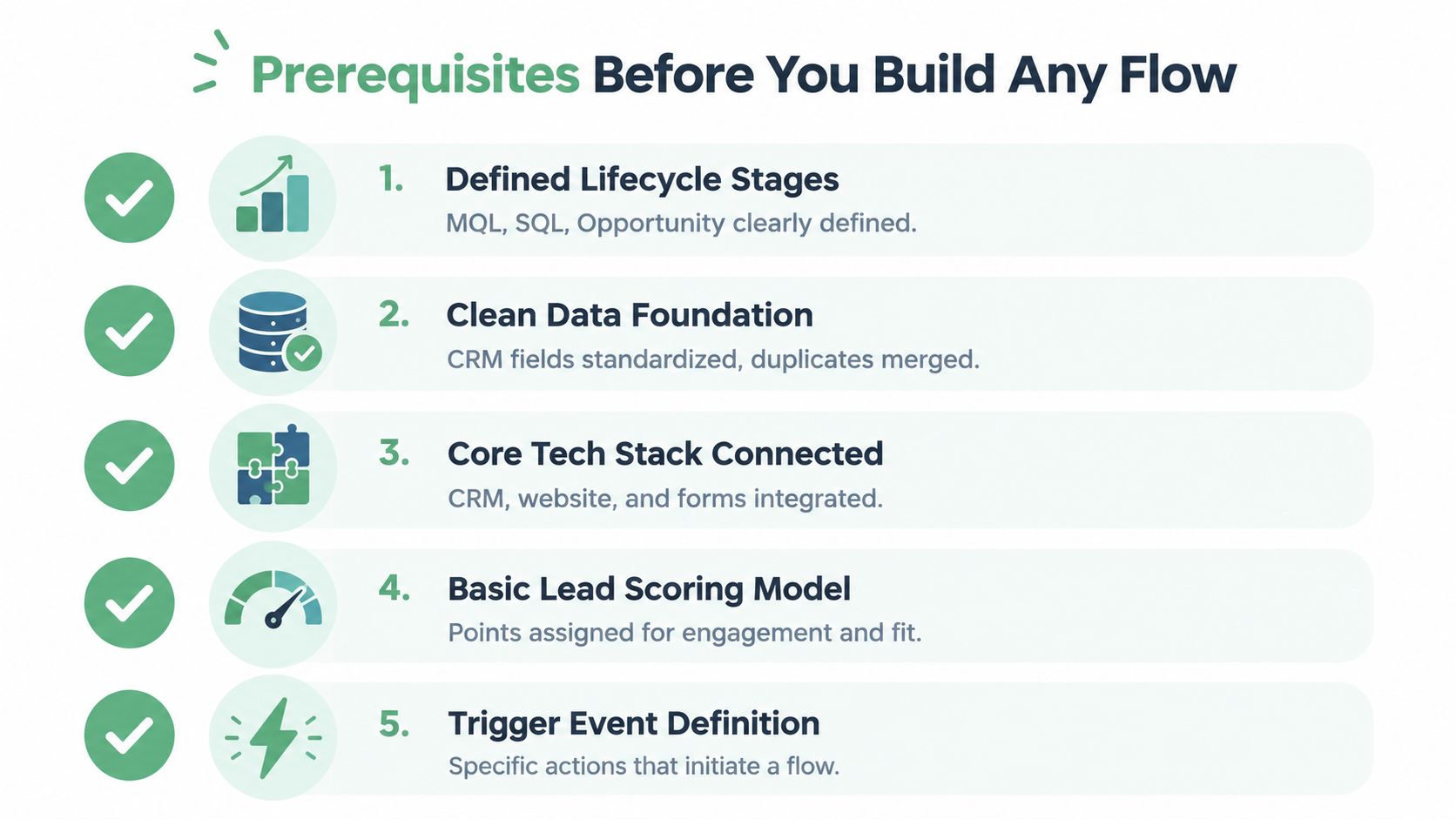
The fastest way to damage trust in automation is to build on ambiguous data. Before mapping a journey, confirm that marketing, sales, and revenue operations use the same language for lifecycle stages, ownership, and qualification.
Start with a working session that produces written definitions. A subscriber is not an MQL. An MQL isn't automatically an SQL. An opportunity shouldn't keep receiving acquisition messages just because one system failed to update the record.
Establish the record of truth
Audit the fields that determine what happens next, not every field your CRM happens to contain.
- Lifecycle stage: Define the entry and exit conditions for subscriber, lead, MQL, SQL, opportunity, customer, and any stages your sales process requires.
- Ownership: Specify who receives a record, what happens when an owner is unavailable, and which team handles accounts that don't fit a standard territory.
- Source context: Preserve original source, latest source, campaign, landing page, and relevant content interaction so the team can distinguish paid acquisition from organic or referral activity.
- Fit data: Standardize fields such as company, role, industry, geography, and segment. Decide which values are required and which can be enriched later.
- Consent and communication status: Store the permissions and suppression logic your systems need before a person enters a marketing flow.
Duplicate records create conflicting histories. Unmapped fields create silent routing failures. A form can collect useful information, but only if the destination system stores it consistently and the automation platform can act on it.
Define the sales-accepted handoff
Ask sales to describe a lead they would want to receive today. Translate that description into observable conditions. “Engaged” is too vague. A useful definition combinesfit, intent, and recency with a clear action for the assigned representative.
Then document the rejection loop. Sales should choose a reason such as poor fit, no active project, duplicate, wrong contact, or timing. Each reason should produce an appropriate next step, whether that means suppression, reassignment, or a targeted nurture path.
Google recommends connecting first-party data through the Google tag, and says enhanced conversions can improve the accuracy of online and offline conversion measurement. Itsguidance on enhanced conversions and first-party measurement supports a practical B2B principle: don't stop measurement at the form fill. Connect website behavior to CRM milestones so acquisition systems can learn from qualified progress.
Use this go/no-go check before building:
- Definitions approved: Marketing and sales have signed off on lifecycle and acceptance criteria.
- Fields mapped: Forms, CRM objects, automation fields, and analytics events have clear ownership.
- Routing tested: Sample records reach the intended owner and stage.
- Suppression logic present: Customers, open opportunities, unsubscribed contacts, and rejected records are treated correctly.
- Measurement connected: Source data can be associated with downstream CRM movement.
If the answer is no, fix the foundation first. Crescade's operating approach starts with Signal before Build for exactly this reason. The team needs to identify the constraint and establish reliable evidence before adding workflow complexity.
Designing Lead Routing Nurture and Scoring That Sales Trusts
Routing, nurture, and scoring shouldn't be three separate projects. They form one system. Routing decides who owns the next action, nurture keeps the relationship relevant when the person isn't ready, and scoring identifies when the balance should shift from automated education to human follow-up.
Route by fit and intent
A demo request from a target account shouldn't follow the same path as a first-time content download. The first may deserve immediate sales ownership, enriched account context, and a short confirmation sequence. The second may need education, progressive profiling, and observation before a handoff.
Use explicit rules:
- Fit: Does the account match the target segment, market, geography, role, and commercial model?
- Intent: Did the person request a conversation, evaluate pricing, return to a product page, attend an event, or engage with educational content?
- Recency: Is the signal current enough to justify action?
- Ownership: Which representative or team can respond with relevant context?
- Fallback: Where does the record go when required data is missing?
Routing should create a useful sales task, not just an alert. Include the trigger, source, recent behavior, account information, and recommended next action. Sales shouldn't have to investigate the automation before deciding whether to act.
Build nurture around buying context
A nurture path should have a reason for existing. Segment by problem, role, buying stage, account fit, or stalled opportunity rather than sending one sequence to everyone.
For a content lead, the first message can deliver the promised resource and establish a relevant next step. Later messages can answer adjacent questions, introduce a decision framework, and offer a conversation only when behavior supports it. For a stalled opportunity, the content should support the open business problem and respect the existing sales relationship, rather than restarting a generic prospect journey.
Published benchmark data reports that nurtured leads can generate20% more sales opportunities, while other cited studies report50% more sales-ready leads at 33% lower cost and up to451% more qualified leads in mature nurture programs. These figures appear in thesales funnel benchmark summary from SHNO, but they shouldn't be treated as automatic outcomes. Sequence design, qualification logic, audience quality, and sales alignment determine whether nurture helps or merely increases message volume.
Score for action, not applause
A scoring model should answer one operational question:what evidence justifies the next action?
Give more weight to signals that indicate evaluation or a direct request. Treat passive engagement as supporting evidence, not proof of readiness. Add fit criteria so high activity from a poor-fit account doesn't outrank a credible buyer with limited digital behavior. Review inactivity and decay rules so old engagement doesn't remain permanently influential.
A practical model might separate:
- Fit score: Account and contact characteristics.
- Intent score: High-value actions and declared interest.
- Engagement score: Content, event, and website activity.
- Recency adjustment: Current activity versus historic activity.
- Exclusions: Students, competitors, existing customers, or records outside the serviceable market.
For a deeper treatment of scoring mechanics, theRoverLead AI lead scoring guide is a useful resource to consult alongside your own CRM history. Validate the model against accepted and rejected leads, then give sales a simple explanation of why a record qualified.
The handoff definition should live where both teams can use it. Crescade'slead qualification marketing framework offers another reference point for connecting qualification logic to the broader funnel.
| Lead Scenario | Routing Rule | Nurture Path | Scoring Action |
|---|---|---|---|
| Inbound demo request from a target account | Assign to the account owner or appropriate segment representative | Short confirmation and sales-support sequence | Treat the request as a high-intent trigger and notify the owner |
| First content conversion with incomplete fit data | Hold in marketing ownership while enriching and validating the record | Educational sequence matched to topic and role | Add engagement evidence, but don't qualify on the download alone |
| Strong-fit contact returning to evaluation pages | Route when the defined intent and recency conditions are met | Decision-stage proof and objection content | Increase intent weight and create a sales task |
| Sales-rejected lead with future potential | Return to the named marketing owner with a rejection reason | Timing, education, or role-specific nurture | Pause the handoff threshold until new evidence appears |
| Open opportunity | Keep ownership with sales and suppress acquisition flows | Opportunity-support or customer-specific communication | Stop prospect scoring from triggering duplicate outreach |
Governance keeps this system credible. Assign one owner for scoring changes, record why thresholds changed, review rejected leads on a regular cadence, and make sales feedback part of the model rather than an informal complaint channel.
Connecting Automation to Your CRM and Acquisition Stack
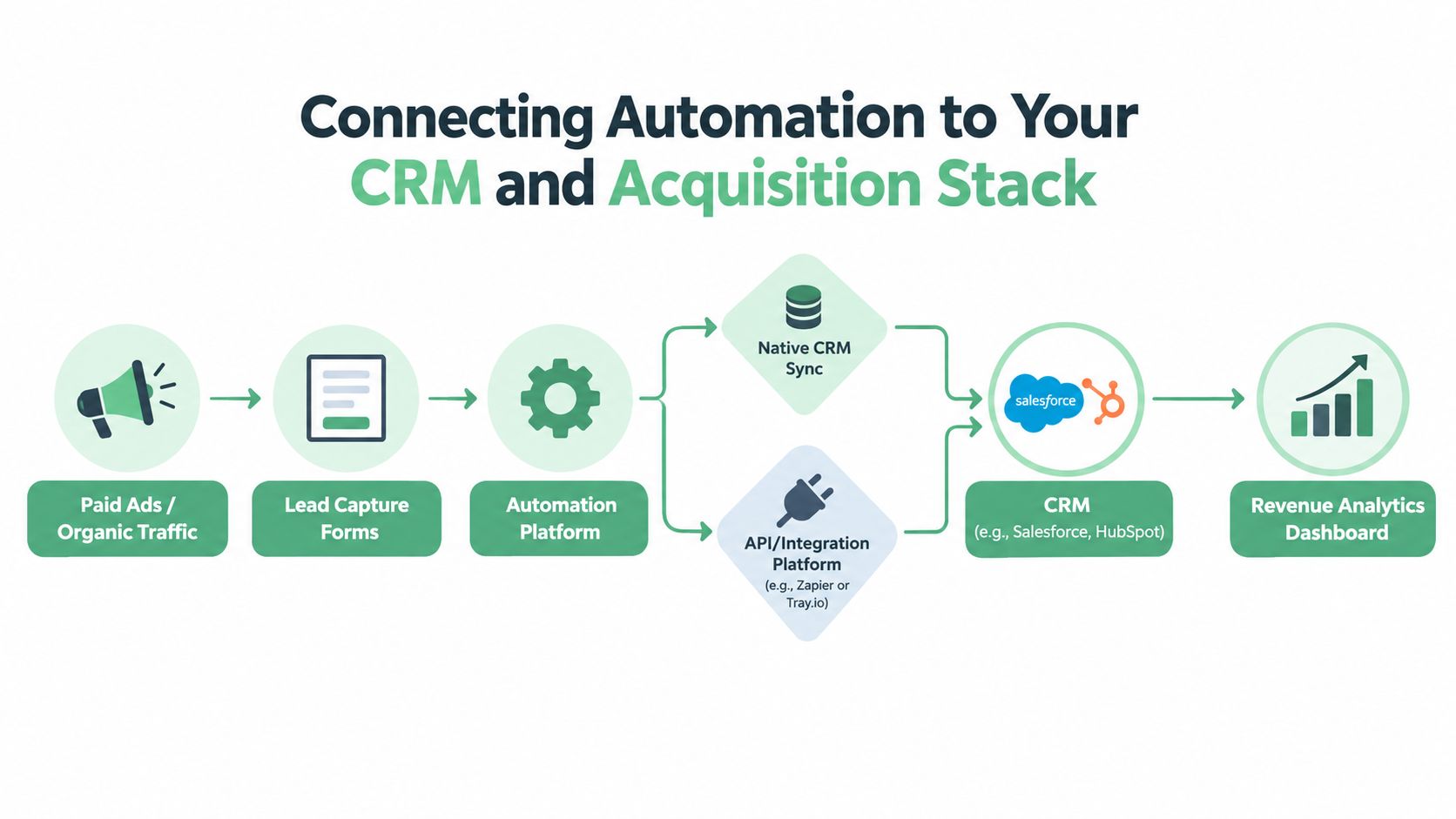
The integration choice affects how much context reaches sales and how accurately acquisition systems can optimize. Native CRM synchronization is usually simpler to maintain. Middleware or direct APIs can provide more flexibility when your stack has unusual objects, enrichment steps, or multiple destinations.
Choose the integration pattern deliberately
| Pattern | Strength | Tradeoff | Suitable use |
|---|---|---|---|
| Native CRM sync | Faster setup and fewer moving parts | Less control over unusual workflows and transformations | Teams with a conventional CRM and straightforward lifecycle |
| Middleware platform | Flexible mapping and orchestration | More monitoring, failure points, and ownership | Teams connecting forms, enrichment, ads, CRM, and internal systems |
| Direct API integration | Maximum control over data behavior | Higher technical burden and ongoing maintenance | Complex stacks with strong technical support |
The important mapping isn't just contact creation. Connectlead source, campaign, lifecycle stage, owner, qualification status, opportunity creation, and revenue outcome. If a CRM stage changes but the automation platform never receives that update, nurture continues under the wrong assumption. If an opportunity closes but acquisition platforms only see a form fill, bidding optimizes for inquiry volume rather than commercial quality.
An effective integration also handles errors visibly. Monitor failed syncs, duplicate creation, field conflicts, missing owners, and records that sit in an impossible stage. A workflow that runs successfully in the automation platform can still fail operationally if its CRM update is rejected or overwritten.
TheCRM and marketing integration guide from Crescade provides a practical reference for mapping the systems around this handoff.
Connect acquisition to downstream outcomes
Google Ads recommends collecting and connecting first-party data with the Google tag. Its enhanced conversion guidance emphasizes more accurate online and offline conversion measurement, which is particularly relevant when a B2B campaign produces leads that mature inside the CRM rather than on the website.
The tradeoff is implementation effort. Passing qualified milestones back into acquisition platforms requires dependable identifiers, consistent event definitions, and CRM-to-ad platform plumbing. The benefit is better optimization data and less risk of bidding toward leads that look productive at the form stage but fail the sales-accepted criteria.
Keep the first version focused. Start with the milestones your revenue team already trusts, such as qualified lead, accepted lead, opportunity creation, or another agreed stage. Don't build an elaborate attribution warehouse before the basic path from ad interaction to CRM outcome works.
Here's a short visual explanation of the integration architecture:
Treat analytics as part of the workflow, not a reporting layer added later. GA4 can help describe on-site behavior, but the CRM must remain connected to the commercial stages that determine whether acquisition and lifecycle efforts are producing useful pipeline.
Testing Measuring and Improving Performance Over Time
Launch day only proves that the workflow can execute. It doesn't prove that the audience is right, the threshold is useful, or the handoff improves pipeline progression.
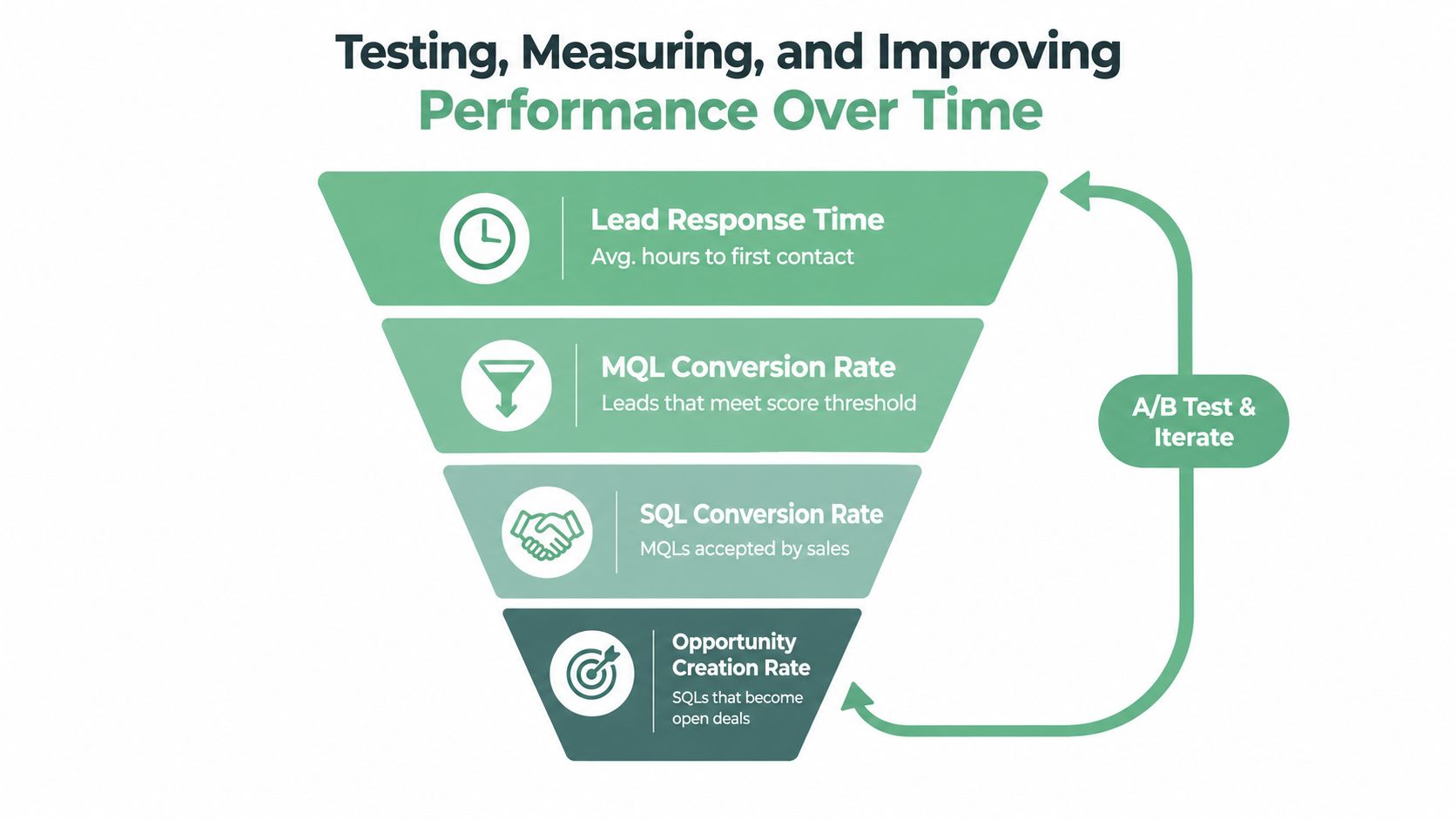
Measure cohorts through a defined path from response to MQL to sales acceptance to opportunity creation. Track volume and conversion together. A high MQL count with weak sales acceptance may indicate loose criteria, poor routing, or low-intent acquisition. A lower MQL count with stronger opportunity progression may justify a different investment decision.
Instrument the funnel before interpreting it
The benchmark summary cited earlier reports anaverage B2B MQL-to-opportunity conversion rate of 13% and amedian cost per MQL of $198. Those benchmarks come from an independent summary atSHNO's marketing automation statistics page. They're reference points, not targets that override your segment, sales process, deal model, or data quality.
Use them to set expectations around measurement discipline. Define the cohort start date, source, segment, lifecycle entry, sales acceptance, opportunity creation, and reporting window before launch. Otherwise, teams tend to default to opens and clicks because those are available immediately.
Review:
- Lead response: How quickly does an assigned lead receive a human action?
- MQL quality: Which sources and segments produce accepted leads?
- Sales progression: Where do accepted leads stall or get rejected?
- Opportunity creation: Which automated paths correlate with real commercial movement?
- Pipeline influence: Which touches appear in the journeys of progressing accounts?
- Operational health: Are syncs, assignments, suppression rules, and alerts working?
Go beyond click attribution
Complex B2B journeys rarely follow a clean last-click path. Recent industry analysis says a B2B software transaction can involveup to 266 touchpoints, while click tracking capturesless than 0.5% of that activity, according toDemand Gen Report's analysis of accountability and intelligent automation. That doesn't make clicks useless. It means clicks are a narrow observation of a much larger journey.
Use a mixed measurement model:
- Click attribution identifies measurable response and helps diagnose creative or landing-page behavior.
- Self-reported attribution captures influential experiences that tracking may miss, such as sales recommendations, peer conversations, or remembered content.
- View-through analysis helps assess exposure where no click occurred.
- Incrementality testing asks whether a journey or channel changes outcomes compared with a reasonable control.
- CRM stage movement anchors the analysis to commercial progression.
Avoid assigning false precision to every touch. A useful operating model combines directional influence with controlled tests, rather than pretending a fractional credit model can observe every decision.
Create a review cadence
Review operational failures weekly. Look at unassigned leads, stalled handoffs, rejected records, suppression errors, broken syncs, and unusual changes in source quality. These issues need fast correction because they affect current conversations.
Review model performance monthly. Compare cohorts by source, segment, journey, and sales outcome. Test one meaningful variable at a time, such as message cadence, channel mix, scoring threshold, qualification language, or routing ownership.
AI adds another layer of risk. A 2026 B2B content marketing analysis reports that95% of B2B marketers use AI in at least one workflow, while only39% say it improves performance, as reported byMarketScale's analysis of AI adoption and performance. Separate 2025 reporting found that51% of marketers identified building an overall marketing automation strategy as the biggest challenge, while44% prioritized data quality and43% used AI audience identification as the leading AI feature, in the same source's cited reporting.
The lesson is operational. Use AI to accelerate research, classification, QA, and production, but keep humans responsible for strategy, approval, data governance, budgets, and consequential routing decisions.
For a broader measurement framework, use Crescade'sguide to measuring marketing performance as a reference when shaping your dashboard and review cadence.
Putting Your B2B Automation Plan Into Action
Start with the constraint, not the platform.
If lead quality is the problem, audit fit fields, source quality, scoring, and sales rejection reasons. If speed to lead is the issue, fix ownership, alerts, fallback routing, and response accountability. If lifecycle performance is weak, map the stages after conversion and build communication that reflects the prospect's actual buying context.
A practical rollout can follow this sequence:
- First phase: Confirm lifecycle definitions, clean priority fields, map ownership, document accepted-lead criteria, and connect source data to CRM records.
- Second phase: Launch one high-value routing flow, one focused nurture path, and the measurement events needed to follow progression beyond form fills.
- Third phase: Compare cohorts, review sales feedback, refine scoring and suppression logic, then extend the system to additional segments, channels, or lifecycle stages.
Don't add AI to compensate for unclear strategy. Add it where the workflow is already understood and the output can be reviewed, such as lead research, data classification, message drafting, QA, or reporting. Automation should reduce repetitive work while people retain control over positioning, qualification policy, and investment decisions.
An accountable partner becomes useful when the work crosses acquisition, conversion, CRM, lifecycle, analytics, and AI workflows. Crescade can fit that operating model for teams that need strategy and execution connected rather than another isolated sequence build.
Crescade helps B2B teams connect acquisition, conversion, lifecycle marketing, CRM integration, analytics, and automation into a managed growth operating system.Visit Crescade to review the approach, then request a 20-minute audit to identify the routing, scoring, or measurement constraint you should fix before scaling spend.