Marketing Mix Modeling: A Practical Guide for Marketers
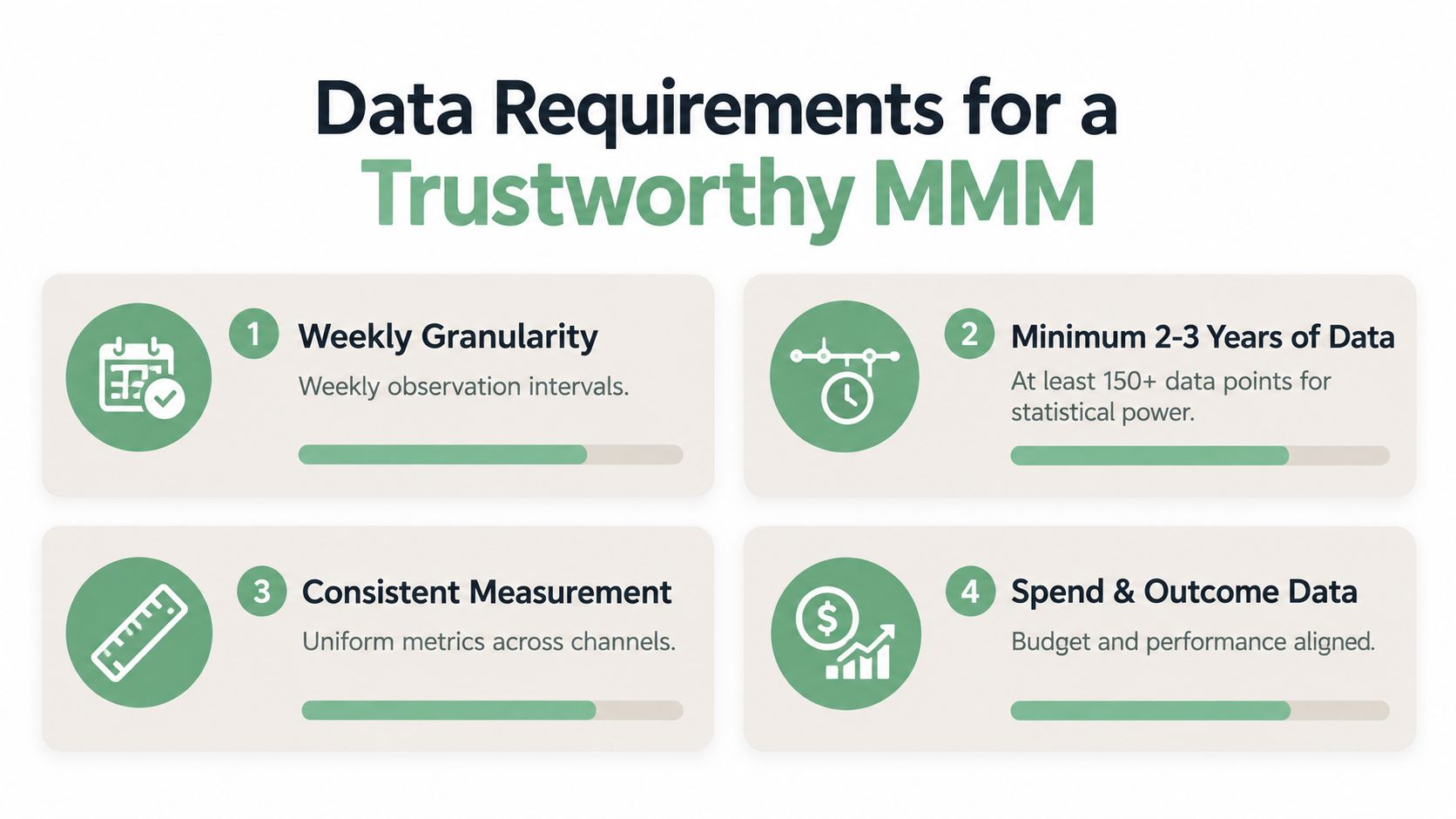
If you want marketing mix modeling to guide budget decisions, start with2 to 4 years of historical data at weekly resolution and make sure you have at least80 to 100 observations for a stable model, with3 or more years improving reliability for seasonal or multi-channel businesses (Improvado). That's because marketing mix modeling is a budget optimization system, not a click-tracking system. It helps you decide how to split spend across channels when attribution reports stop being credible.
You're probably in the same situation most growth teams hit eventually. Paid search wants more budget because branded conversions look efficient. Paid social says it's filling the top of funnel. SEO points to rising assisted conversions. CRM says lifecycle is lifting repeat purchase or lead-to-opportunity conversion. Then the CMO asks a simple question: where should the next dollar go?
Last-click can't answer that. Platform-reported ROAS definitely can't answer it. And a dashboard with ten conflicting views of “performance” just turns budget planning into politics.
The useful way to think about marketing mix modeling is this: it gives you a single planning framework for cross-channel decisions. Not perfect truth. Not user-level attribution. A defensible operating system for deciding where to push, where to hold, and where to stop.
Table of Contents
- What Marketing Mix Modeling Actually DoesIt answers allocation questions, not click-credit questions
- The four decisions MMM should drive
A Brief History of Marketing Mix Modeling
MMM vs Granular Attribution and When to Use Each
Data Requirements for a Trustworthy Model
How Adstock and Saturation Shape Budget Decisions
- Adstock changes how you read channel performance
- Saturation tells you where to stop
- Why these curves change real decisions
Combining MMM With Incrementality and Attribution
Why Most MMM Programs Fail at Activation
- What failure actually looks like
- The operational gaps that block activation
- Usefulness beats model elegance
Implementation Roadmap and Next Step
- Phase one builds the inputs
- Phase two creates the baseline model
- Phase three wires it into the operating cadence
- Phase four adds calibration and reconciliation
What Marketing Mix Modeling Actually Does
The weekly budget meeting is where most measurement systems fail.
One channel lead wants more spend because volume is there. Another wants patience because the effect is delayed. Analytics shows session paths and conversion tags, but nobody can explain the actual revenue contribution across channels in a way finance will accept. That's whenmarketing mix modeling becomes useful.
In one sentence, marketing mix modeling is aregression-based tool that uses historical marketing inputs and business outcomes to estimate how each channel contributes to revenue over time.
It answers allocation questions, not click-credit questions
That distinction matters. MMM doesn't try to tell you which ad got the conversion. It estimates the aggregate effect of channel activity on outcomes like revenue or new customers, then turns that into planning guidance.
That's why it belongs in the same conversation as budget planning, forecast reviews, and channel mix decisions. It doesn't belong in a creative QA thread or a landing page test readout.
If your team still treats measurement as a fight over “who gets credit,” you're solving the wrong problem. The problem is deciding how much to spend, where to spend it, and when extra budget stops helping.
Practical rule: Use marketing mix modeling when the question is “how should we split budget across channels?” Use attribution when the question is “what happened inside this channel or funnel step?”
A solid primer onhow to measure marketing performance helps frame where MMM sits relative to other methods. It's one layer in the stack, not the whole stack.
The four decisions MMM should drive
A usable MMM program should inform four decisions:
- Total budget level Whether the business should lean in, hold, or pull back overall.
- Channel mix How much should go to Google Ads, paid social, SEO, CRM, or offline channels.
- In-channel distribution Where budget should move inside a channel family once the top-level mix is set.
- Stopping points When additional spend is no longer worth it because returns are flattening.
If your model can't support those calls, it's reporting theatre. A good MMM output should change a budget sheet, not just decorate a deck.
A Brief History of Marketing Mix Modeling
Marketing mix modeling isn't new. What's changed is why people need it.
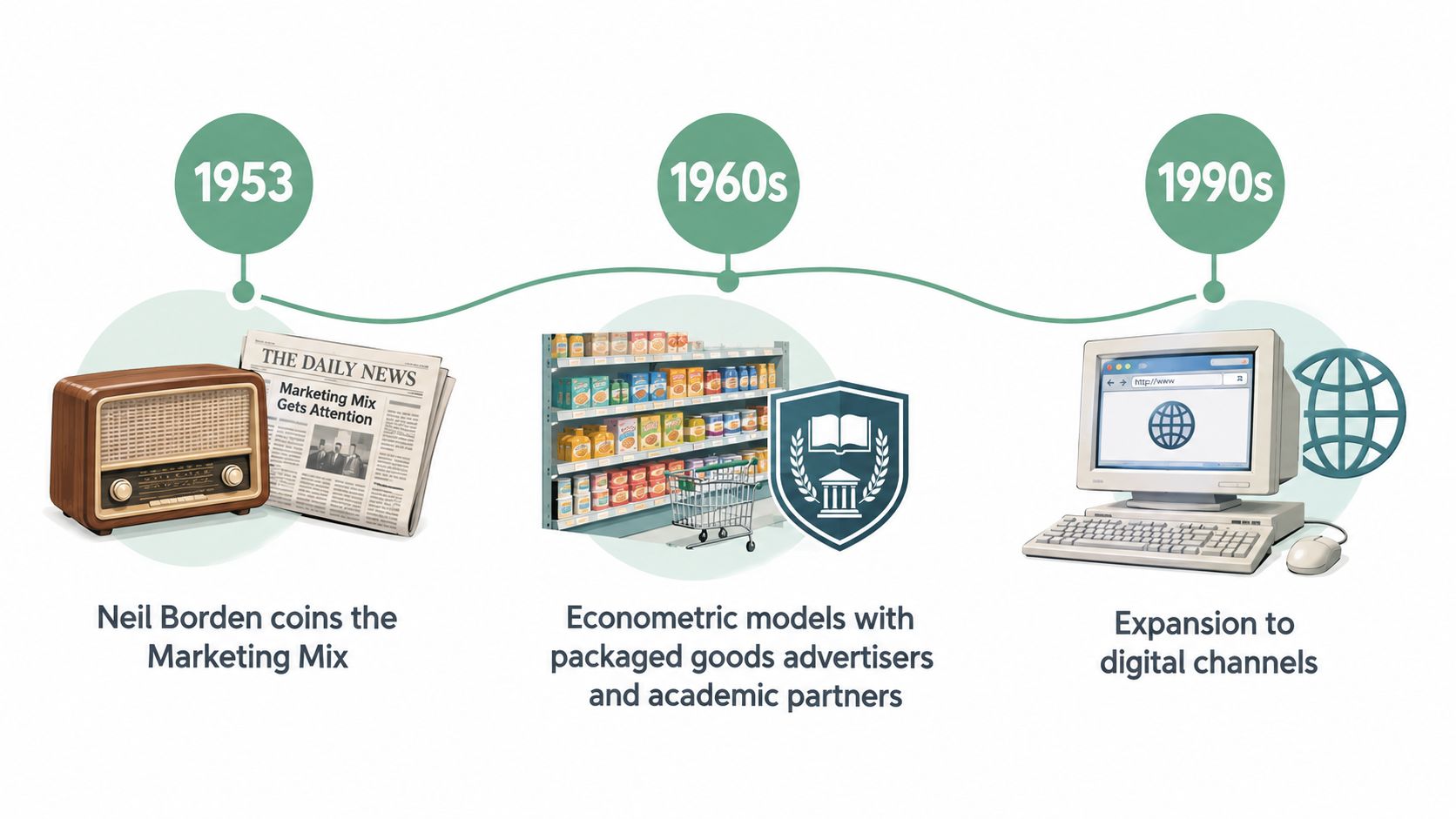
The roots go back to the broader marketing mix concept introduced in the1950s by Neil Borden, while the statistical version used for budget optimization took shape in the1970s, when University of Chicago statisticians developed early models linking marketing activity to sales. MMM gained large-scale commercial traction in the1980s in consumer packaged goods, then expanded as more syndicated data became available. Industry histories also note early commercial pioneers includingHudson River Group in 1989 andMarketing Management Analytics in 1990 (Wikipedia history of marketing mix modeling).
Why early MMM mattered
In the early days, MMM helped large advertisers answer broad planning questions. Which media channels moved sales. How pricing and promotions affected baseline demand. How seasonality distorted simple before-and-after reads.
That worked well for packaged goods because those teams had relatively strong sales and media data. The downside was speed. These models were useful for planning cycles, not for rapid digital optimization.
Why it faded, then came back
The attribution boom pulled attention away from MMM for years. Once digital teams could watch clicks, sessions, and tagged conversions in near real time, a lot of marketers decided user-level tracking was enough.
It wasn't.
Attribution made tactical questions easier. Which ad group converted. Which email got the click. Which campaign generated the form fill. But cross-channel planning got harder because every platform started grading its own homework.
Now MMM is back because it solves a durable problem. You still need a way to compare channels on a common outcome basis even when identifiers are incomplete, platform reporting conflicts, and upper-funnel effects don't show up cleanly in last-click reports.
Why modern MMM is more usable
Modern implementations are also better suited to digital-heavy teams. Bayesian approaches and machine-learning-assisted workflows can handle more nuanced channel behavior, sparse data, and more realistic response curves than the old spreadsheet-era models.
That doesn't make MMM easy. It makes it usable, if you build it for decisions instead of presentations.
MMM vs Granular Attribution and When to Use Each
Too many teams frame this as a winner-take-all debate. That's lazy thinking.
MMM and granular attribution answer different questions. If you ask attribution to set cross-channel budget, you'll usually overweight the channels closest to conversion. If you ask MMM to optimize a landing page or audience segment, you're using the wrong tool.
The decision criteria that actually matter
| Criterion | Marketing Mix Modeling | Granular Attribution |
|---|---|---|
| Granularity | Channel-level contribution, usually at weekly or daily rollups | User-, session-, or touchpoint-level paths |
| Privacy readiness | Runs on aggregated, first-party-friendly data | Depends more heavily on identifiers and trackable journeys |
| Time horizon | Medium- and long-term planning | Near-real-time tactical optimization |
| Decision fit | Budget allocation, channel mix, scenario planning | Creative, audience, campaign, and on-site optimization |
If your team needs a stronger grounding in attribution approaches, thismarketing attribution models guide is useful background because it shows why attribution models differ so much even before privacy and platform constraints enter the picture.
The simplest operating rule
Useattribution for:
- Creative optimization where you need fast directional reads
- Audience and campaign decisions inside Google Ads, paid social, and email
- On-site conversion work where path analysis still matters
Usemarketing mix modeling for:
- Cross-channel budget allocation
- Quarterly and monthly planning
- Scenario analysis before reallocating meaningful budget
Runincrementality testing before large reallocations when you need stronger causal confidence.
A separate look atrevenue attribution models can help teams map where attribution still adds value without pretending it can settle every budget argument.
Granular attribution tells you what happened in the path. MMM tells you what to fund next.
That's the difference that matters in an executive budget review.
Data Requirements for a Trustworthy Model
Your weekly budget meeting goes sideways fast when the model is built on messy inputs. The chart looks polished, the coefficients look precise, and the recommendation is still wrong.
A trustworthy MMM is less about squeezing every possible row into a regression and more about building a stable weekly decision system. If the inputs do not line up with how finance closes revenue, how media teams book spend, and how operators log promotions or pricing changes, the model will assign credit to the wrong levers. Then your team starts reallocating budget based on noise.
What data you actually need
Four input groups determine whether the model will help with real budget decisions or just summarize the past.
- Paid media inputs Weekly spend by channel is the base requirement. Impressions, clicks, or reach can help in some channels, but only if those fields are consistent over time.
- Owned and earned factors Promotions, pricing changes, email pushes, PR spikes, distribution gains or losses, site launches, and major sales motions belong in the model if they can move demand.
- External context Seasonality, holidays, weather, macro pressure, and competitor activity matter because media does not operate in a vacuum.
- Business outcome Use a KPI with financial weight. Revenue, new customers, qualified pipeline, or contribution margin are defensible choices. Platform conversions usually are not.
The common failure point is obvious. Teams load in media spend and conversions, skip the non-media controls, and then act surprised when branded search or paid social gets credit for a promo, a product launch, or a temporary lift in demand.
What makes a model trustworthy
Start with weekly data. That matches how budget reviews happen and strips out a lot of platform noise that looks actionable at daily resolution but does not hold up in planning.
Then check these five conditions:
- Clean history You need enough uninterrupted history to capture seasonality, lag, and changes in channel mix.
- Consistent taxonomy Channel names, spend definitions, and campaign groupings need to stay stable across the full time series. If “paid social” includes different things every quarter, the output will drift.
- Stable outcome metric Do not switch from leads to MQLs to pipeline halfway through the dataset and expect a usable read.
- Control variables that reflect the business Pricing, promos, inventory constraints, distribution changes, and major site issues should be logged in a way the model can use.
- Diagnostics plus operator sanity checks A model can fit historical data and still fail as an operating tool. If the result contradicts what channel owners, finance, and demand gen leaders know from actual execution, investigate before you move budget.
This is the standard I use: if a variable cannot change a budget decision in next week's meeting, question why it is in the model. If a known business event can change demand and is missing from the dataset, fix that first.
If your reporting stack is fragmented, audit the systems before you model. This guide tomarketing measurement tools for unifying spend and performance data is a useful starting point.
Reality check: More rows do not mean more truth.
Daily exports often create fake precision. Weekly resolution is usually the right operating level because MMM is supposed to support budget and channel decisions, not impersonate clickstream attribution.
How Adstock and Saturation Shape Budget Decisions
Marketing mix modeling stops being a generic regression and starts acting like a budget optimizer.
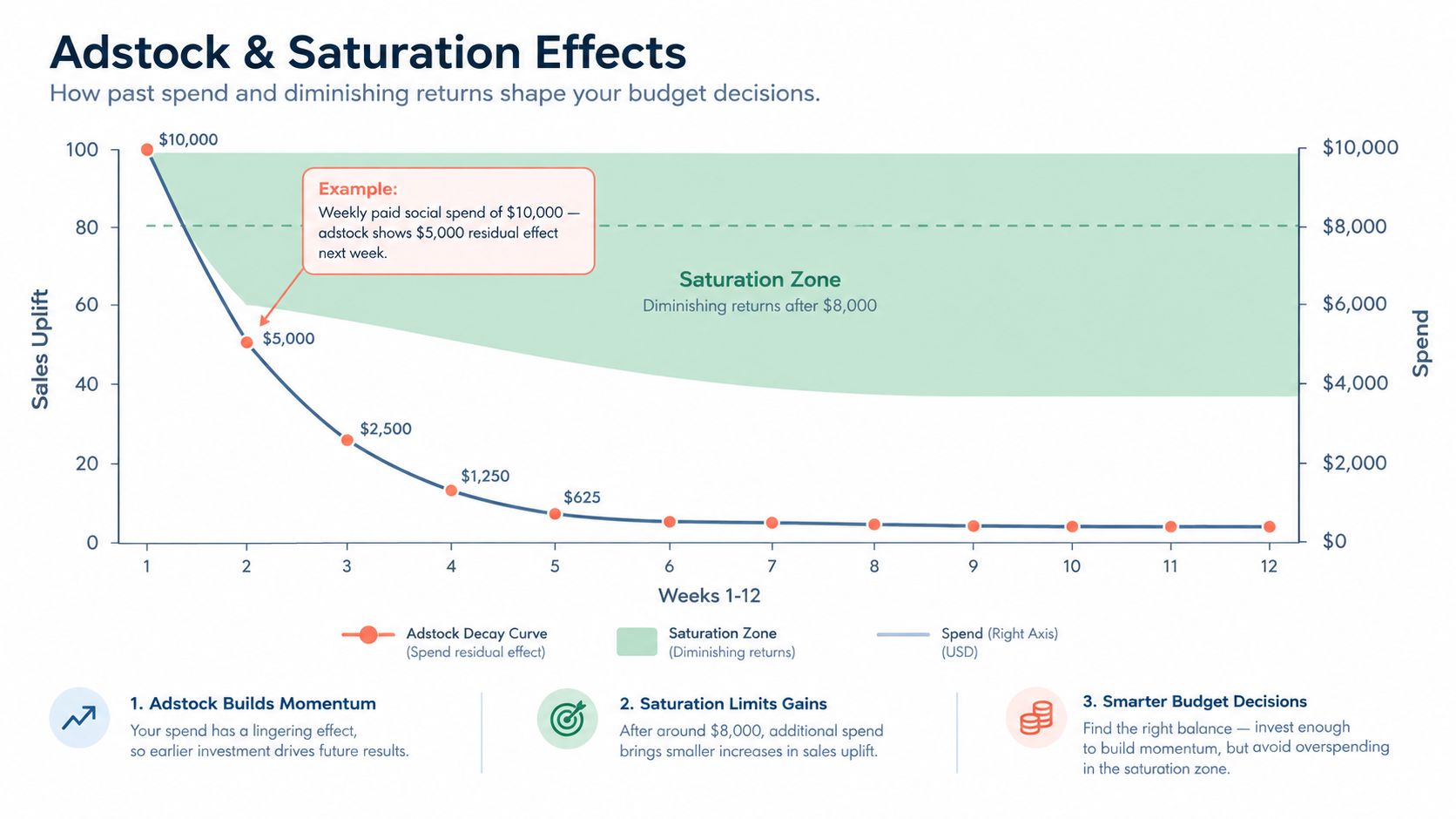
The two concepts that matter most areadstock andsaturation. A strong technical summary is simple: the most defensible MMM specification modelscarryover anddiminishing returns explicitly rather than treating spend as linear and immediate. Adstock represents delayed impact over time, and a saturation function such as a Hill curve captures falling marginal return as spend rises. In Bayesian MMM, these parameters often dominate model behavior, and mis-specifying them can materially distort ROI, timing, and budget allocation (technical paper on adstock and saturation).
Here's the visual needed before trusting the budget recommendation.
Adstock changes how you read channel performance
Say your paid social spend stays flat for several weeks, then conversions dip. A last-click read might tell you the channel suddenly got worse.
That may be wrong.
Adstock assumes some of the effect of this week's spend carries into future weeks. Awareness, consideration, repeat exposure, delayed direct visits, branded search lift. Those effects don't hit instantly and disappear on the reporting cutoff.
If you ignore carryover, you'll often understate the value of channels that create delayed demand and overstate channels that harvest it later.
A channel can look weak in this week's click path and still be doing important work in the revenue system.
Saturation tells you where to stop
Now take the same paid social channel and imagine spend keeps climbing. At first, each additional dollar may work well because you're reaching responsive audiences. Then the response curve starts flattening.
That's saturation.
The point isn't that the channel “stops working.” The point is thatmarginal return falls. At some point, the next budget increase is less attractive than funding another channel, another market, or another lifecycle motion.
That's the moment MMM should trigger a reallocation conversation.
Why these curves change real decisions
Without adstock and saturation, teams make naive budget calls:
- Spend appears to drive impact only in the week it runs
- Every incremental dollar is treated as equally productive
- Short-lag channels get overfunded
- Brand or upper-funnel channels get undervalued
With those curves modeled properly, you can ask better questions:
- Is this channel creating delayed lift we're missing in attribution?
- Are we near the point where more spend produces weaker marginal return?
- Should the next dollar stay in-channel or move elsewhere?
This video gives a useful walkthrough of how those effects show up in practice.
The output you want isn't “paid social contributed X percent.” The output you want is a reallocation recommendation grounded in response curves.
Combining MMM With Incrementality and Attribution
You don't need one measurement method. You need a stack.
The smarter setup is simple.Attribution handles tactical reads.Incrementality testing gives you causal evidence on specific interventions.MMM sets the broader budget envelope and mix. Teams that try to make one method do all three jobs usually end up with political reporting instead of decision support.
A useful signal from current industry research is that55% of advertisers said they frequently encounter conflicting results across measurement solutions, yet only 4% integrate multiple approaches like MMM, experiments, brand lift, and attribution (Kantar and Meta thought leadership report).
What each layer should own
| Question Type | MMM | Incrementality Testing | Granular Attribution |
|---|---|---|---|
| Where should next quarter's budget shift across channels? | Best fit | Useful for validation | Weak fit |
| Did this specific campaign create causal lift? | Directional | Best fit | Weak fit |
| Which creative, audience, or path variation is winning right now? | Weak fit | Sometimes useful | Best fit |
| Are we overspending in a channel relative to marginal return? | Best fit | Strong validation layer | Weak fit |
That conflict rate isn't the problem. The problem is that teams don't have a process for reconciling disagreement between methods.
A practical workflow that works
Use the methods in sequence:
- MMM flags a budget issue Example: paid search looks oversaturated relative to other channels.
- Incrementality testing validates the call A geo or holdout test checks whether reducing or shifting spend changes outcomes the way the model predicts. If you need a practical primer, this guide onhow to design holdout experiments is a good operational reference.
- Attribution narrows the action inside the channel You identify which campaigns, audiences, keywords, or creative clusters still deserve budget.
- The budget owner acts Spend moves based on a combined read, not a single dashboard.
Don't run MMM in isolation
A more advanced MMM workflow combines observational modeling with geo-experiments to estimate adstock decay, saturation, and effectiveness from real lift data, which helps anchor parameters that are often weakly identified from spend-and-sales data alone (arXiv paper on calibrating MMM with geo-experiments).
That matters because an elegant model can still be wrong in practice if correlated spend, seasonality, or overlapping funnel effects confuse the signal.
The goal isn't to make every tool agree. The goal is to know which tool gets the final say for each decision.
That's how measurement becomes operational instead of academic.
Why Most MMM Programs Fail at Activation
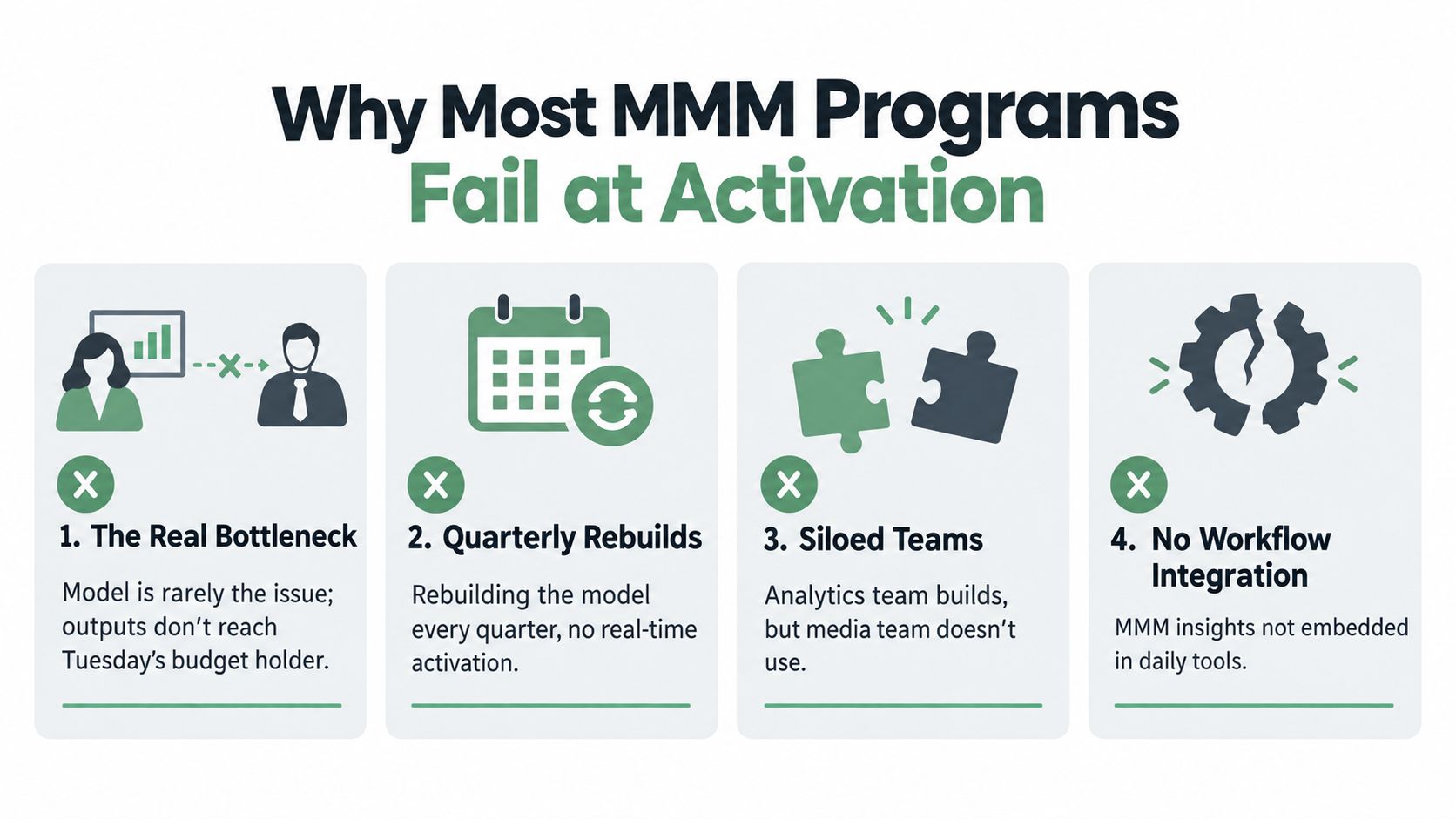
Monday morning, finance wants a reforecast, paid media is pacing behind plan, and CRM wants to protect retention volume. The MMM deck from last month exists, but nobody can turn it into a same-week budget call. That is why MMM stalls. The model is present. The operating system around it is missing.
The failure point is usually execution, not model design. Organizations say MMM matters, yet only28% report being very effective at turning MMM insights into timely action, whiledata quality at 47% andsiloed-data integration at 46% are the top blockers (Microsoft and MMA study on MMM actionability).
What failure actually looks like
A mid-market team gets a quarterly model refresh. Analytics presents contribution charts, adstock curves, and a few budget recommendations. Everyone nods. Then channel leads return to platform dashboards, attribution reports, and pacing sheets because those tools sit inside the weekly workflow and the MMM file does not.
That pattern tells you something important. MMM was treated as a measurement upgrade, not as the system that governs budget decisions.
The operational gaps that block activation
The model is rarely the bottleneck. The handoff into planning is.
- No named decision owner Someone has to own the reallocation call across paid, lifecycle, and finance constraints. If that owner does not exist, MMM becomes a discussion input instead of a decision tool.
- No weekly decision cadence Quarterly readouts are fine for planning. They are too slow for active budget management. If spend moves every week, MMM needs a weekly operating review, even if the full model refresh happens less often.
- No scenario tool tied to live budgets Teams need answers to simple questions fast. What happens if search drops 15%? Where should that money go this week? If MMM cannot support those scenarios in the format budget owners use, nobody will act on it.
- No reconciliation layer with attribution and tests Channel teams will ignore model guidance if it conflicts with the dashboards they use every day. You need one place where MMM sets budget direction, attribution guides in-channel execution, and tests break ties when the signals conflict.
- No feedback loop If you never compare recommended reallocations against what the team did and what happened after, the program does not improve. It just restarts every quarter.
Crescade fits into this operating layer for teams that need strategy, acquisition, lifecycle marketing, analytics, automation, and AI connected in one weekly decision system instead of managed as separate workstreams.
Usefulness beats model elegance
I would take a good-enough MMM that changes spend every week over a prettier model that lives in slides.
Pressure-test your program with two blunt questions:
- What budget change did the last model recommend?
- What did the team change within the next week?
If you cannot answer both quickly, stop spending energy on marginal model improvements. Fix ownership, scenario planning, and the weekly budget cadence first.
Implementation Roadmap and Next Step
You don't need a giant transformation program to make marketing mix modeling useful. You need a disciplined rollout tied to real decisions.
Phase one builds the inputs
Start with data readiness.
Audit at least24 months of weekly spend and KPI data if you have it, then standardize channel taxonomies across ad platforms, CRM, analytics, and finance views. Resolve obvious breaks first. Missing spend categories, renamed channels, incomplete revenue mapping, disconnected lifecycle sends.
Don't build a model on top of semantic chaos.
Phase two creates the baseline model
Build or buy a baseline MMM that reflects the actual business, not a generic template.
Include paid channels, owned motions, major commercial events, and external controls that materially affect outcomes. Then pressure-test the output against one business event everyone remembers clearly, such as a major promotion, pricing change, launch period, or known shift in channel mix.
Phase three wires it into the operating cadence
The critical moment is missed during this phase.
Use a simple rhythm:
- Weekly: review directional changes and channel pressure points
- Monthly: run a reallocation exercise
- Quarterly: refresh the full model and compare recommendations to actual decisions
That operating layer matters more than presentation quality. If the budget owner doesn't see the model in the same cycle as spend decisions, it won't shape spend decisions.
Phase four adds calibration and reconciliation
Once the baseline is live, add experiments and attribution where they sharpen the decision.
Use holdouts or geo tests to validate major budget shifts. Use attribution to improve campaign and funnel execution inside channels already approved in the mix. Reconcile disagreements explicitly instead of pretending one source is the truth.
Start with a defensible model and a weekly decision cadence. Sophistication can come later. Actionability can't.
The practical next step is straightforward: map your current data state against the requirements above, identify where weekly channel decisions are currently made without defensible evidence, and build a 30-day remediation list before you talk about tools.
If your team needs that mapped into an operating system,Crescade helps connect acquisition, conversion, lifecycle marketing, analytics, automation, and AI into one accountable growth workflow. We use measurement to improve budget and channel decisions, not to generate another isolated dashboard. Send this article for editorial review, then request a working session if you want a clear starting point.