- paid social management
- paid social strategy
- social ads workflow
- creative testing
- marketing measurement
Paid Social Management That Compounds: A Practical Guide
By Crescade · · 15 min read
A practical guide to paid social management covering audience strategy, creative testing, bidding, measurement, and workflows that turn ad spend into
Your paid social account is probably producing plenty of activity and not enough confidence. Meta reports strong ROAS, TikTok is delivering inexpensive traffic, LinkedIn is consuming budget, and your CRM tells a more complicated story.Paid social management works when it becomes a repeatable operating system for audience decisions, creative iteration, budget control, conversion quality, and measurement, not when a team launches more ads.
The stakes are substantial. One industry summary reports that US social media advertising revenue rebounded36.7% year over year in 2024 to $88.8 billion, while global social media ad spending is projected to reach$338.75 billion in 2026 (industry summary of social media advertising statistics). At that scale, small process weaknesses can turn into persistent waste. The practical question isn't whether to advertise on social platforms. It's whether your team can turn every campaign into better evidence for the next allocation decision.
Table of Contents
Building an Audience Strategy by Funnel Stage
Creative Testing and Iteration at Speed
Bidding, Budget Pacing, and Platform Controls
Measurement Beyond Platform-Reported ROAS
The Weekly Operating Cadence That Compounds
- Monday and Tuesday create the inputs
- Wednesday launches controlled tests
- Thursday and Friday turn data into decisions
Common Failure Modes and a Practical Next Step
What Paid Social Management Actually Means Now
Paid social management used to be treated as a sequence of media tasks: choose an audience, upload creative, set a budget, and report results. That approach can survive while spend is modest and conversion paths are simple. It breaks when the account contains multiple markets, objectives, creative formats, funnel stages, and revenue outcomes.
The work now resembles an operating system.Audience research supplies the signal, creative production supplies testable inputs, campaign structure controls delivery, and measurement determines whether the result deserves more budget. Each part affects the others. A weak landing page can make a good ad look inefficient. A poor conversion event can teach the algorithm to find cheap actions instead of valuable prospects. A narrow creative pipeline can force the team to overwork yesterday's winner.
The channel's expansion makes this operational view necessary. A historical summary cites global social advertising spend rising from less than$93 billion in 2019 to approximately$275.98 billion in 2025, while another industry summary reports$207 billion in global social ad spend in 2025 and$78.2 billion in US spend (social media marketing statistics). The sources present different totals, so treat them as directional market markers rather than interchangeable accounting figures. The shared lesson is that paid social has become a major acquisition system, not a supporting awareness line item.
The decision loop
A durable operation has explicit inputs and checkpoints:
- Research: Identify customer language, objections, high-intent events, competitor positioning, and creative patterns.
- Build: Translate those signals into audience logic, campaign structure, landing-page requirements, and creative briefs.
- Launch: Release controlled tests with a defined objective, conversion event, budget, and owner.
- Learn: Separate delivery problems from message problems, conversion problems, and measurement problems.
- Compound: Preserve the insight in a decision log, refresh the next test, and move budget according to evidence.
Practical rule: If your team can't explain what changed, what was learned, and what decision follows, the campaign generated activity but not operating knowledge.
The rest of the system depends on this discipline. Paid social management scales when the team protects learning velocity, keeps signal quality visible, and makes reallocation rules explicit before performance becomes emotional.
Building an Audience Strategy by Funnel Stage
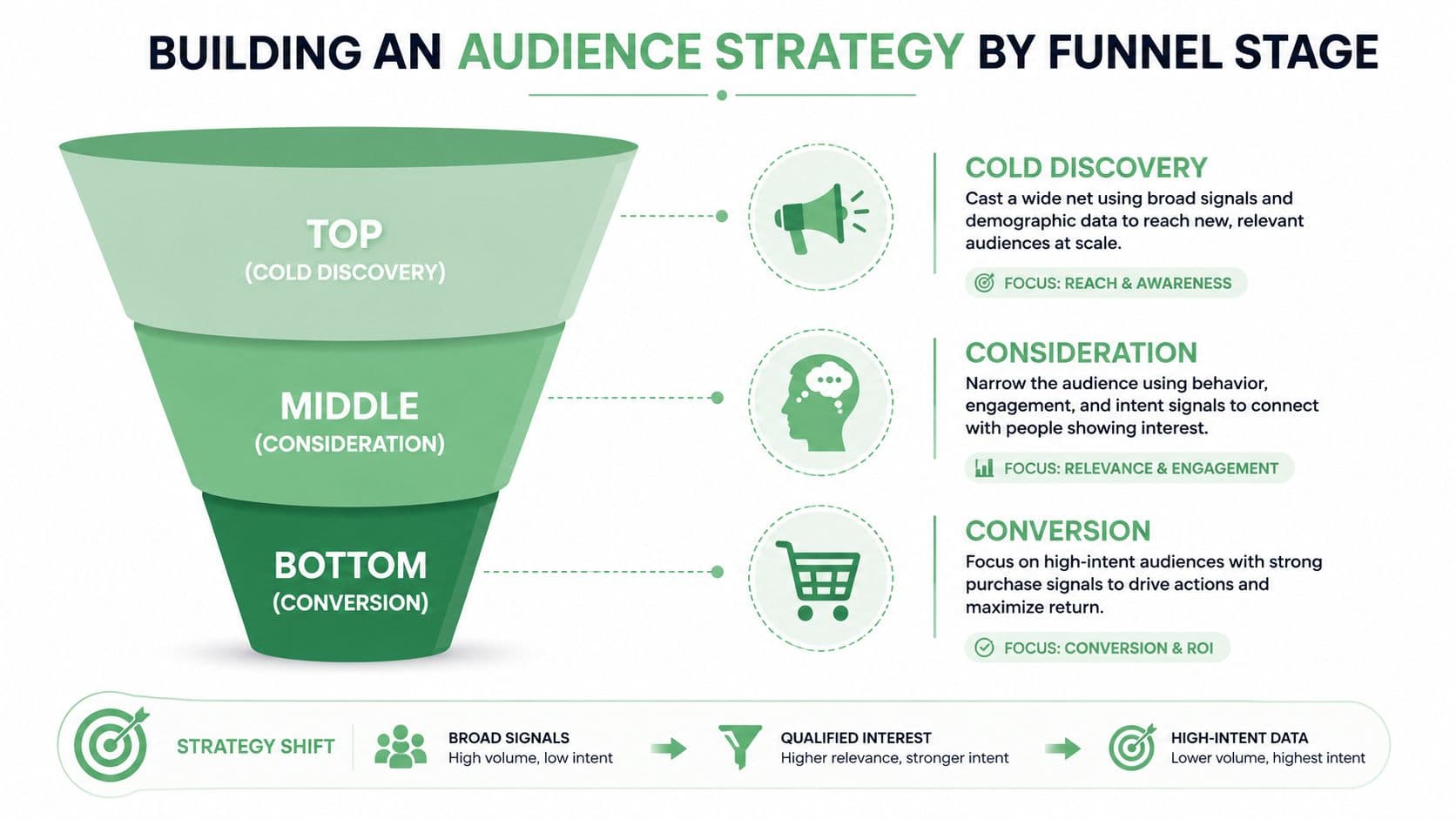
Audience strategy should begin withsignal quality and funnel intent, not a long list of interests. A cold prospect, a product-page visitor, a sales-qualified lead, and an existing customer have different reasons to respond. Giving them the same creative, optimization event, and budget logic makes the account harder to read.
Start with four audience jobs:
- Cold discovery introduces the problem and creates an initial signal. Broad platform targeting can work here, especially when the creative clearly qualifies the viewer. Lookalikes should be seeded from meaningful events, such as qualified leads or purchasers, rather than from low-intent engagement.
- Consideration converts attention into active evaluation. Use engaged video viewers, visits to important pages, content interactions, and relevant site behavior. Exclude recent converters so the campaign isn't paying to repeat a completed action.
- Conversion focuses on high-intent prospects. Customer lists, CRM-qualified leads, product viewers, demo activity, and offline conversion feedback are more useful than audience size alone.
- Retention or expansion speaks to customers differently. It can support onboarding, repeat purchases, upgrades, referrals, or cross-sell, but it shouldn't compete with acquisition campaigns for the same budget without a clear commercial reason.
Define one primary signal
Give each stage one primary optimization signal and document the exclusions in plain language. For example, a prospecting campaign might optimize toward a qualified site action, a consideration campaign toward a completed lead form, and a conversion campaign toward a CRM-confirmed opportunity. The exact event depends on the business, but the decision should be deliberate.
Benchmark data illustrates why blended account reporting can mislead. Median CTR is reported at approximately0.9% for broad prospecting, 1.1% for lookalike or interest targeting, 1.8% for retargeting, 1.6% for lead-form campaigns, and 1.3% for short-form video. Top-quartile figures are approximately1.6%, 1.9%, 3.2%, 2.7%, and 2.4%, respectively (paid social benchmarks). These aren't promises or universal targets. They show why cold and warm audiences need separate expectations.
A useful audit asks whether each audience islearning, overlapping, or merely spending. Review exclusions, frequency, conversion quality, and downstream progression. For practical setup guidance,how to start advertising on Facebook can help teams translate the strategy into a structured launch rather than defaulting to ad hoc interest groups.
Creative Testing and Iteration at Speed
Creative testing becomes expensive when the team changes the hook, format, offer, audience, and landing page at the same time. You may see a performance change, but you won't know which input caused it. A better system separates the main creative variables and records the hypothesis behind each variation.
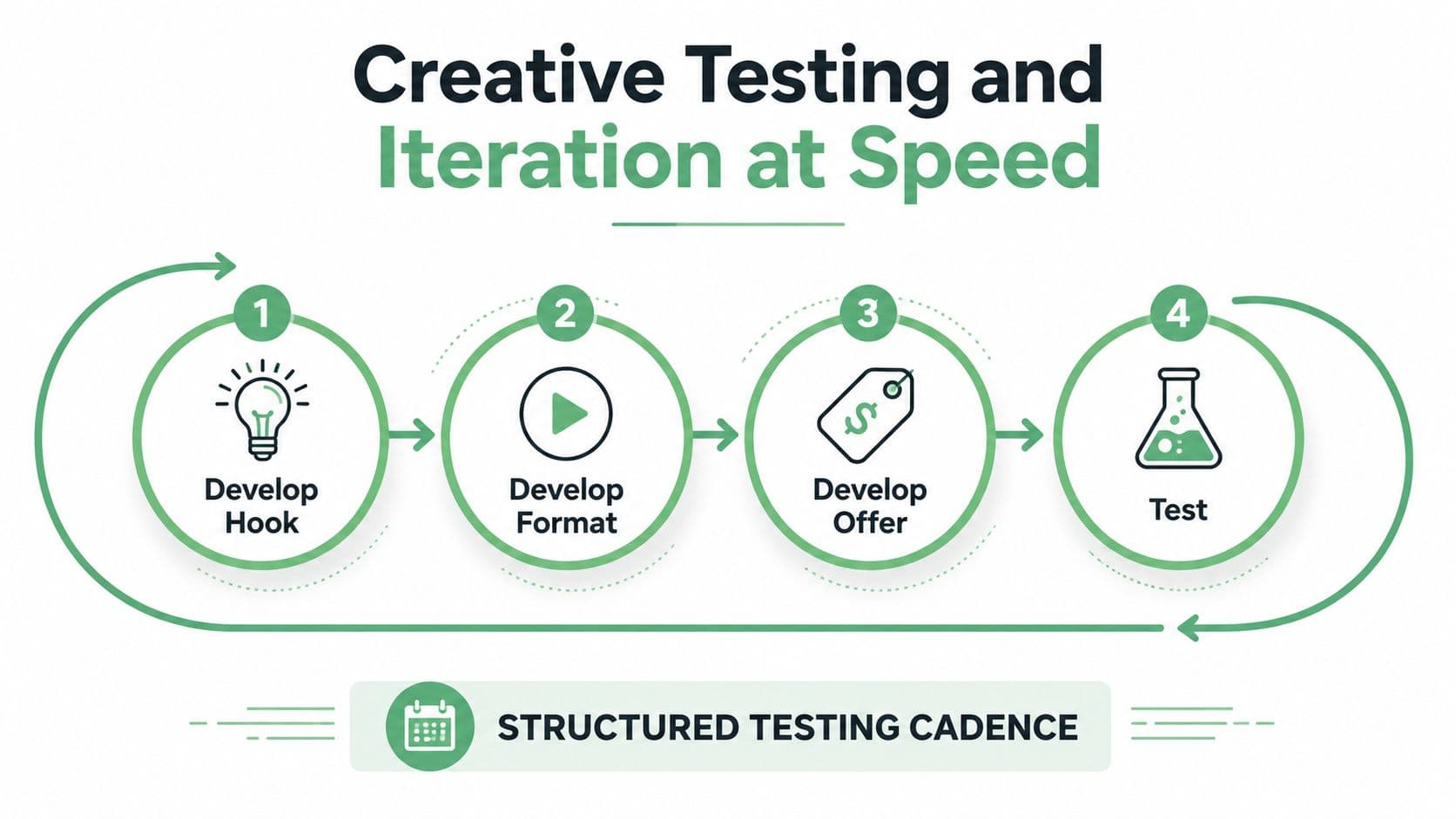
Treat every concept as a combination of:
- Hook: The opening frame, first spoken line, problem statement, or visual interruption that earns attention.
- Format: UGC, a talking head, product demonstration, motion graphic, founder explanation, testimonial, or stat-led treatment.
- Offer: A trial, consultation, lead magnet, product bundle, price message, proof point, or other reason to act.
Build a test matrix that changes one major variable at a time. The plan notes for a structured cadence call forsix variants per cell, but the right volume depends on production capacity, audience size, conversion rate, and the cost of reaching a usable learning threshold. The important point is to create enough variation to test a hypothesis, not six near-identical edits that only change a caption.
Move from winner to knowledge
Set the evaluation rule before launch. You might use a cost-per-result threshold, a minimum number of meaningful conversions, or both. Don't declare a winner because it has the best early CTR. Ask whether the result survives closer review of landing-page behavior, lead quality, sales acceptance, and revenue progression.
A winner should produce a new brief. Review the opening frame, the promise, the objections addressed, the proof used, the pace, and the offer. Then create adjacent variations that preserve the effective mechanism while testing a new angle. A losing ad also has value if the team records why it failed. The resulting library should containwinners, losers, hypotheses, and evidence, not just a folder of approved files.
Teams that need faster production can use a resource such asShortGenius AI ad creative tool to support early variation development. AI can accelerate drafts and edits, but people still need to define the customer insight, approve claims, judge brand fit, and connect the asset to a measurable test.
The following video provides another practical reference point for thinking about creative production and testing:
Bidding, Budget Pacing, and Platform Controls
Bidding decisions should follow the campaign's job. Lowest-cost bidding gives the platform room to find available conversions and is often a reasonable starting point when the event has enough volume and the team is still learning. Target-cost controls can make sense when economics are stable and delivery remains sufficient. Cap bidding offers more control, but it can restrict delivery when the cap is below what the auction and audience can support.
The same principle applies across Meta, TikTok, and LinkedIn, although auction dynamics and audience intent differ. Comparative benchmark reporting places CPMs around$8 to $14 on Meta, $7 to $11 on TikTok, $10 to $18 on YouTube, and $20 to $45 on LinkedIn (paid advertising benchmarks). LinkedIn may look expensive for awareness, but B2B teams may accept that cost when account value and intent justify it. Cheap impressions aren't automatically efficient acquisition.
Match the control to the campaign
| Campaign Type | Recommended Bidding | When to Override |
|---|---|---|
| Broad prospecting | Start with lowest cost and a strong conversion event | Override when delivery is unstable or the event is too shallow to guide optimization |
| Retargeting | Use automated delivery with clear exclusions | Override when the pool is small, frequency rises, or spend concentrates too aggressively |
| Lead generation | Optimize toward completed forms and pass quality feedback downstream | Override when the platform produces volume that sales rejects |
| High-intent conversion | Use the control that protects contribution margin and qualified outcomes | Override when attributed results don't match CRM or revenue evidence |
| B2B account campaigns | Test automated delivery against stricter controls | Override when spend reaches low-value accounts or misses priority buying groups |
Don't change bids every time the dashboard moves. First check whether the conversion event fired correctly, whether delivery is pacing against the intended schedule, whether the audience overlaps another campaign, and whether the landing page is available. Manual controls are most useful when you have a clear economic constraint. They aren't a substitute for weak signal quality.
For TikTok-specific account mechanics and campaign considerations,brand growth with TikTok ads offers additional context. For broader Meta budget governance,how to scale Facebook ads is useful when deciding whether to consolidate, separate, or reallocate campaigns.
Measurement Beyond Platform-Reported ROAS
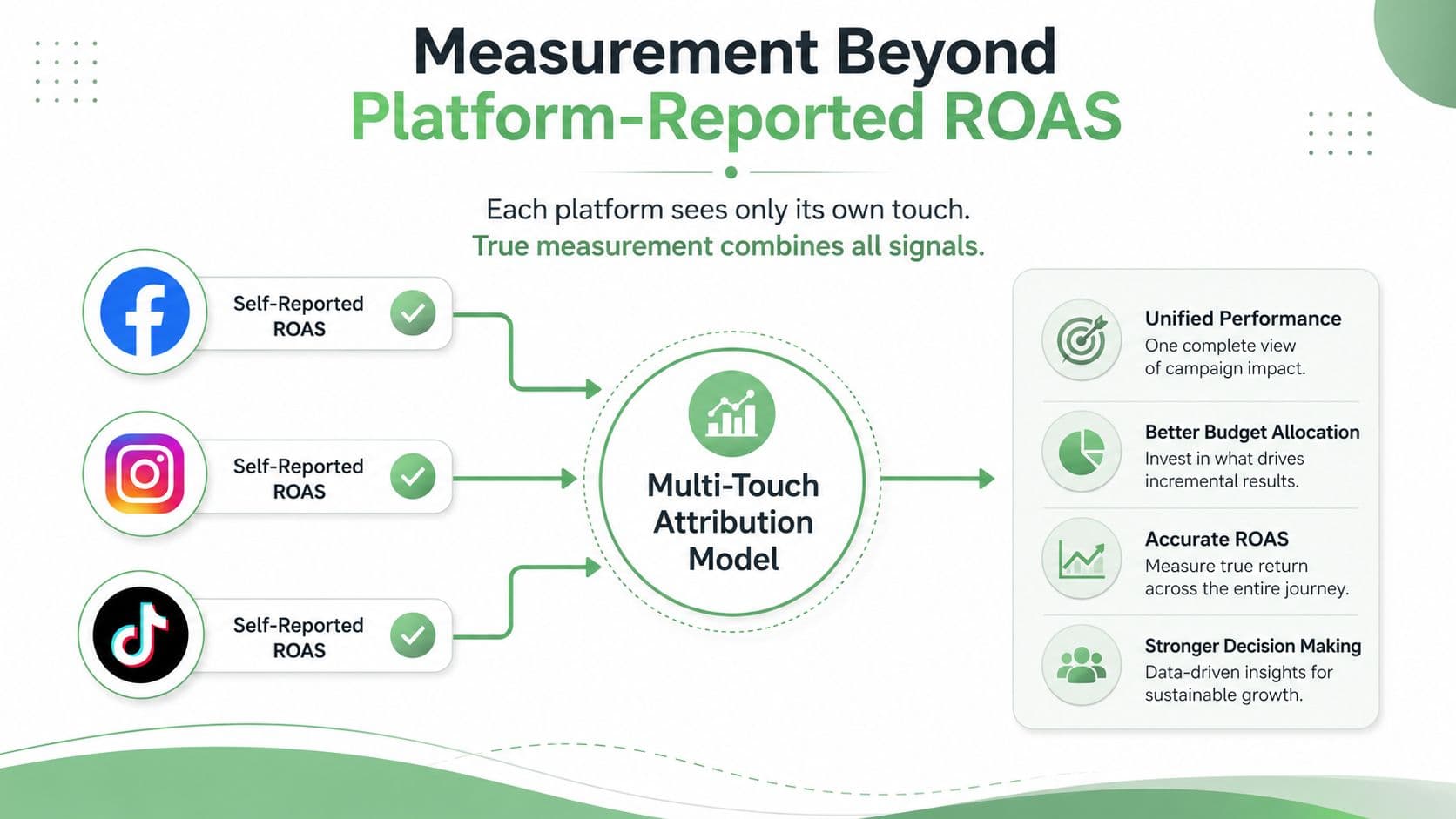
Platform-reported ROAS is useful as an operational diagnostic, but it shouldn't be the only basis for a budget decision. Each platform observes its own impressions, clicks, conversions, and attribution rules. That creates an incentive for several platforms to claim credit for the same customer journey.
Use three layers of measurement:
- Reported performance is what Meta, TikTok, or LinkedIn attributes inside its own system. It helps identify delivery changes, creative movement, and campaign anomalies.
- Observed performance comes from analytics, landing-page behavior, CRM stages, purchases, and blended business reporting. It shows what happened across channels, although it still contains attribution limitations.
- Incremental performance asks what would have happened without the spend. Holdouts, geo-based tests, matched-market designs, and marketing mix modeling can help answer that question when the business has enough volume and operational control.
Build a connected event path
Google's documented workflow starts with an Analytics event becoming akey event, after which that key event can be created or imported as a conversion in Google Ads. Google also documents segmentation by conversion source, which helps isolate GA4-imported conversions in Ads reporting (Google Ads conversion setup). This doesn't solve attribution on its own, but it creates a more consistent path between website behavior and campaign optimization.
For actions completed outside the website, Google's documentation describes Offline Conversion Import, which connects CRM outcomes such as signed contracts or completed applications back to Google Ads (Google Ads measurement documentation). A similar principle applies to paid social: pass qualified downstream outcomes wherever the platform and privacy setup support it, then compare those outcomes with CRM records.
Your weekly review should show spend, reported conversions, analytics conversions, qualified leads, opportunities, purchases, revenue, margin, and any incrementality evidence available. Include the attribution window and conversion definition beside each metric. When a campaign looks excellent in-platform but weak in CRM, don't scale it until you understand the gap.
For teams building a more complete model,what is multi-touch attribution explains the broader measurement problem. For controlled experiments,valid ad testing methods can help you evaluate holdouts and control groups without treating platform credit as causal proof.
The Weekly Operating Cadence That Compounds
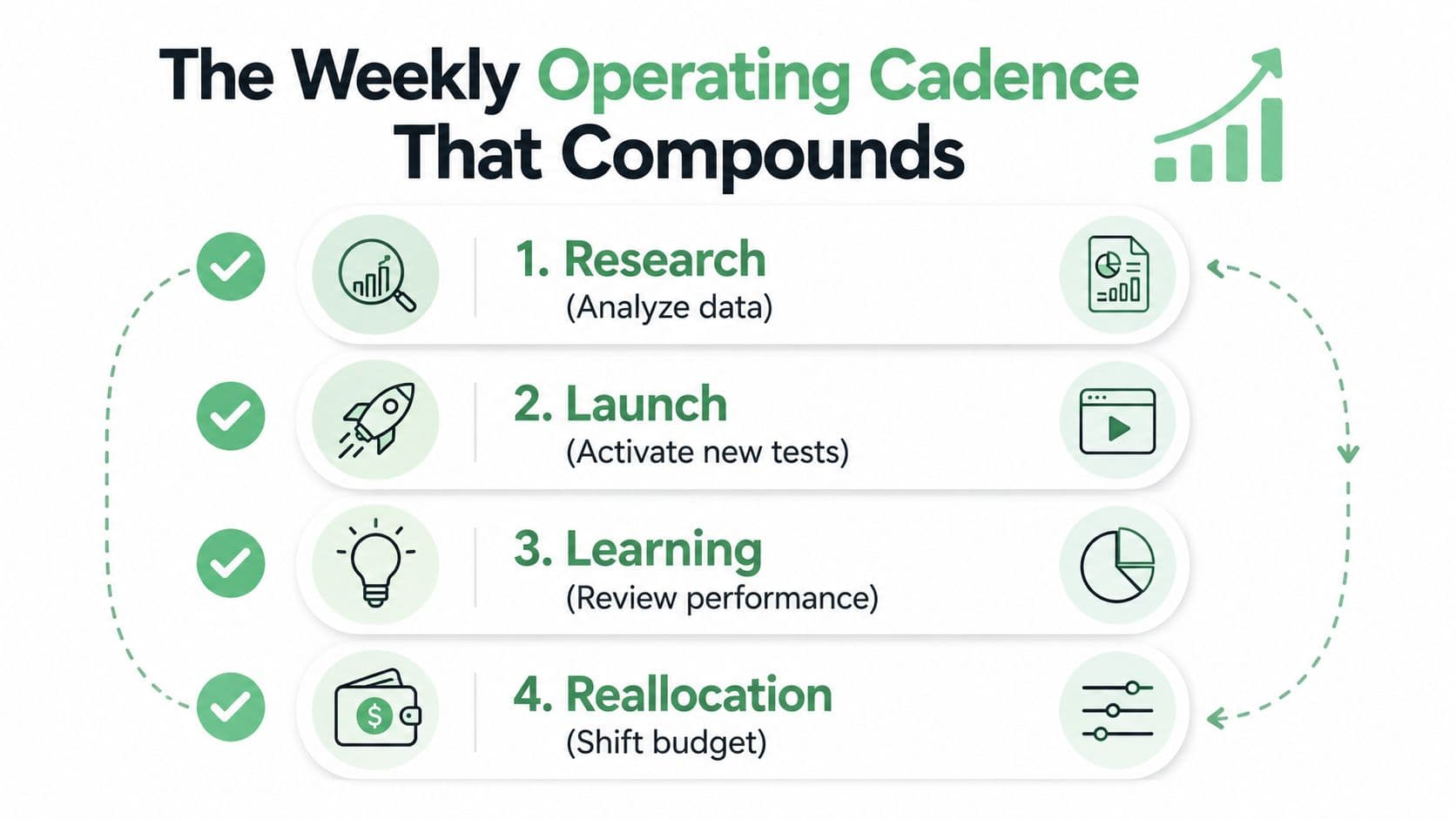
Paid social management needs a calendar that protects both speed and judgment. A fixed rhythm prevents the team from making a budget decision because of a single dashboard spike, while still giving new creative and audience tests a predictable path into market.
Monday and Tuesday create the inputs
Monday is for research and diagnosis. Review performance by funnel stage, inspect search terms and customer language, read sales objections, examine creative fatigue, and identify where the previous week's evidence is incomplete. Produce a short research note with the strongest signal, the unresolved question, and the decision it could influence.
Tuesday turns those findings into production. Write creative briefs, define hook and offer variations, confirm audience exclusions, check landing-page continuity, and verify that the conversion event is available. Keep approvals short and assign one decision owner. A campaign shouldn't wait through an undefined chain of reviewers while the underlying opportunity changes.
Wednesday launches controlled tests
Wednesday is the activation point for new campaigns, creative variations, landing-page changes, or audience experiments. Record the campaign objective, event definition, budget logic, hypothesis, launch time, owner, and evaluation rule in a decision log. That documentation makes later analysis possible because the team can distinguish an intentional test from an accidental account change.
Thursday and Friday turn data into decisions
Thursday is for early diagnostics, not premature winner declarations. Check delivery, spend distribution, event volume, creative engagement, landing-page continuity, and tracking integrity. Friday is for decisioning: continue, revise, pause, consolidate, or reallocate. Record why.
Keep the operating review focused on actions that affect current delivery. Reserve broader channel strategy, forecasting, and organizational questions for the monthly business review. Lifecycle marketing belongs in the same conversation when paid acquisition creates contacts that need nurturing. A lifecycle playbook citing Litmus estimates$36 returned for every $1 spent on email, and reports Klaviyo benchmark data showing automated flows generating about41% of email revenue from roughly 5% of total sends (lifecycle email playbook). These figures are directional benchmarks, not guarantees, but they reinforce the value of connecting acquisition to triggered follow-up rather than stopping at the lead form.
Common Failure Modes and a Practical Next Step
Most paid social operations don't stall because the team lacks another targeting option. They stall because governance and evidence are weak.
Common failure modes include:
- Fixed audience lists: Teams keep spending against the same segments without checking signal quality, exclusions, overlap, or changing customer intent.
- Early winner declarations: An ad earns attention before it has enough qualified conversion evidence, so the team scales noise.
- ROAS-only reallocations: Budget moves toward the campaign claiming the most credit, even when CRM outcomes or margin tell a different story.
- Shallow optimization events: The platform learns to find an inexpensive action that doesn't progress toward revenue.
- Variable overload: The team changes audience, creative, offer, landing page, and bid together, then can't identify the cause.
- Slow approvals: Launch governance takes longer than the useful learning cycle, leaving the account dependent on aging assets.
- Unclear ownership: Nobody has authority to pause spend, approve a new test, or resolve a tracking discrepancy.
A practical reset starts with documentation. Write down the campaign objective, conversion event, audience logic, budget owner, and decision threshold for every active campaign. Then align GA4 and Google Ads so meaningful downstream actions are recorded and imported consistently, using the documented key-event and conversion workflow rather than a collection of disconnected events.
Next, review the previoussix to eight weeks of spend, and treat that period as an audit window rather than a performance guarantee. Pause structurally unprofitable ad sets, refresh the topthree proven hooks, and consolidate overlapping audiences where the account is competing with itself. Set a weekly reallocation rule based on marginal cost and incremental evidence, not last-click ROAS alone.
Schedule three recurring checkpoints: a creative review, a pacing review, and a measurement review. Crescade can support this kind of accountable, AI-assisted growth operations system by connecting paid acquisition, creative testing, conversion review, lifecycle marketing, analytics, automation, and decision logs. VisitCrescade to see how a focused acquisition constraint or a broader full-funnel operating system could fit your team, then request a 20-minute audit with the campaign data and CRM questions you already have.