- retention marketing
- lifecycle marketing
- customer retention
- marketing automation
- agency selection
Retention Marketing Agency: Find the Right Partner
By Crescade · · 16 min read
A retention marketing agency helps you keep customers and boost revenue. Learn what they do and how to choose the best one for your brand.
You're staring at a stalled activation rate, a CRM nobody trusts, and a growing list of lifecycle campaigns your team never has time to build properly. Hiring aretention marketing agency can fix that, but only if you're buying an operating system for customer retention, not a vendor that sends more email. The right partner will connect segmentation, post-purchase experience, automation, analytics, and ownership boundaries to a measurable retention outcome. The wrong one will report opens, clicks, and campaign volume while churn continues.
Table of Contents
Why Retention Became a Separate Discipline
Core Services a Retention Agency Owns
- Segmentation comes first
- Messaging follows the customer state
- Automation turns decisions into journeys
- Experimentation needs a control group
The Measurement Layer Behind Retention Work
Comparing Agencies Against Your Situation
Questions Most Buyers Forget to Ask
Running a 30 to 60 Day Evaluation
- Weeks one and two for scope
- Weeks three and four for a paid diagnostic
- Weeks five through eight for execution
What a Retention Marketing Agency Actually Does
A retention marketing agency is an outsourced operating team for the customer relationship after acquisition. Its job isn't limited to writing email copy or scheduling SMS. It should define lifecycle stages, build audience logic, manage messaging, improve automation, and maintain the measurement loop that shows whether customers are activating, returning, renewing, or expanding.
That distinction matters because acquisition and retention require different operating habits. A paid media agency is built to generate demand and acquire new customers. A creative shop may produce strong assets. A retention partner should own what happens after the customer enters your ecosystem, including the decisions that determine whether that customer receives the next useful message, product prompt, offer, or intervention.
The system inside your business
A capable agency usually works across several connected layers:
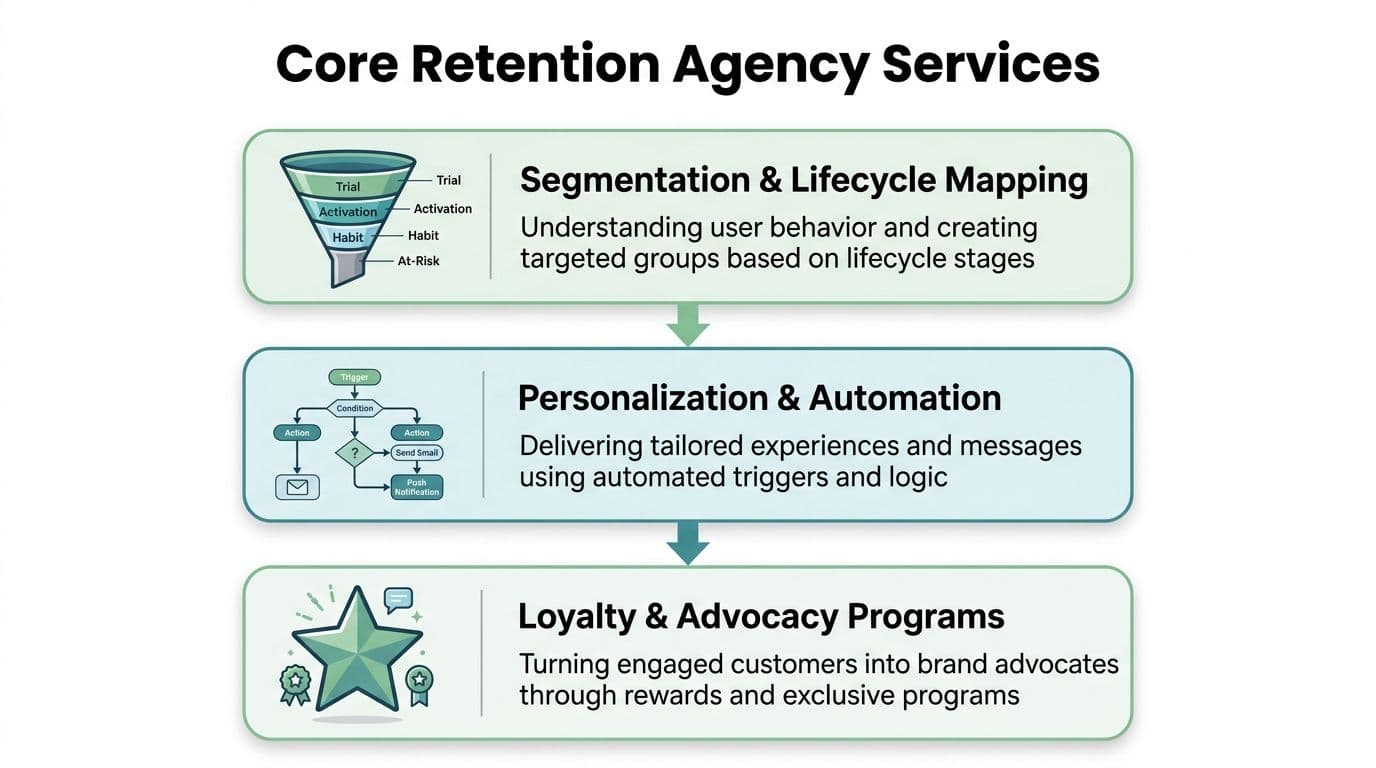
- Lifecycle definition: Establish stages such as trial, activation, habit, at-risk, renewal, and win-back.
- Segmentation logic: Translate customer behavior, purchase history, product usage, and account attributes into audiences your CRM can query.
- Messaging strategy: Coordinate email, SMS, push, in-product prompts, and post-purchase communications around customer context.
- Automation: Build welcome, onboarding, nurture, cancellation, upgrade, and reactivation journeys.
- Experimentation: Test timing, content, offers, channels, and escalation rules against a defined outcome.
- Reporting: Tie activity to cohort retention, churn, repeat purchase, renewal, or customer lifetime value.
Every layer should connect to the next. A segment without a journey is just a label. A journey without reliable events is a misfire waiting to happen. A dashboard without cohort logic gives you activity data, not operating intelligence.
Practical rule: If the agency can't explain which retention metric it owns, it isn't selling retention ownership. It's selling channel execution.
The category exists because companies need specialized lifecycle skills that often don't exist in their acquisition-focused teams. Founders can use this overview ofretention marketing strategies to broaden the tactical context, but the buying decision should remain operational: who will build the system, maintain it, and make weekly decisions from its evidence?
Your agency should leave behind visible artifacts. Ask to see the lifecycle map, audience definitions, automation diagrams, experiment backlog, event requirements, and reporting template before signing. If the proposal only contains a channel list, it doesn't describe an operating system.
Why Retention Became a Separate Discipline
Retention became a separate discipline because the economics of replacing customers are hard to ignore. Industry summaries report that acquiring a new customer can cost5x to 25x more than keeping an existing one, while a5% increase in retention can lift profits by 25% to 95%, depending on the business context, as summarized byRivo's customer retention statistics. The probability of selling to an existing customer is also reported at60% to 70%, compared with5% to 20% for a new prospect, using the same benchmark source.
Those figures don't mean every retention program produces the same result. They do explain why retention moved from a loyalty side project into a serious growth function. When acquisition becomes more expensive and payback takes longer, improving the value of customers you've already acquired becomes a direct operating decision.
Subscription, SaaS, ecommerce, and professional services businesses feel this particularly sharply because their revenue quality depends on what happens after the first conversion. A subscription company needs to control churn. A SaaS company needs customers to reach value and renew. An ecommerce brand needs repeat purchase behavior. A professional services firm needs expansion, referrals, and continued engagement.
The operating consequence
Retention teams think in cohorts, lifecycle stages, churn signals, repeat behavior, and lifetime value curves. That is a different skill set from managing top-of-funnel impressions, clicks, and acquisition bids.
A global benchmark summary places average customer retention across industries at roughly75%, while B2B SaaS is often cited near90% and transactional ecommerce around38% in a 2026 industry summary fromFocus Digital. The variation is the point. A retention agency can't apply one generic playbook across business models.
The same source reports that89% of marketers use email marketing for customer retention, which makes email foundational but not sufficient. Email is a delivery mechanism. The retention system includes the segmentation, triggers, data, offer strategy, product experience, and reporting that determine whether the message is useful.
The agency category grew because companies needed this specialized operating layer without building every capability internally. That makes the engagement worthwhile only when the partner owns decisions across the system, rather than treating retention as a bundle of sends.
Core Services a Retention Agency Owns
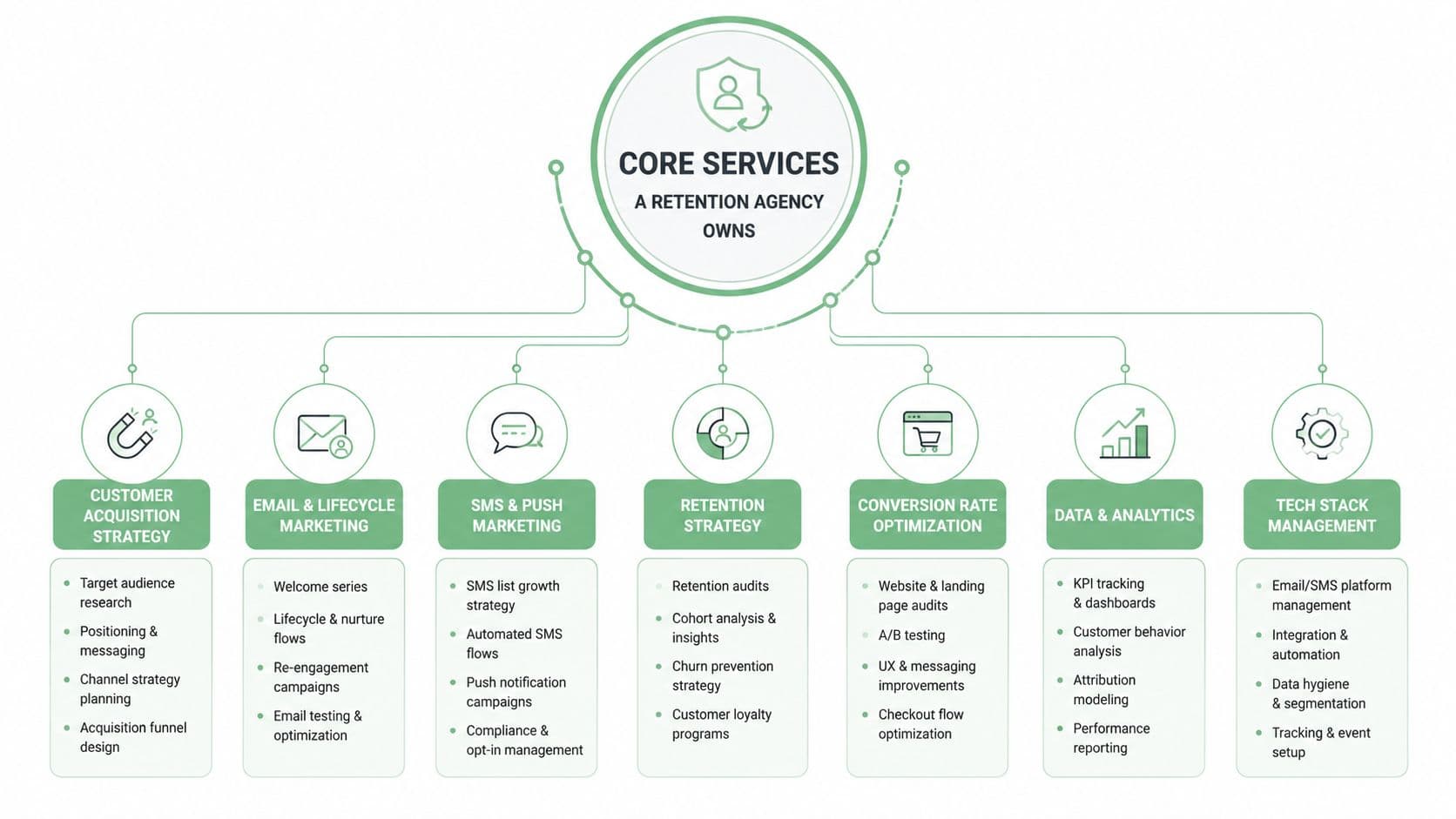
A retention agency should operationalize the work in a deliberate order. Start with customer understanding, then build communications, then automate, test, and clean the data supporting every decision.
Segmentation comes first
The first deliverable should be a lifecycle map that describes how customers move through your business. A SaaS map might include trial, activation, habitual usage, expansion, at-risk, and cancellation. An ecommerce map might include first order, delivered, second-order opportunity, repeat buyer, dormant, and win-back.
The agency should convert those stages into queryable logic inside your CRM, customer data platform, or marketing automation tool. Ask for the actual definitions. “High intent” isn't a segment until someone specifies the events, time window, exclusions, and required customer attributes.
Messaging follows the customer state
The agency then creates briefs for email, SMS, push, in-app messaging, or direct mail based on lifecycle stage. A post-purchase message should help the customer use what they bought, not ask for another purchase. A SaaS onboarding message should move the user toward a meaningful product action, not just announce features.
For ecommerce teams, theecommerce retention strategy framework is useful because it connects lifecycle automation with repeat purchase and retention measurement rather than treating campaigns as isolated promotions.
Automation turns decisions into journeys
Automation should reflect specific behavioral conditions. Examples include:
- A habit-building sequence: Guide a new user through a meaningful product routine over a defined onboarding window.
- A usage-based upgrade prompt: Trigger an expansion conversation when account activity indicates that the current plan may be limiting adoption.
- A cancellation flow: Capture the cancellation reason, offer relevant support, and route high-value accounts to the appropriate team.
- A reactivation journey: Adjust timing and message based on inactivity, prior value, and customer preference.
A useful overview ofSuby churn reduction tips can help teams compare intervention ideas, but your agency should still tailor each journey to your own lifecycle evidence.
Experimentation needs a control group
Personalization and testing are where many agencies become vague. Require a documented hypothesis, target audience, treatment, control or holdout approach, success metric, and follow-up decision. Test subject lines and send times when they matter, but don't mistake improved engagement for durable retention.
The agency should also produce a CRM and data hygiene plan. That includes event taxonomy, identity resolution, consent handling, audience availability, suppression rules, and QA ownership. GA4 can connect to BigQuery through its export, while CRM-to-GA4 workflows can map fields such asutm_source,utm_medium,utm_campaign,gclid, andga_client_id, as described in thisGA4 and CRM integration guide. Those mechanics matter when you need to connect acquisition context to closed revenue.
The Measurement Layer Behind Retention Work
A retention program can look busy while customers leave. Open rates and click rates diagnose delivery and creative relevance, but they cannot show whether a cohort stayed, renewed, purchased again, or expanded. Your agency needs to connect campaign activity to customer movement.
Start with cohorts. Group customers by acquisition month, signup period, first purchase, plan, or another meaningful entry point, then follow behavior across the lifecycle. Separatelogo churn fromrevenue churn because lost accounts and lost dollars require different decisions, as explained in this retention lifecycle playbook.
Leading signals and lagging outcomes
Leading indicators show whether customers are approaching value. Depending on the business, they can include activation, second purchase, feature adoption, onboarding completion, support engagement, or renewal preparation. Lagging outcomes include retention rate, churn, reactivation, gross revenue retention, net revenue retention, and customer lifetime value.
For SaaS and subscription teams, widely used operating benchmarks cite monthly churn below2% for SMB SaaS and below1% for enterprise SaaS, with at-risk detection occurring more than30 days before cancellation, according toArise GTM's lifecycle marketing KPI framework. Use these figures as operating references, not promises. Require the agency to define the denominator, cohort, period, and revenue scope behind every target.
| Metric Layer | Vanity Dashboard | Retention Operating Dashboard |
|---|---|---|
| Audience | Total contacts and sends | Cohorts defined by acquisition, plan, purchase, or lifecycle entry |
| Engagement | Opens and clicks by campaign | Engagement tied to stage progression and customer outcomes |
| Churn | One blended churn number | Logo churn and revenue churn separated by segment |
| Revenue | Campaign-attributed revenue | Repeat purchase, renewal, expansion, and cohort LTV |
| Reactivation | Total win-back conversions | Reactivation by inactivity window, value, and treatment |
| Cadence | Monthly campaign recap | Weekly source-of-truth retention report with decisions |
The measurement layer also needs documented event definitions, stable identity resolution across web, product, email, CRM, and billing systems, plus a weekly report that continues after campaigns end. Review a practicalCRM and marketing integration guide before approving the agency's data plan. Teams can use cohort analysis toimprove LTV with cohorts, but the agency should configure the implementation, validate the data, and turn findings into decisions.
A full-funnel program usually needs90 to 180 days to reach steady-state performance because teams must tune segment rules, suppress misfires, and validate incremental lift, according toDarkroom's retention measurement framework. Reactivation recovers only a modest share of dormant users, reported at roughly8% to 14% at 30, 60, and 90-day inactivity checkpoints by the same source. Ask who owns each metric, which system is authoritative, and what decision follows a miss. Those answers separate an agency operating your retention system from a vendor reporting campaign activity.
Comparing Agencies Against Your Situation
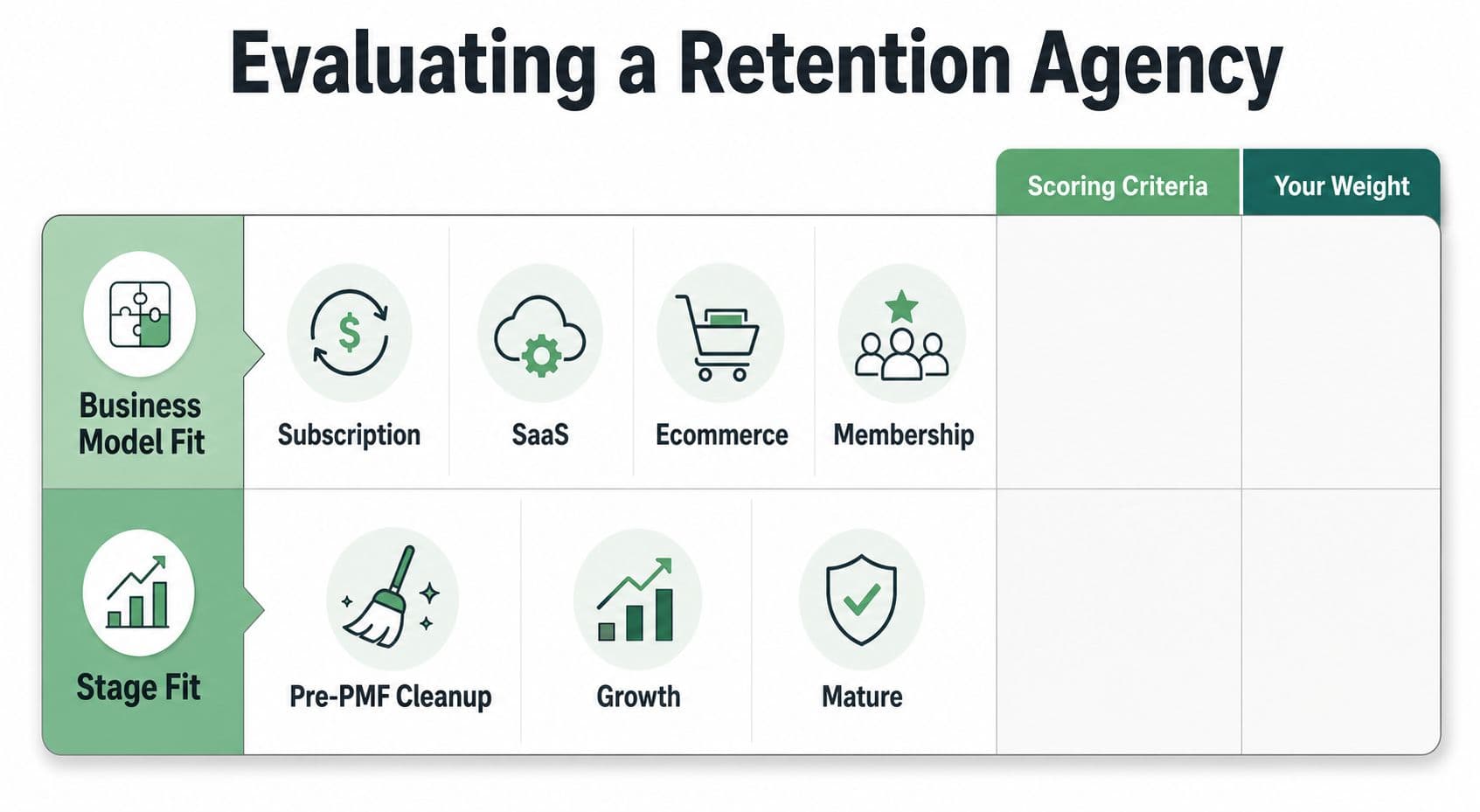
Don't choose a retention marketing agency from a generic “best agencies” list. Score each candidate against your business model, lifecycle maturity, data environment, and internal ownership.
A subscription business needs renewal protection and cancellation intelligence. A SaaS company needs activation, product adoption, and expansion logic. An ecommerce brand needs post-purchase education, repeat purchase timing, margin-aware offers, and dormant customer recovery. A membership business needs engagement and participation signals that may precede renewal.
Use a weighted scorecard
| Decision criterion | Candidate A | Candidate B | What to verify |
|---|---|---|---|
| Business model fit | Has the agency operated your revenue motion? | ||
| Stage fit | Can it clean up a weak foundation or scale an established program? | ||
| Measurement ownership | Does it define and report the KPIs it owns? | ||
| Stack alignment | Can it work with your CRM, analytics, billing, product, and messaging tools? | ||
| Lifecycle capability | Can it map stages, triggers, journeys, and escalation rules? | ||
| Experimentation | Does it use holdouts, tests, and documented hypotheses? | ||
| Commercial structure | Is compensation connected to outcomes or only production volume? | ||
| Handoff quality | Will your team retain logic, access, documentation, and knowledge? |
Weightbusiness model fit andmeasurement ownership at least a quarter of the total score each. A polished creative portfolio can't compensate for weak understanding of your retention motion or an inability to prove influence on customer outcomes.
Stage fit matters just as much. A pre-product-market-fit company may need lifecycle cleanup, instrumentation, onboarding analysis, and a smaller number of carefully chosen journeys. A scaled business may need advanced segmentation, channel coordination, predictive churn signals, and governance across teams.
Use thisguide to hiring a marketing agency to pressure-test communication, access, accountability, and contract expectations before you compare proposals.
Two disqualifiers matter more than the sales deck:
- No owned KPIs: The agency can't name the retention measures it will improve, monitor, and explain.
- Send-based pricing: The commercial model rewards message volume while ignoring retained revenue, activated users, renewal, or repeat purchase.
Pricing structure isn't automatically wrong because it includes a retainer or production component. The problem is a contract that makes campaign output the only measurable success.
Questions Most Buyers Forget to Ask
Most retention engagements break at the ownership boundary. The agency promises to improve the customer journey, but the contract only covers campaigns. Product owns onboarding, customer support owns friction, revenue operations owns the CRM, and marketing owns messaging. When churn remains high, each team can point elsewhere.
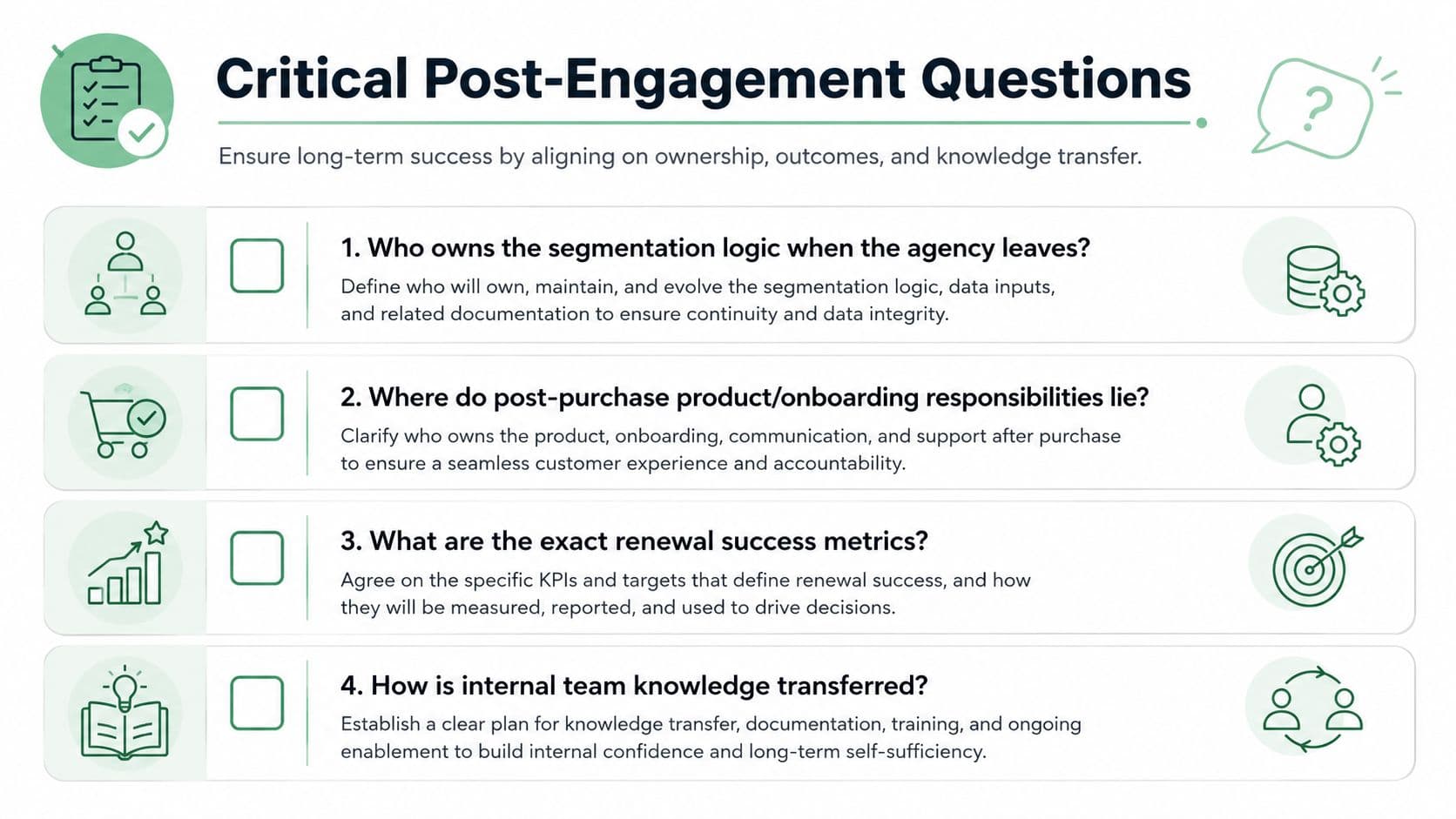
Ask who owns the segmentation logic when the agency leaves. The answer should include audience definitions, event dependencies, exclusions, documentation, access, and training. If the logic lives only in an agency employee's account or institutional memory, you've rented a system you can't operate.
Clarify the post-purchase boundary
Post-purchase retention isn't only messaging. Delivery, setup, product usability, support, billing, and customer success can all influence whether a customer returns or renews. The agency should identify which problems it can address through communication and which require changes to product, operations, or service design.
Ask these questions directly:
- Who owns the customer state: Which team decides whether a customer is activated, at risk, dormant, or ready for expansion?
- Where does messaging stop: Which post-purchase failures require product, operations, or customer support action?
- Who instruments experiments: Will the agency create event requirements and holdouts, or only execute a playbook someone else designed?
- What happens to the work: Who owns templates, automations, audience logic, test history, dashboards, and documentation after termination?
- What does renewal mean: Is success defined by retained revenue, activated users, repeat purchase, renewal, or another verifiable lifecycle outcome?
Compensation reveals incentives. An agency paid only for campaign volume has a reason to increase activity. An agency accountable for verified lifecycle metrics has a reason to improve targeting, timing, measurement, and customer experience.
The strongest contract makes ownership visible before the first campaign launches.
Reporting rhythm is the final test. Ask whether the agency runs a weekly operating review, what decisions happen there, and which report serves as the source of truth. Agencies that ship real retention work usually have a default answer because the cadence is part of delivery, not an optional meeting.
Running a 30 to 60 Day Evaluation
Use a short evaluation to test how the agency thinks before committing to a long engagement. The evaluation shouldn't ask the partner to solve your entire retention problem. It should reveal whether the team can diagnose, instrument, ship, and learn.
Weeks one and two for scope
Start with access and evidence. Provide the agency with relevant CRM, analytics, product, billing, campaign, and customer-support context under controlled permissions. Ask for:
- A written audit: Identify lifecycle leaks, tracking gaps, audience problems, and ownership conflicts.
- A lifecycle map: Define stages, entry criteria, exit criteria, triggers, and suppression rules.
- A data assessment: Document missing events, identity issues, unreliable fields, and reporting limitations.
- Reference conversations: Speak with founders or marketing leaders operating at a similar stage and business model.
- An access log: Record who has access to which systems and why.
The agency should return a prioritized diagnostic, not a long list of disconnected tactics. You need to see whether it can identify the constraint that matters most.
Weeks three and four for a paid diagnostic
Choose one lifecycle problem for a paid pilot. It might be activation, post-purchase education, second-order timing, renewal risk, or reactivation. Require a segmentation recommendation, one working automation, a measurement specification, and a retention dashboard or reporting prototype.
Don't approve a campaign that can't be measured against a defined cohort. Ask how the agency will handle exclusions, holdouts, missing events, customer-service escalation, and message fatigue.
Weeks five through eight for execution
Run the selected campaign through a controlled implementation. Review the working automation, audience population, QA record, campaign influence, and early leading indicators. End the pilot with a30, 60, and 90-day proposal that separates confirmed evidence from assumptions.
Hire if the agency ties compensation and accountability to lifecycle metrics you can verify, documents the system it builds, and ships one relevant campaign before you sign a longer agreement. Pass if the proposal lists only channel outputs or demands a long commitment without pilot evidence.
Crescade operates as an AI-assisted Growth Operations partner connecting acquisition, conversion, lifecycle marketing, CRM integration, analytics, automation, and AI workflows. VisitCrescade to request a 20-minute audit of your retention measurement, ownership boundaries, and highest-priority lifecycle constraint.