SaaS Growth Strategy That Compounds Acquisition to Revenue

You're probably looking at a familiar SaaS problem: paid campaigns are generating traffic, the trial funnel is active, and the team wants to increase spend, but revenue isn't compounding at the same rate. The rightSaaS growth strategy doesn't begin with another channel. It identifies the constraint across acquisition, activation, conversion, retention, and expansion, then builds a repeatable operating loop around fixing it. That means connecting paid acquisition, SEO, conversion rate optimization, lifecycle marketing, CRM workflows, analytics, automation, and AI-assisted production to one commercial outcome.
Table of Contents
- What a SaaS Growth Strategy Must Do to Compound
- Why Retention Economics Set Your Growth CeilingWhat the metrics change operationally
Find the Constraint Before You Scale Spend
Build an Experimentation Cadence That Improves the Funnel
Retention Levers and Org Alignment That Make Growth Stick
Put Your SaaS Growth Strategy Into Action
What a SaaS Growth Strategy Must Do to Compound
A SaaS growth strategy should make the next decision better than the last one. If a Google Ads campaign produces clicks but no reliable signal about qualified trials, it hasn't created a durable growth asset. If onboarding increases product activity but the CRM can't connect that activity to upgrades or renewals, the team still can't judge whether the work is improving revenue.
The operating model matters more than the channel list. Paid search can capture existing demand, SEO can build durable discovery, content can educate buyers, lifecycle campaigns can recover dormant users, and sales can convert complex accounts. These activities compound only when they share definitions, handoffs, and measurement.
A useful model is the Crescade Loop:
- Signal: Find the evidence of friction, demand, intent, or expansion.
- Build: Create the landing page, campaign, onboarding flow, CRM rule, or reporting path that addresses it.
- Launch: Put the change in front of the right audience with a clear owner.
- Learn: Evaluate downstream behavior, not just immediate engagement.
- Compound: Turn the learning into a better process, asset, audience definition, or prioritization rule.
That loop prevents a common failure mode. Teams treat acquisition, product activation, customer success, and marketing operations as separate budgets, then wonder why each function reports activity while the company struggles to improve revenue quality. A full-funnel system gives every team a shared question:where is growth being restricted right now?
Practical rule: Don't scale the channel that produces the most visible activity. Scale the part of the system that has already demonstrated a path from intent to retained revenue.
The choice isn't always acquisition versus retention. Early-stage teams may need enough demand to validate positioning, while established teams often have more influence over activation, expansion, or churn control. The decision depends on the stage where qualified users stop progressing.
For a practical view of channel selection, funnel stages, and the operating rhythm behind a repeatable acquisition program, see Crescade'sSaaS acquisition strategy framework. Teams also benefit from studying adjacent approaches, such asLead Printer's guidance on localization for SaaS lead generation, especially when message-market fit differs across regions or buyer segments.
Why Retention Economics Set Your Growth Ceiling
New-logo acquisition creates a starting point. Retention determines how much of that starting point remains available to grow.
Net revenue retention, or NRR, measures the revenue retained from an existing customer cohort after churn, downgrades, and expansion. When NRR exceeds 100%, the cohort can grow without adding new customers.Gross revenue retention, or GRR, excludes expansion and focuses on how well the core revenue base survives. That distinction matters because a company can show healthy expansion while still losing too much of its original revenue.
A 2025 benchmark fromSaaS Capital's retention benchmarks reported amedian NRR of 101% across SaaS companies andmedian gross retention of 91%. Earlier industry benchmarks from 2023 foundmedian NRR at 102% andmedian GRR at 91%, using the same source's benchmark context.
The practical reading is more important than the comparison between benchmark years. A median NRR just above 100% means expansion can offset churn for a typical company, but it doesn't make weak retention harmless. SaaS Capital also noted that growth rate is positively and exponentially correlated with NRR, while GRR of at least90% is effectively table stakes for performance parity, as reported in the same benchmark source.
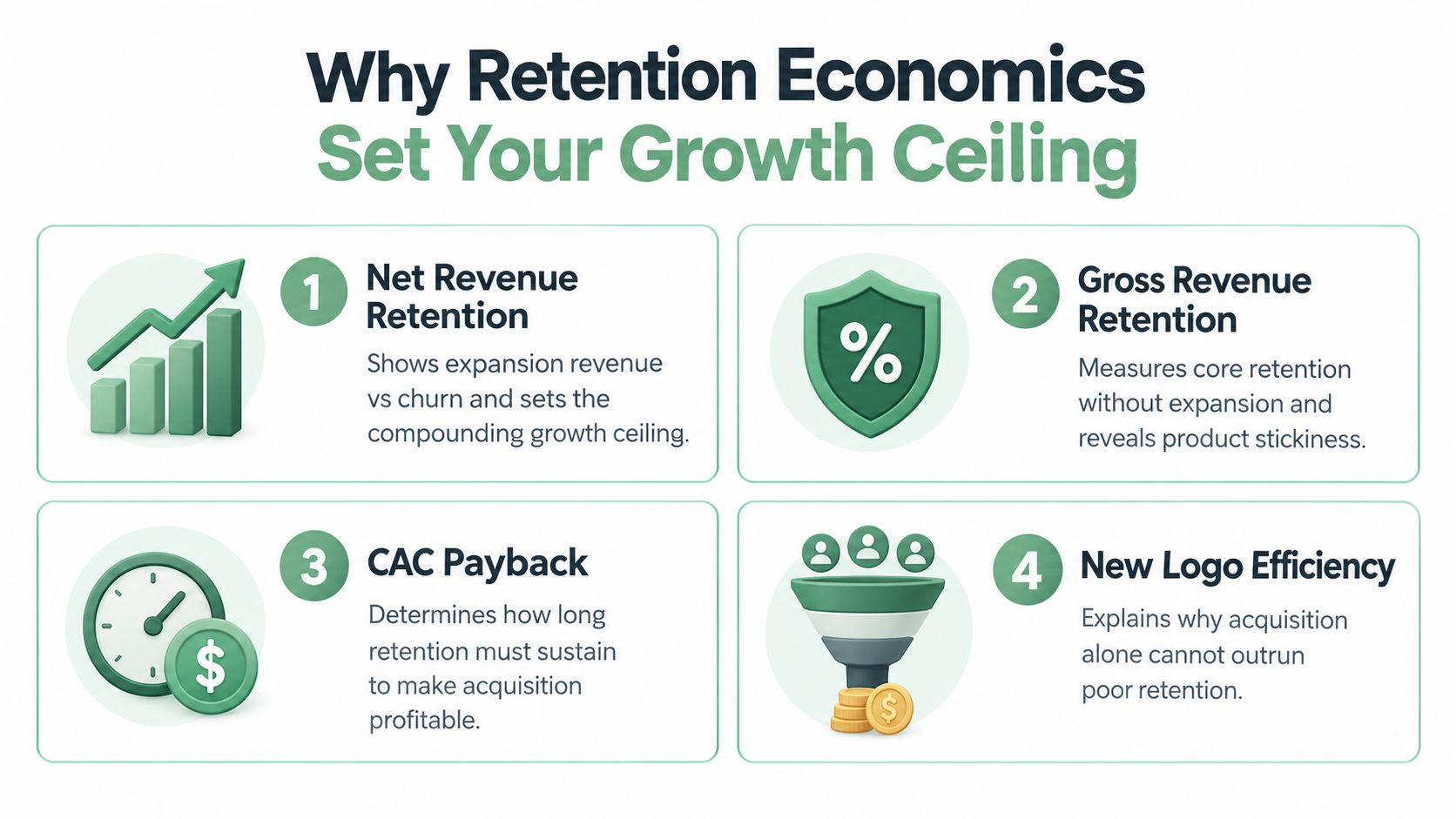
What the metrics change operationally
These metrics should change prioritization, not just populate an executive dashboard.
- Low GRR: Investigate product value, implementation quality, support gaps, pricing pressure, and customer fit. Expansion can hide the underlying weakness, but it can't repair a leaky core indefinitely.
- Healthy GRR with modest NRR: The product retains customers, but expansion paths may be unclear. Review packaging, usage thresholds, seat growth, add-ons, and sales-assist triggers.
- Healthy NRR with weak acquisition efficiency: Retention may support more acquisition investment, but the team still needs to control payback and qualification before increasing spend.
- Weak retention and weak acquisition efficiency: Fix the customer journey before trying to create more volume. More leads will create more customers who struggle to reach value.
Customer lifetime value analysis should reflect this relationship rather than treating lifetime value as a standalone output. Crescade's guide tocustomer lifetime value calculation can help teams connect retention, revenue, and acquisition assumptions in one model.
The ceiling is set by the interaction between acquisition economics and cohort durability. A campaign can look efficient at signup while producing poor economics after activation and renewal. Conversely, a modest acquisition channel can become strategically valuable when it brings customers who adopt quickly, renew reliably, and expand.
Find the Constraint Before You Scale Spend
The fastest way to waste a budget is to scale before identifying where qualified users stop moving. Start with one path:
Visitor → trial signup → activated user → paid account → retained account → expanded account
The exact activation event depends on the product. It might involve connecting a data source, inviting a teammate, publishing a workflow, completing a project, or reaching another behavior that demonstrates real value. Don't define activation as a page view or login unless that action strongly predicts continued use.
Use three control variables for the first pass.Independent SaaS funnel benchmarks place typical performance around2% to 5% visitor-to-trial,10% to 25% free-trial-to-paid, and a strong CAC payback target atunder 12 months. Median CAC payback is often reported closer to15 to 18 months, which indicates that many teams need to improve activation and conversion before adding acquisition volume.
A constraint-first triage table
| Funnel Stage | Healthy Benchmark | If Below Benchmark Fix This First |
|---|---|---|
| Visitor to trial | 2% to 5% | Clarify the offer, segment landing pages by use case, and remove signup friction |
| Free trial to paid | 10% to 25% | Improve time to value, onboarding guidance, qualification, and sales assist |
| CAC payback | Under 12 months for strong efficiency | Recheck gross margin, channel quality, pricing, conversion, and retention assumptions |
| Expansion and renewal | No single benchmark applied | Review adoption depth, customer health signals, lifecycle communication, and packaging |
The table is a diagnostic reference, not a mandate to chase an industry average. A complex enterprise product may require a different path from a simple self-serve tool. The point is to compare each stage consistently and investigate the largest commercially meaningful gap.
What to inspect before increasing budget
First, separate traffic quality from page performance. If visitors don't match the ideal customer profile, a better landing page won't solve the problem. If the audience is qualified but signup intent is weak, test positioning, proof, calls to action, form length, and the promise made in the ad.
Next, inspect the trial experience. Review the first session, setup requirements, empty states, product prompts, help content, and the handoff to sales or customer success. Activation within the first week is a major predictor of paid conversion, according to the benchmark guidance linked above, so measure the behavior that precedes payment rather than treating every trial as equivalent.
Finally, calculate payback using gross margin. A CAC model that uses revenue without accounting for delivery costs can make an expensive channel look acceptable. Lead volume alone is also a weak decision metric because it ignores qualification, activation, conversion, and downstream retention.
The constraint is the stage where additional effort elsewhere produces the least useful revenue.
Build an Experimentation Cadence That Improves the Funnel
A growth team needs a cadence that turns observations into controlled changes. Without one, teams test whatever idea is easiest to launch, celebrate surface-level movement, and lose the reasoning behind the result.
A practical weekly rhythm has four parts:
- Hypothesize: State the observed problem, the proposed change, the audience, and the metric expected to move.
- Prioritize and assign: Rank the work by likely commercial impact, confidence in the diagnosis, and execution cost. Give one person decision ownership.
- Run the sprint: Launch the smallest credible version across acquisition, activation, conversion, or lifecycle.
- Measure and iterate: Record the result, limits of the test, and the decision it supports.
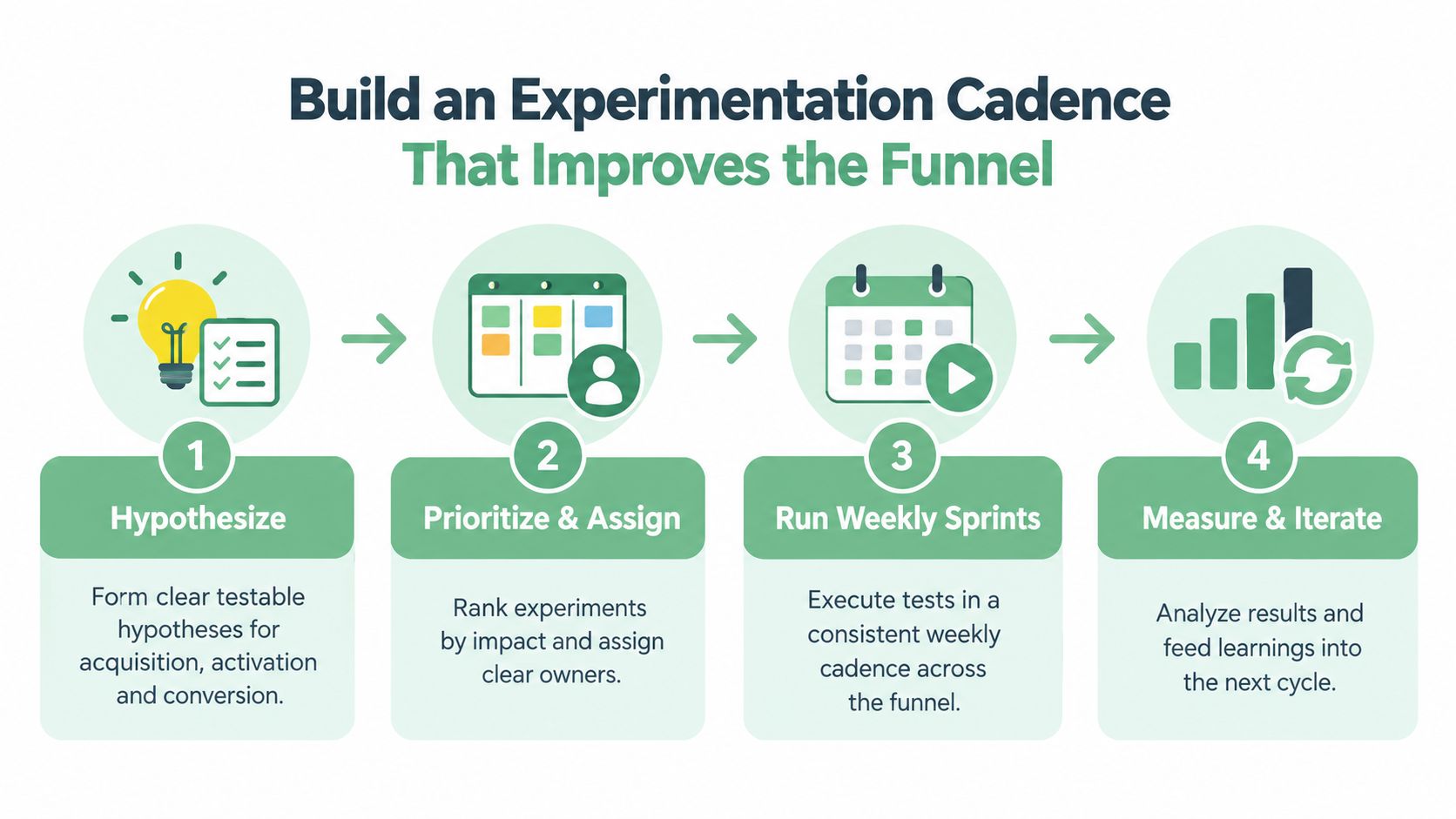
Sequence tests by leverage
Start with the highest constraint from the funnel review. If qualified visitors aren't starting trials, changing an in-app tooltip isn't the first move. If trial users start but don't activate, producing more top-of-funnel content may increase the number of stalled users rather than improve revenue.
A useful experiment brief includes:
- Observed signal: The behavior or segment that needs attention.
- Hypothesis: The reason users may be stopping.
- Change: The page, message, flow, audience, or automation being modified.
- Primary metric: The downstream action that defines success.
- Guardrail: A quality or retention measure that prevents a false win.
- Owner and decision date: The person responsible for shipping and interpreting the result.
GA4 should reflect lifecycle milestones rather than stop at sessions and lead forms.SaaS measurement guidance for GA4 recommends tying conversion events totrial signup, activation, upgrades, and renewals, so marketing activity can be connected to revenue.
For lead capture, the form itself is only one part of the system. The routing, enrichment, consent handling, CRM status, and follow-up logic determine whether the submission becomes useful revenue data. Teams evaluating their stack can review practicallead capture form integrations when connecting forms to downstream workflows.
Set paid search expectations before judging performance
For B2B SaaS Google Ads, a recent benchmark set reported non-brand search performance around$13.75 CPC,3.60% CTR, and a3.94% conversion rate, producing approximately$207 per lead, according toPiperocket's Google Ads benchmarks.
Those figures are a planning reference, not a target that overrides your economics. The right comparison is qualified pipeline and retained revenue. A campaign with a higher cost per lead may be more valuable if it reaches the right buying committee and produces stronger activation. A cheaper campaign can still destroy payback if it attracts users who never reach value.
Use the weekly meeting to make decisions, not to read dashboards aloud. Keep, revise, pause, or replace each experiment. Store the learning in a shared system so the next campaign, landing page, or onboarding change starts with evidence instead of memory.
For teams that need a structured approach to page friction, messaging, and test prioritization, Crescade'sconversion rate optimization guidance provides a useful reference point.
Retention Levers and Org Alignment That Make Growth Stick
Retention rarely comes from one campaign. It comes from the combined effect of product value, customer communication, commercial design, and internal accountability.
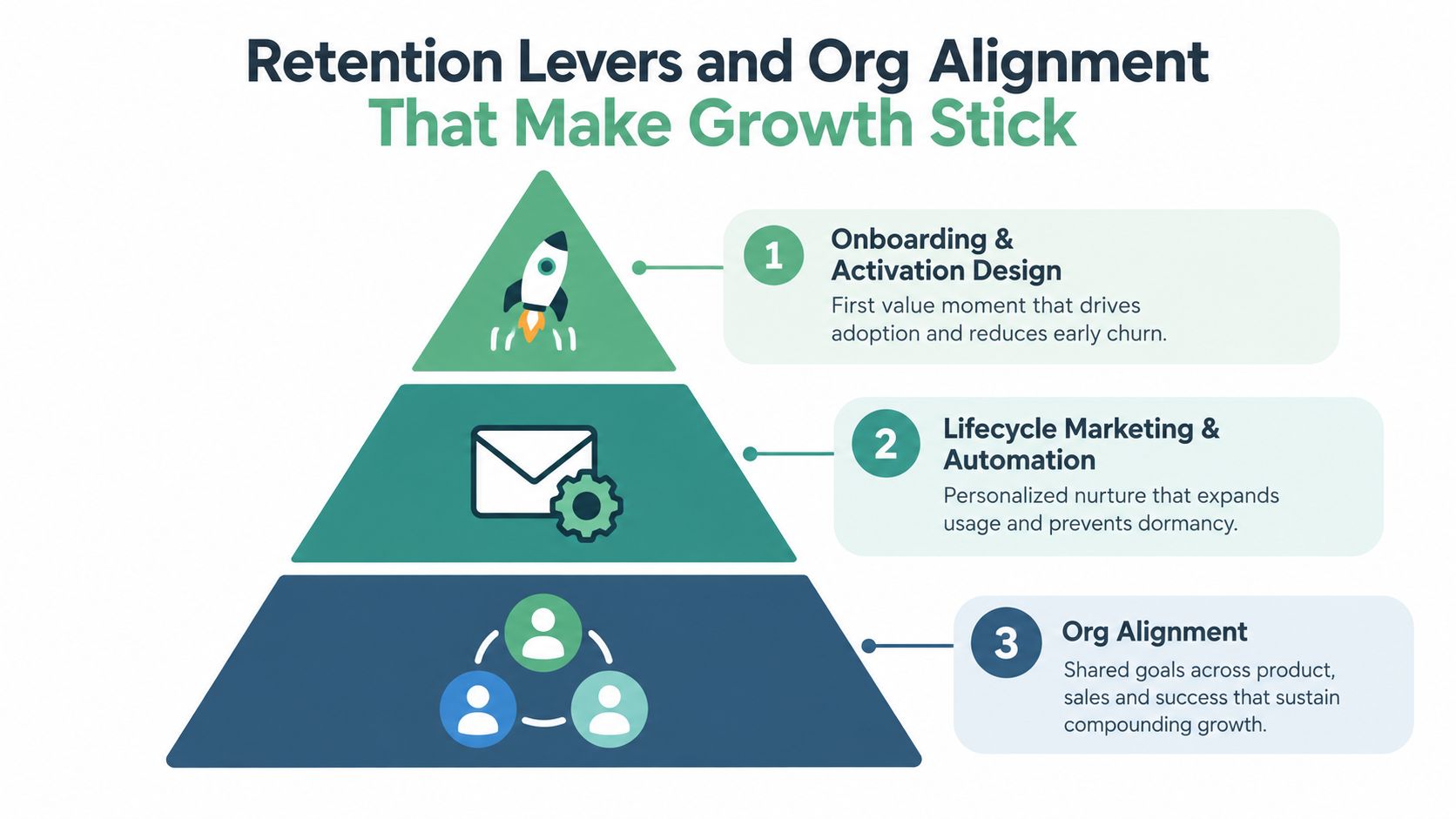
Choose the lever that matches the failure
Onboarding and activation deserve priority when new accounts sign up but fail to reach the first meaningful value moment. Reduce setup ambiguity, guide users toward the critical workflow, tailor paths by persona, and expose progress clearly. More email won't compensate for a product experience that leaves users unsure what to do.
Lifecycle marketing and automation become more useful when users understand the product but usage becomes inconsistent. Trigger education, reminders, feature discovery, and re-engagement from behavior, not from a generic calendar. A user who hasn't completed setup needs a different message from an active account approaching a plan limit.
Customer success and expansion plays matter when customers retain but don't broaden their usage. Define health signals, establish handoff rules, and give sales or success teams context about adoption. Expansion should follow demonstrated value, not arrive as an untargeted promotion.
Pricing and packaging deserve attention when customers receive value but the commercial structure doesn't reflect differences in usage, team size, or needs. Packaging can create a clearer expansion path, but changing prices before understanding churn reasons can make the underlying problem harder to diagnose.
Make the operating model shared
Marketing owns demand, but marketing alone can't explain why accounts fail after signup. Product owns activation mechanics, sales owns qualification and commercial progression, customer success owns adoption and renewal support, and RevOps connects the definitions and records.
Create shared lifecycle stages in the CRM. Pass source, campaign, use case, qualification, activation, opportunity, upgrade, and renewal signals through the same account record. GA4's lifecycle events should match the language used by product and revenue teams, sinceGA4 SaaS measurement practices are most useful when events connect user behavior to commercial milestones.
A weekly growth review should answer three questions:
- Which stage is restricting revenue movement?
- Which experiment or workflow is responsible for addressing it?
- What evidence changes the next decision?
When teams share those answers, channel owners stop optimizing isolated dashboards. They can evaluate whether an acquisition source produces customers who activate, renew, and expand.
Put Your SaaS Growth Strategy Into Action
A workable plan doesn't require rebuilding the entire marketing stack at once. It requires choosing one constraint, assigning ownership, and creating a measurement path that can survive the next campaign.
Use this30-day operating checklist:
- Map the journey: Document the path from visitor to trial, activation, paid conversion, renewal, and expansion.
- Define activation: Choose the product behavior that demonstrates meaningful value for each important segment.
- Audit the data path: Confirm that GA4, Google Tag Manager, ad platforms, and the CRM use compatible lifecycle definitions.
- Rank constraints: Compare acquisition quality, signup conversion, activation, paid conversion, payback, and retention.
- Build the backlog: Write experiment briefs with hypotheses, owners, primary metrics, guardrails, and decision dates.
- Review weekly: Keep a record of what shipped, what changed, and what the result means for the next decision.
Keep execution in-house when the team has clear ownership, reliable data, and enough capacity to maintain the cadence. Bring in an accountable partner when paid acquisition, conversion, lifecycle, analytics, CRM workflows, and automation are managed by separate owners with no shared operating rhythm.
For a broader perspective on sequencing infrastructure, process, and growth capacity, Sensoriium'soperational scaling roadmap for SaaS offers useful planning context. The right roadmap should still begin with your own constraint, not with a predetermined channel package.
Crescade fits when the business needs a managed connection between strategy, acquisition, conversion, lifecycle marketing, analytics, automation, and AI-assisted production. Its role is to help identify the limiting constraint, build the measurement and execution path, and maintain the Signal, Build, Launch, Learn, and Compound rhythm with human approval for strategy, budgets, and creative.
If your team can't agree on the funnel constraint or can't trace a campaign from first touch to activation and renewal,visit Crescade and request a20-minute audit. Crescade will help you identify what to fix first, which lifecycle signals to connect, and which experiment should enter the next growth sprint.