- b2b loyalty program
- customer retention
- lifecycle marketing
- revenue growth
- crm integration
B2B Loyalty Program Design That Drives Revenue
By Crescade · · 16 min read
Build a B2B loyalty program that improves retention, expansion revenue, and referrals. Covers incentives, tiering, CRM integration, and ROI measurement.
The popular advice is to maximize enrollment in aB2B loyalty program. That's usually the wrong starting point. Enrollment and point redemption can make a quarterly dashboard look active while telling you almost nothing about retention, expansion, referrals, or profit. A stronger program begins with a behavior hypothesis, rewards actions that improve account economics, and compares enrolled accounts with a matched non-enrolled baseline over a long enough period to detect real change.
Table of Contents
Designing Incentives Around High-Value Behaviors
Structuring Tiers That Actually Motivate Accounts
Building a Cohort-Based ROI Framework
Integrating Loyalty Into CRM and Lifecycle Marketing
Deciding Whether to Launch or Iterate Your Program
Why Most B2B Loyalty Programs Fail at Measurement
A busy loyalty dashboard can hide a weak commercial result. Enrollment, points earned, and reward redemption show that accounts interacted with the program. None of those measures proves that participation improved retention, expansion, referrals, or profit.
The useful question is behavioral:What did enrolled accounts do differently, and did that difference improve the account relationship? For a SaaS company, examine product adoption, stakeholder participation, renewal behavior, and expansion revenue. For a professional services firm, examine repeat engagements, referrals, and earlier renewal conversations.
Multi-touch attribution helps teams assess how several interactions contribute to a conversion. Loyalty measurement needs another layer of control. Isolate the program's effect from account size, sales coverage, product fit, and engagement that existed before enrollment.
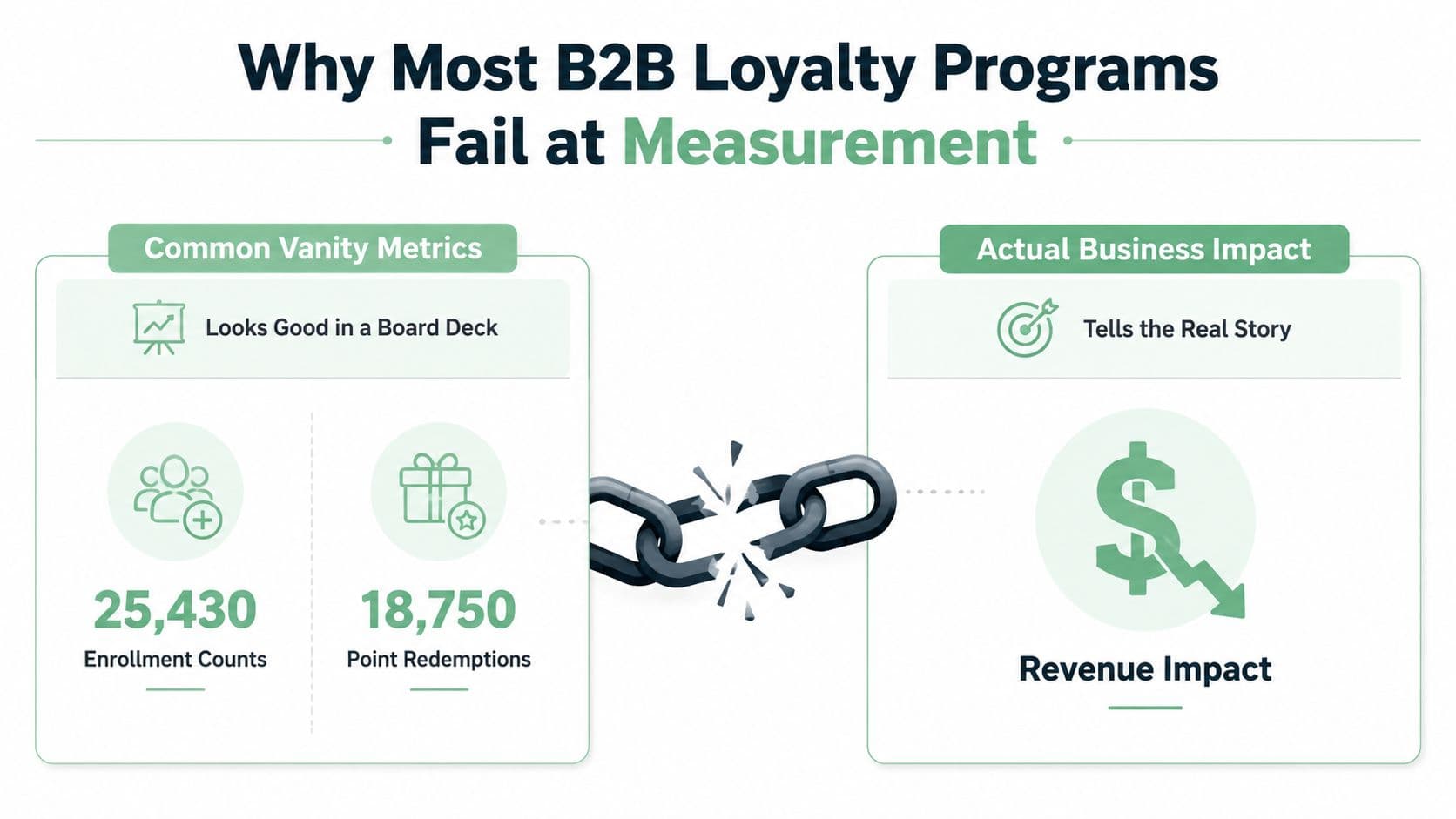
Replace activity metrics with economic outcomes
Set the baseline before launch:
- Retention: renewal rate, churn behavior, and account tenure.
- Expansion: expansion revenue, cross-sell activity, and expansion MRR.
- Advocacy: referral conversion and qualified introductions.
- Service effort: support volume and customer success effort required to maintain the relationship.
Compare enrolled and non-enrolled cohorts over6–9 months, the practical observation window described inOpen Loyalty's B2B loyalty benchmark. The benchmark notes that many B2B loyalty programs show measurable ROI within that window and that39% of programs use revenue, ROI, or profit as their primary success metric.
Practical rule: If the dashboard cannot connect participation to incremental revenue per enrolled account, it measures engagement, not ROI.
A matched baseline does not need to be perfect to be useful. Match accounts on contract value, industry, lifecycle stage, product usage, purchase frequency, and historical support needs. Review performance before enrollment, then compare the change after enrollment.
The core measure is incremental revenue per enrolled account versus the matched non-enrolled baseline. If participation rises without better retention, expansion, or referral performance, the program is creating operational work without proving commercial value.
Designing Incentives Around High-Value Behaviors
A B2B loyalty program should reward behaviors that improve the relationship, not every action that can be counted. Points for logging in or opening an email may create activity, but they rarely justify a reward unless those actions lead to stronger adoption or commercial outcomes.
Start with the customer journey. Identify where accounts become more likely to retain, expand, or advocate, then select a small set of behaviors that the program can influence. The right behaviors differ by business, but common examples include onboarding completion, adoption of underused modules, executive business reviews, repeat purchases, training, referrals, and deal registration. B2B programs commonly rewardpurchase volume, training completion, referrals, and deal registration, with rewards issued after a defined milestone rather than as an upfront discount, as described byCalusa Marketing's overview of B2B loyalty programs.
Make the reward fit the account's economics
A reward should feel valuable to the recipient and rational to the supplier. A gift card may be easy to distribute, but a co-marketing budget or dedicated implementation session can create more business value for both sides. The reward should also arrive close enough to the behavior that the account understands the connection.
| Target Behavior | Revenue Impact | Incentive Type | Example Reward |
|---|---|---|---|
| Complete onboarding milestones | Faster time to value and stronger adoption | Enablement benefit | Guided implementation workshop |
| Adopt an underused product module | Creates a path to broader account value | Access or education | Advanced training or roadmap session |
| Attend an executive business review | Builds multi-stakeholder alignment | Relationship benefit | Executive planning session |
| Provide a qualified referral | Adds potential pipeline from a trusted source | Advocacy reward | Co-marketing support |
| Increase product mix or repeat purchases | Supports expansion and share of wallet | Commercial benefit | Volume-based pricing lock |
Avoid incentives that train the wrong behavior
A discount tied only to volume can encourage unprofitable purchases, deal timing manipulation, or concentration in low-margin products. A points system that rewards every small interaction can overwhelm customer success teams with fulfillment work while producing little change in account economics.
Use a behavior map before choosing the reward:
- Name the behavior. Write the action in observable terms.
- Connect it to an outcome. Explain why the action should influence retention, expansion, or referrals.
- Set a milestone. Issue the benefit after the account completes a meaningful step.
- Audit the cost. Compare reward cost with incremental revenue per participant.
- Remove weak mechanics. If an action generates activity but not commercial movement, stop rewarding it.
Behavioral economics also matters. Accounts often respond more strongly when they feel they're protecting an earned benefit than when they're collecting an abstract balance. A benefit that can lapse, such as access to priority planning or a pricing lock tied to continued activity, can create useful urgency. It must be communicated transparently, though. A surprise demotion damages trust faster than a simple flat program ever would.
Structuring Tiers That Actually Motivate Accounts
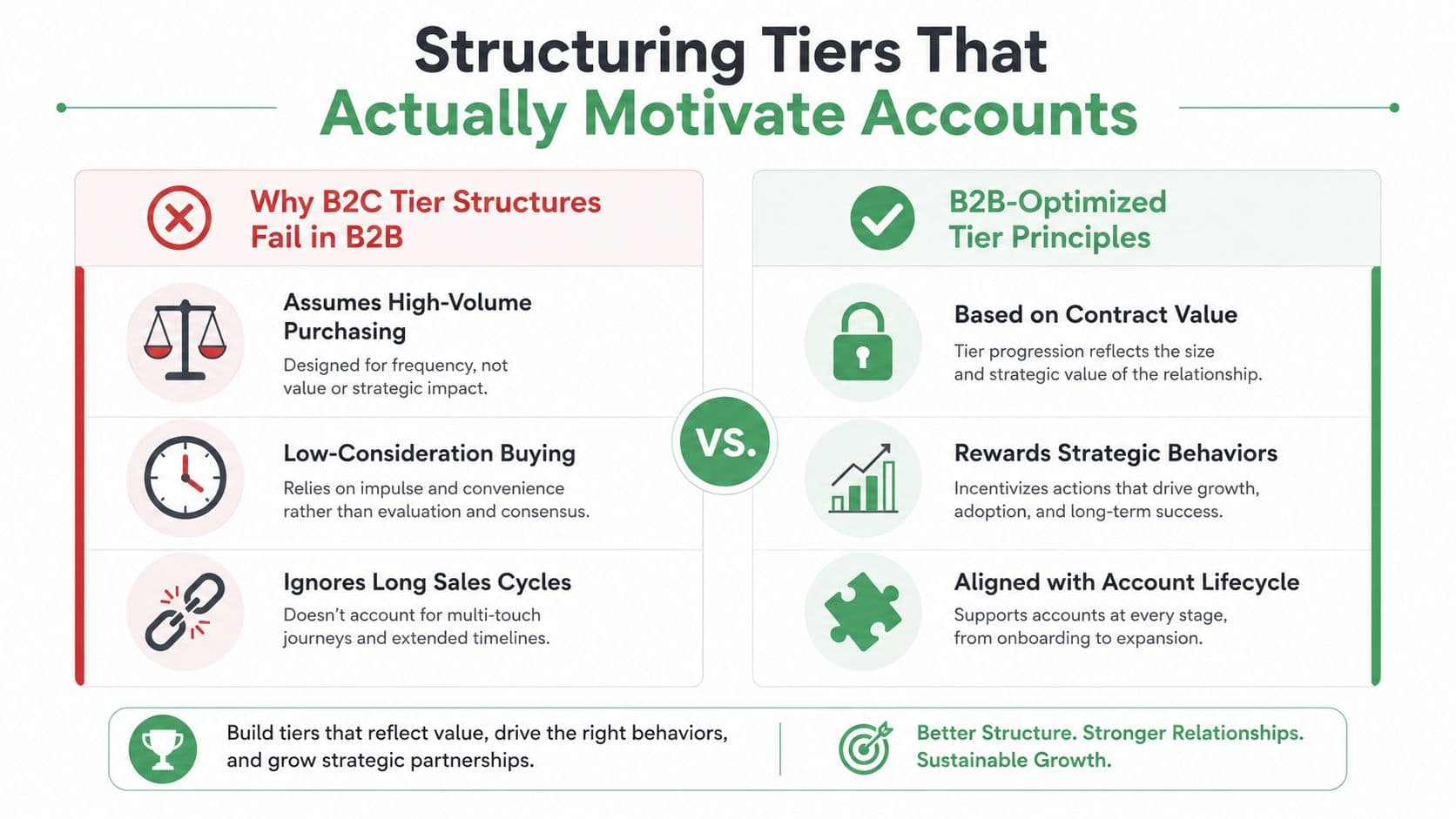
Tiering works when status reflects a meaningful business relationship. It fails when a B2B company copies a consumer model built for frequent, low-consideration purchases and applies it to enterprise accounts with long buying cycles, multiple stakeholders, and uneven transaction volume.
A tier should answer a practical question for the account:What valuable capability do we gain by progressing, and what behavior gets us there? If the answer is unclear, tiers add labels without motivation.
Three structures and their trade-offs
Spend-based tiers are easy to explain and align naturally with volume or contract value. They can also over-reward accounts that spend heavily but remain at risk because adoption, satisfaction, or stakeholder coverage is weak.
Engagement-based tiers recognize behaviors such as training, product adoption, advisory participation, and referrals. They're more strategic, but they require reliable event tracking and careful validation that engagement correlates with commercial outcomes.
Outcome-based tiers use renewal, expansion, product mix, or account development milestones. These tiers have the strongest economic logic, but they're harder to administer because sales, finance, and customer success data must agree on what counts.
For a program with fewer than500 enrolled accounts, a simple structure is usually more defensible than a complex ladder. Use a flat benefit or a small number of tiers, then measure whether the distinctions change behavior. Adding a third tier becomes justified only when the data shows a meaningful difference between account segments and the operational team can support different benefits without manual confusion.
A practical tier decision matrix
| Situation | Better Structure | Why |
|---|---|---|
| Similar account economics and one dominant behavior | Flat program | Less friction and simpler reporting |
| Clear contract-value differences | Spend-based tiers | Benefits can match commercial value |
| Product adoption is the main growth constraint | Engagement-based tiers | Rewards actions that improve stickiness |
| Expansion and renewal data are reliable | Outcome-based tiers | Connects status to business results |
| Tier demotion creates relationship risk | Stable status with annual review | Protects trust while preserving accountability |
Demotion deserves particular care. An account may interpret a downgrade as a signal that the supplier no longer values the relationship, especially when several contacts experience the program differently. A safer design can preserve earned recognition while changing future eligibility, rather than removing benefits abruptly.
Building a Cohort-Based ROI Framework
A loyalty program can show strong enrollment and still produce no incremental revenue. The defensible test compares participating accounts with similar accounts that were not enrolled, using behavior measured before launch. Without that baseline, self-selection can make existing loyalty look like program impact.
Build the baseline before inviting accounts
Choose one primary commercial outcome first. For retention, define the renewal or churn event and the period in which it should appear. For expansion, specify which revenue qualifies and when the account can reasonably be credited for it. This decision prevents teams from switching metrics after early engagement looks encouraging.
Match cohorts with the firmographic and behavioral information already available:
- Account size and contract value
- Industry and customer segment
- Tenure and renewal timing
- Product usage and purchase history
- Existing expansion activity
- Referral or advocacy history
- Support effort and account management coverage
Record each account's pre-enrollment behavior, then compare the change in the enrolled group with the change in the matched group. A practical calculation is:
Incremental lift = outcome change for enrolled accounts minus outcome change for matched non-enrolled accounts
For revenue, report incremental revenue per enrolled account rather than total program revenue. Total revenue can rise because larger accounts joined. Per-account analysis exposes reward cost, operating cost, and whether the economics hold across segments.
The test is not whether participants are valuable. The test is whether participation made them more valuable than they would have been without the program.
Behavioral economics matters here because participation is rarely random. Accounts with stronger motivation, better internal champions, or a near-term renewal may enroll sooner. Matching cannot remove every source of bias, so document why accounts were paired and which differences remain.
Use an observation window that fits the buying cycle
Early engagement is an input, not proof of success. B2B purchasing and renewal decisions take time, so the observation window must extend far enough to capture the outcome the program is meant to change. For many retention and expansion tests, operators use6–9 months as a practical comparison period, while adjusting for the account's buying cycle.
| Metric | Measurement Method | Minimum Observation Window | Success Threshold |
|---|---|---|---|
| Retention | Compare renewal or churn outcomes by matched cohort | 6–9 months | Positive delta versus baseline |
| Expansion revenue | Track new expansion revenue per enrolled account | 6–9 months | Incremental revenue exceeds reward cost |
| Referral conversion | Measure qualified referrals through closed revenue | Through the relevant sales cycle | More attributable referral revenue |
| Support effort | Compare service effort for similar accounts | 6–9 months | Lower effort without weaker outcomes |
| Program economics | Incremental revenue minus reward and operating cost | After sufficient outcome data | Positive contribution after costs |
B2B samples can be small, especially in high-value segments. Avoid manufacturing statistical certainty where the data cannot support it. Record the matching logic, pre-launch differences, available confidence intervals, and test limitations. A directional result can still guide iteration, provided the team labels it as directional.
Teams measuring outbound efficiency can apply the same unit-economic discipline to loyalty. The Pipecorn guide toSales Navigator cost efficiency offers a useful reference for separating attributable activity from output volume. For retention teams,ecommerce retention strategy provides a related measurement lens. The channel differs, but the operating rule is the same: track changed behavior, connect it to revenue, and keep the matched baseline visible.
Integrating Loyalty Into CRM and Lifecycle Marketing
A loyalty program that lives in a separate dashboard becomes an operational dead end. Sales can't see eligibility, customer success can't act on unfinished milestones, and marketing keeps sending generic lifecycle messages because program data never reaches the customer profile.
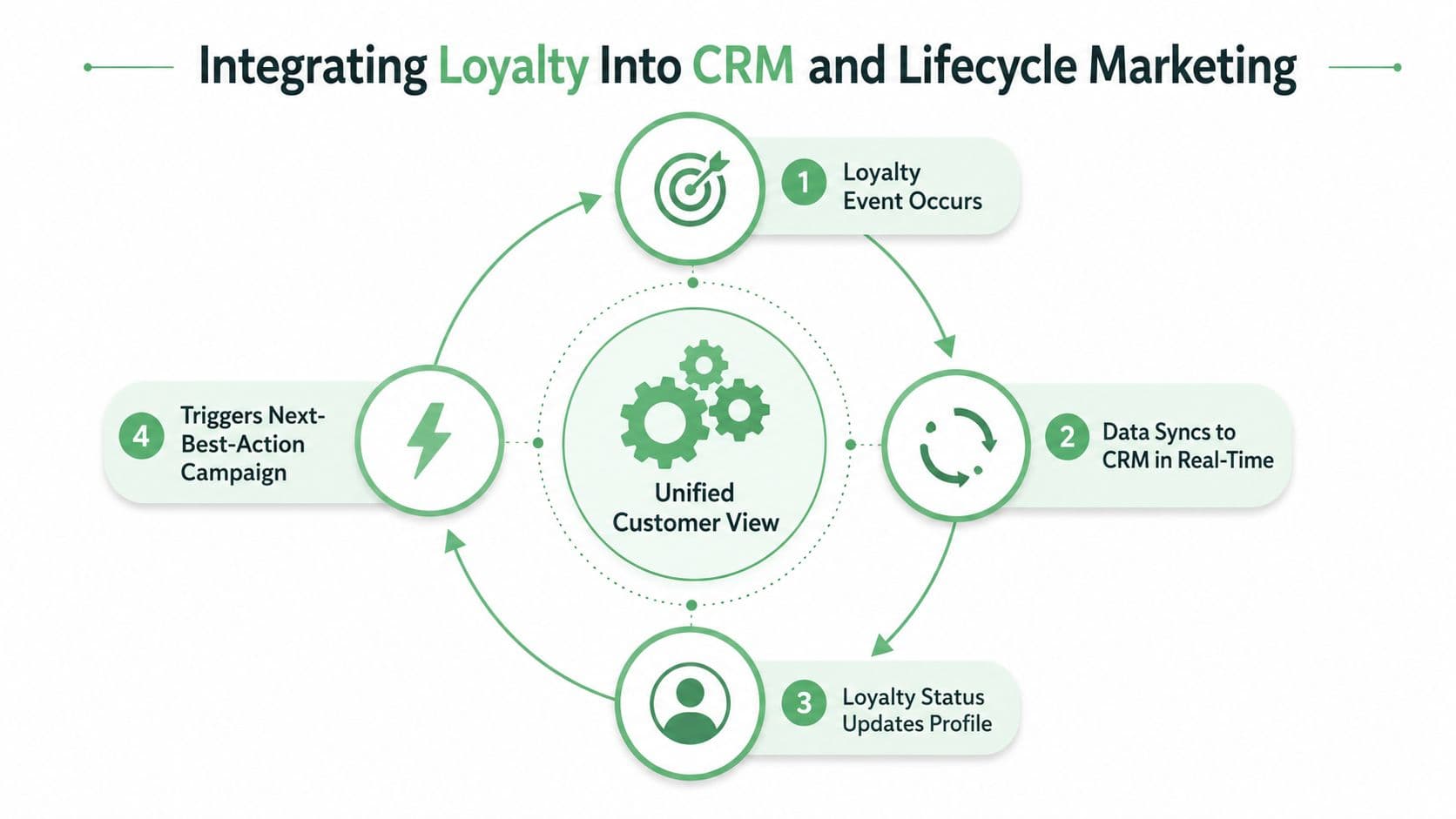
The integration should treat loyalty events as first-class CRM signals. A completed training session, a newly qualified referral, an approaching reward threshold, or an unredeemed benefit should update the account record and trigger an appropriate next action.
Create a shared account record
In Salesforce, HubSpot, or another CRM, define fields or custom objects for the account's loyalty status, qualifying behaviors, reward eligibility, balance, last activity, and next milestone. Store the account as the primary commercial entity, then associate individual contacts with their roles and actions. B2B loyalty spans users, champions, executives, procurement teams, and partner contacts.
Your CRM should answer four questions without requiring a manual lookup:
- What has the account done?
- What benefit has it earned?
- What behavior should happen next?
- What revenue outcome is connected to the program?
The integration should work in both directions. Loyalty events should update CRM fields, while account status, product ownership, renewal timing, and sales outcomes should flow back into the loyalty system. Use stable account identifiers, event timestamps, source fields, and an audit trail for every balance adjustment.
A short process flow is useful for implementation:
- Loyalty event occurs.
- The event syncs to the CRM.
- The account profile updates.
- Lifecycle automation selects the next action.
For teams exploring AI-assisted workflows, anautonomous sales agent can be evaluated as a way to support follow-up on qualified signals. It shouldn't replace account judgment. A reward threshold may warrant a helpful outreach task, not an automatic sales pitch.
The lifecycle layer is where the program becomes useful. An onboarding sequence can explain how to earn the first benefit. An expansion campaign can surface a relevant module when adoption creates eligibility. A win-back flow can remind an account about earned benefits that remain unused.
CRM marketing integration provides the broader operating context for connecting these signals across teams.
Use strict governance. Define who can issue adjustments, how duplicate events are handled, when balances expire, and how finance reconciles rewards. Executive dashboards should show loyalty participation beside retention, pipeline, expansion, and closed revenue, not in a disconnected activity report.
A short walkthrough can help stakeholders visualize the operating model:
Deciding Whether to Launch or Iterate Your Program
Not every company needs a loyalty program. If you can't identify a behavior worth changing, can't match participating accounts with a credible baseline, or can't fulfill rewards consistently, adding a program will create complexity before it creates insight.
The first decision is whether loyalty is the right intervention. A business with weak onboarding, inconsistent support, poor product fit, or unclear renewal ownership may need to fix those fundamentals first. Rewards can reinforce a good customer experience, but they can't compensate for one that customers already distrust.
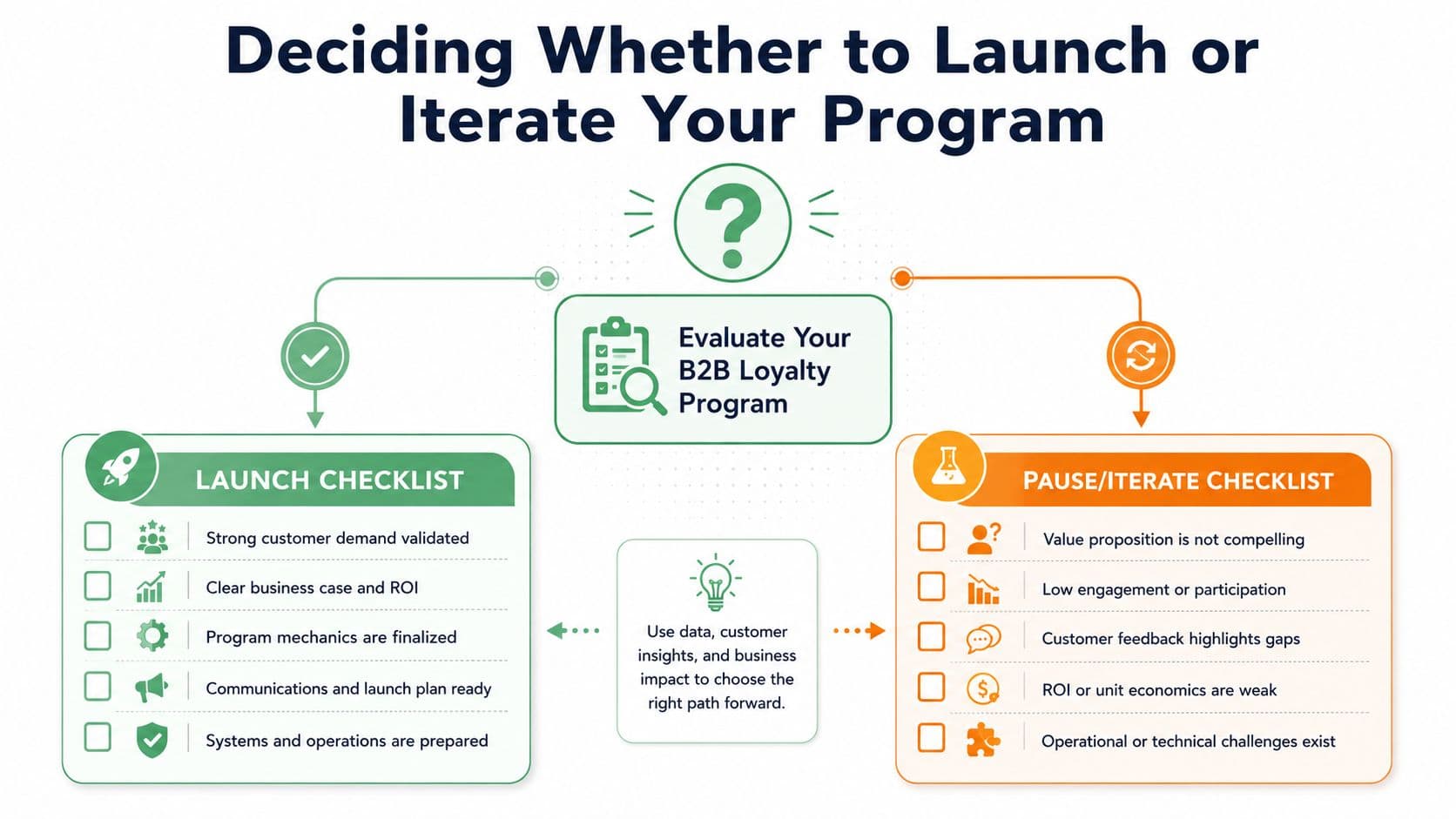
Use a launch, iterate, or pause test
Launch with a pilot cohort when you have a clear high-value behavior, enough comparable accounts for a useful baseline, reliable CRM data, and an owner for fulfillment. Keep the first version narrow. Test one primary business outcome and avoid adding mechanics that you can't explain to an account executive or customer success manager.
Iterate in place when participation is healthy but the program's commercial effect is unclear. Review which behaviors participants complete, whether those behaviors correlate with expansion or retention, and whether reward costs are concentrated in low-value actions. Preserve the cohort design while changing one mechanic at a time.
Pause and redirect when the program produces activity without behavior change, requires extensive manual administration, or attracts accounts that were already unusually loyal. Redirecting resources toward onboarding, product adoption, or renewal operations may produce faster feedback than continuing to refine a poorly aligned reward structure.
A simple readiness review can expose the decision:
- Commercial potential: Can the program influence retention, repeat purchase, expansion, or referrals?
- Behavior clarity: Can the team name the specific actions to reward?
- Measurement quality: Can enrolled accounts be compared with a matched baseline?
- Operational capacity: Can sales, customer success, finance, and marketing manage the workflow?
- Reward relevance: Do the benefits support the account's business objectives?
- Data integrity: Can the CRM and loyalty system reconcile events and balances?
Trade loyalty programs often usequarterly or annual qualifying periods, followed by redemption from a curated catalog on the participant's own timeline, according toBrandfire's trade loyalty program guidance. That delay between earning and redemption is operationally important. Your ROI model should record when the account earns, when it redeems, and when the related commercial outcome occurs.
A sensible next step is a90-day matched cohort test before committing to a full buildout. Define the target behavior, select the enrolled and comparison accounts, establish pre-test baselines, and set the decision rule in advance. Continue only if the test produces evidence of behavior change and a credible path to incremental revenue.
Cresc ade can support teams that need to connect loyalty mechanics with CRM data, lifecycle marketing, analytics, automation, and revenue decisions. VisitCrescade to discuss a focused measurement audit or a managed growth operations engagement, then request a 20-minute audit to identify whether your program should launch, iterate, or pause.