- b2b marketing funnel
- demand generation
- funnel optimization
- lead qualification
- growth operations
B2B Marketing Funnel: Stages, Metrics, and Growth
By Crescade · · 16 min read
Map your B2B marketing funnel with clear stages, conversion metrics, and channel alignment. Learn how to find constraints and compound growth across
Most advice about theB2B marketing funnel starts with a familiar prescription: generate more awareness, capture more leads, and add more nurture emails. That sequence is often backwards. The funnel works better as aconstraint-finding system, where each stage reveals the next problem to solve, from visitor quality and form friction to qualification, follow-up, proof, and internal consensus. The practical question isn't how to maximize lead volume. It's which handoff is limiting qualified pipeline right now, and what evidence will show that the fix worked.
Table of Contents
The Five Core Stages and Where Conversion Actually Breaks
How AI-Assisted Buying Changes Middle-Funnel Conversion
Mapping Channels and Content to Funnel Movements
Metrics That Predict Pipeline Health Versus Vanity KPIs
Finding and Fixing Your Weakest Funnel Handoff
Building a Repeatable Decision System for Funnel Growth
Why Most B2B Funnels Leak Before Sales Ever Sees the Lead
The linear funnel suggests that buyers move neatly from awareness to consideration to decision. B2B buying rarely behaves that way. A buying group researches independently, compares vendors, asks internal questions, and builds agreement before anyone submits a form or accepts a sales call.
Research compiled in a 2026 buyer-journey report found that the point of first contact moved earlier from69% to 61% of the way through the journey, while another benchmark reported that buyers spend only about17% of the total purchase journey in direct contact with suppliers (LinkedIn's 2026 B2B buyer journey research). The exact path varies by market, but the operating implication is consistent: much of the work that creates demand happens before the CRM records a recognizable opportunity.
AI-assisted research compresses the early stages further. A 2026 buyer-behavior report states that94% of business buyers use AI during a purchase (Allied Insight's B2B buyer journey research). Buyers can ask an AI system to summarize categories, compare finalists, identify implementation risks, and surface security or pricing questions before speaking with a vendor. Generic awareness content may still attract attention, but it won't necessarily create preference or consensus.
The hidden constraint is consensus
A lead isn't the same thing as a buying group. One person may download a guide because it helps with research, while a finance stakeholder wants an economic case, an operations leader wants implementation detail, and a security reviewer wants risk documentation. If your funnel measures only form fills, it hides whether the account can progress.
Strong middle-funnel assets are designed to circulate internally:
- Role-specific proof: Give practitioners, executives, finance stakeholders, and technical reviewers answers they can use.
- Forwardable explanations: Create concise one-pagers that make the problem, solution, evidence, and next step easy to share.
- Decision support: Address comparisons, implementation, security, pricing logic, and expected operating change without forcing every question into a sales call.
Speed still matters after a buyer raises a hand. Benchmark summaries place average lead response time at about47 hours, while only7% of companies respond within 5 minutes (Lead Forensics' B2B pipeline metrics). That gap doesn't prove that every fast response wins, but it does show why speed-to-lead belongs in the operating model. A well-qualified inquiry that waits days for a useful response can lose momentum before sales gets a chance to shape the evaluation.
Practical rule: Treat every stage as a handoff with an owner, an entry condition, an exit condition, and a measurable delay.
The best B2B systems connect marketing, sales, operations, analytics, and automation around those handoffs. They don't celebrate traffic while qualified accounts stall. They identify the weakest transition, fix it, and then measure the next constraint.
The Five Core Stages and Where Conversion Actually Breaks
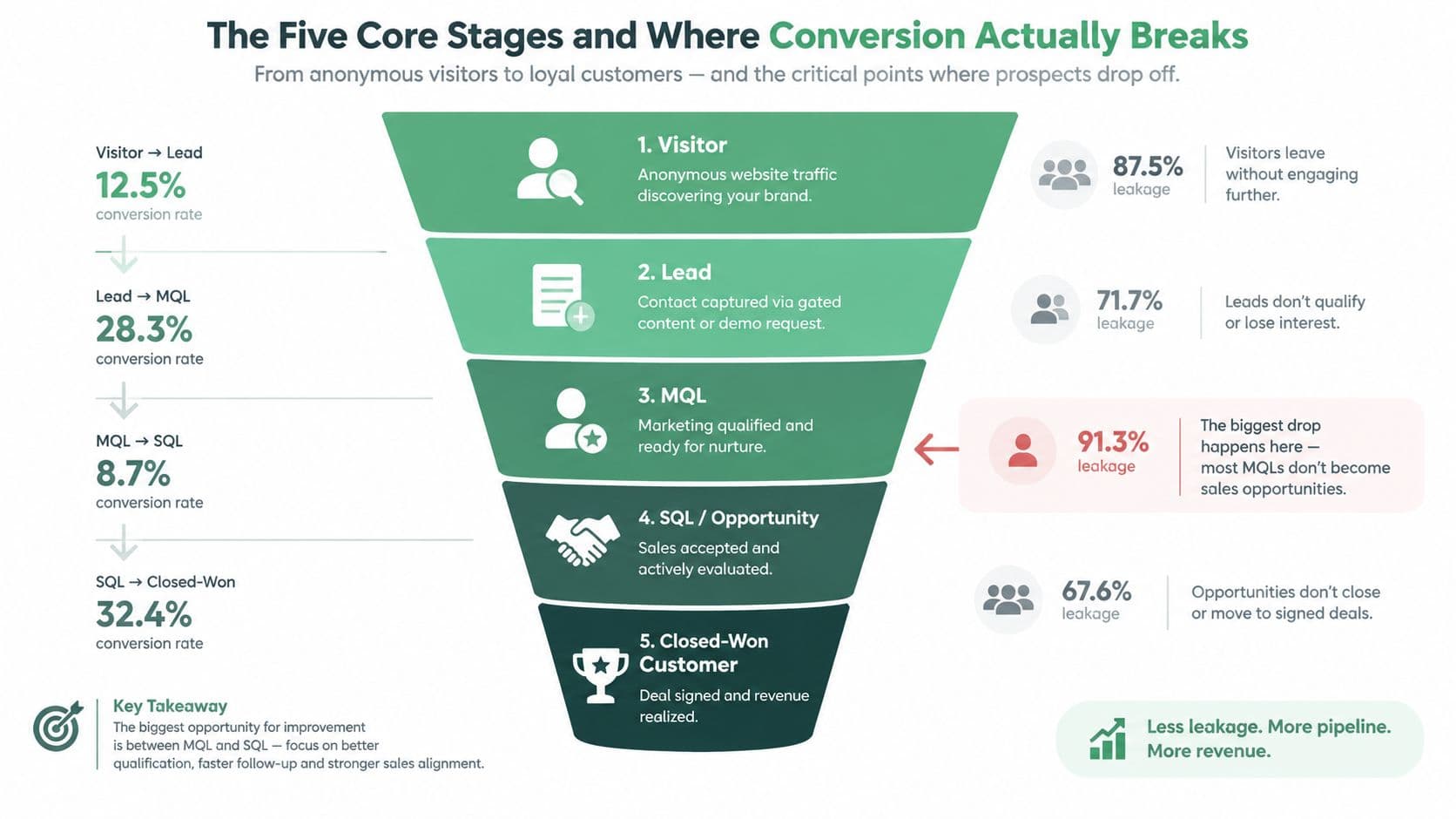
A useful funnel has explicit operating definitions, not just labels such as top, middle, and bottom. The five-stage model below turns anonymous demand into a sequence that marketing and sales can inspect together.
Visitor to lead
Avisitor is an anonymous person or account engaging with your site, search result, advertisement, or referral. Alead is a contact you can identify, usually through a form, meeting request, content registration, or another permission-based action.
Benchmark summaries place visitor-to-lead conversion at roughly2% to 3% in one B2B funnel path, while another benchmark range places it at about1% to 3% (Shno's sales funnel benchmarks,SPOTIO's B2B sales funnel benchmarks). A weak result can indicate poor traffic quality, a mismatched offer, unclear positioning, or unnecessary form friction. Raw visits won't tell you which one is responsible.
Lead to MQL
Amarketing-qualified lead, or MQL, meets the agreed criteria for continued marketing attention. Those criteria might combine fit, problem relevance, engagement, and a meaningful action. Benchmark summaries put lead-to-MQL conversion at about25%, while another range places it around25% to 35% (Shno's benchmark summary,SPOTIO's funnel analysis).
The operational question is whether the MQL definition predicts useful next steps. If nearly every captured lead becomes an MQL, the threshold may be too loose. If strong accounts remain outside the workflow, the scoring model or data capture may be too restrictive.
MQL to SQL
AnSQL is a lead sales has accepted as worth direct attention under a shared qualification standard. This is commonly the steepest leakage point. Benchmark summaries put MQL-to-SQL conversion around15% to 21%, while other sources cite roughly13% to 26% (Shno's B2B funnel statistics,SPOTIO's stage benchmarks).
When this stage underperforms, don't immediately blame sales. Review the audience, offer, scoring rules, routing, and the context attached to each handoff.
SQL to opportunity
An opportunity represents active commercial evaluation, not merely a conversation. Benchmark ranges place SQL-to-opportunity conversion at about50% to 62% (SPOTIO's B2B sales funnel benchmarks). Track whether accepted leads receive a clear next step, whether the right stakeholders join, and how long accounts remain without movement.
Opportunity to closed-won customer
A closed-won customer has completed the commercial process and signed or otherwise entered the revenue relationship. Opportunity-to-customer conversion is commonly cited at roughly15% to 30%, while another benchmark path reports about15% to 22% (SPOTIO's opportunity benchmarks,Shno's funnel statistics).
For a practical primer on stage definitions and sales alignment, reviewhow to build a B2B sales funnel. The value of these benchmarks isn't to grade your business against an industry average. It's to locate the largest constraint and decide whether you're facing a volume problem, a qualification problem, or a progression problem.
How AI-Assisted Buying Changes Middle-Funnel Conversion
AI changes the job of funnel content. It doesn't eliminate the need for education. It raises the standard for whether that education is clear, specific, and reusable.
The evaluation stage now has to support several activities at once. Buyers compare finalists, validate proof, scrutinize pricing logic, assess security, and pressure-test implementation. An AI system can help summarize a vendor's claims, but it still needs accessible evidence, precise explanations, and sourceable details to produce a useful answer.
Replace nurture volume with decision support
Generic nurture sequences often fail because they describe the vendor's preferred narrative instead of answering the buying group's questions. A better middle-funnel system creates assets around the questions that appear during evaluation:
- Question-shaped pages: Answer questions such as who the solution fits, what implementation requires, how it integrates with existing workflows, and which use cases it doesn't address.
- Comparison assets: Explain meaningful differences between approaches or solution categories. Avoid unsupported claims that a product is universally better.
- Proof libraries: Organize customer evidence, workflows, outcomes, objections, and implementation context so each stakeholder can find relevant support.
- Forwardable one-pagers: Make it easy for a champion to explain the recommendation internally without recreating the argument from scattered pages.
- Commercial and risk material: Address pricing structure, procurement questions, security considerations, and operational ownership in language that can survive internal review.
The point isn't to automate persuasion. It's to reduce the amount of interpretation buyers must do before they can form a confident view.
A useful AI workflow starts with research and content inventory, then uses people to choose the positioning, approve evidence, and decide what should publish. Crescade's guide tousing AI in digital marketing is relevant when teams need to connect AI production with human review, analytics, and channel execution rather than treating generation as the strategy.
Make proof citable
A buying committee doesn't need more claims. It needs material that answers, “How do we know this will work for our situation?” Use clear definitions, visible assumptions, specific implementation steps, and evidence tied to a defined use case. If a result isn't documented, describe the capability or process qualitatively instead of manufacturing a number.
Outbound automation can support this system by helping teams coordinate relevant follow-up around account research and buyer signals. A focused resource onAPAC outbound sales automation offers useful context for teams designing that kind of workflow, although automation should reinforce qualification and relevance rather than increase message volume indiscriminately.
The middle funnel becomes a bottleneck when marketing measures content production instead of buyer readiness. Track whether the right stakeholders engage, whether sales receives usable context, whether evaluation questions are answered, and whether accounts advance with fewer clarification cycles.
Mapping Channels and Content to Funnel Movements
Channels shouldn't be assigned to funnel stages because a playbook says they belong there. Assign them based on the transition they can influence and the evidence needed to prove that influence.
The mapping below is a starting model, not a universal allocation rule:
| Funnel movement | Useful channel roles | Content that supports the movement | What to inspect |
|---|---|---|---|
| Visitor to lead | Paid search, SEO, LinkedIn organic, paid social | Problem-focused pages, reports, practical guides | Message fit, landing-page relevance, form friction |
| Lead to MQL | Email nurture, webinars, retargeting, targeted content | Educational sequences, case evidence, role-specific guides | Engagement quality, fit, repeat activity |
| MQL to SQL | Sales enablement, targeted outreach, comparison content | Evaluation pages, proof assets, qualification prompts | Acceptance rate, routing, sales feedback |
| SQL to opportunity | Sales conversations, proposals, stakeholder outreach | Implementation plans, commercial detail, internal business cases | Meeting quality, stakeholder coverage, next-step rate |
| Opportunity to customer | Sales collaboration, customer proof, decision support | Testimonials, security responses, ROI logic, onboarding detail | Objections, procurement delay, close progression |
The important distinction is betweenchannel activity andfunnel movement. Paid search can produce high-intent visitors, but a poor landing page may prevent conversion. Organic content can attract the right category of buyer, yet still generate weak leads if the call to action asks for a sales conversation too early. Email can keep a lead engaged, but it can't compensate for unclear qualification or missing proof.
Allocate budget by constraint
Start with the stage that limits qualified pipeline. If visitor-to-lead performance is weak, test message and offer fit before expanding spend. If lead volume is acceptable but MQL-to-SQL progression is poor, invest in qualification, routing, proof, and sales follow-up rather than buying more traffic.
Use one channel as a diagnostic lens at a time. Compare source, campaign, landing page, audience, form completion, qualification, and downstream progression. A source that appears expensive at the lead level may create stronger opportunities, while a cheap lead source may consume sales capacity without producing useful accounts.
Teams building a connected demand system can usedemand generation for B2B as a reference point for linking acquisition, content, conversion, and lifecycle work. The practical standard is simple: every program should have a defined job in the funnel and a downstream metric that can confirm whether it performed that job.
Metrics That Predict Pipeline Health Versus Vanity KPIs
A funnel dashboard should help a team make decisions. If a metric doesn't change budget, routing, content, staffing, or experiment priorities, it may belong in a diagnostic report rather than the executive view.
GA4 engagement rate is more useful than raw traffic when the question is whether a source brings people who meaningfully interact. Google defines an engaged session as one lasting at least10 seconds, including a key event, or including2 or more page views or screens (Google Analytics engagement rate documentation). GA4 calculates engagement rate as engaged sessions divided by total sessions (GA4 engagement rate explanation).
That definition makes engagement rate a quality signal, not a revenue metric. Pair it with form starts, qualified submissions, account fit, and downstream opportunity data. A source can have strong engagement while attracting the wrong audience, or weak engagement while still producing a small number of valuable accounts.
A measurement view by stage
| Funnel stage | Leading indicator | Vanity metric to avoid |
|---|---|---|
| Visitor to lead | Qualified conversion by source and landing page | Total sessions without source or fit context |
| Lead to MQL | Fit-adjusted engagement, scoring movement, and useful repeat actions | Total leads captured |
| MQL to SQL | Sales acceptance, qualification reasons, and response time | MQL volume alone |
| SQL to opportunity | Stakeholder participation, completed next steps, and stage velocity | Meetings booked without progression |
| Opportunity to customer | Win progression, objection patterns, and forecast quality | Pipeline value without stage evidence |
| Closed-won | Revenue attribution, onboarding readiness, and expansion signals | Closed deals without source or cohort context |
Speed belongs in the dashboard
Response time is a process metric with direct operational consequences. Benchmark summaries report an average lead response time of about47 hours, and only7% of companies respond within 5 minutes (Lead Forensics' response-time benchmarks). Track the time from submission to first human or relevant automated response, then separate business hours, lead type, source, and routing path.
Don't use a single top-line conversion rate to judge the funnel. A reported2% to 5% overall lead-to-customer conversion rate across B2B industries can conceal very different combinations of traffic quality, qualification, sales execution, and deal economics (Shno's B2B funnel benchmark summary). Review the stage rates together, then ask which one your team can influence in the current planning cycle.
Finding and Fixing Your Weakest Funnel Handoff
Funnel optimization gets slower when every channel receives an equal share of attention. The better approach is to calculate each transition, identify the weakest handoff, and run a focused improvement cycle before changing the rest of the system.
Start with the numbers you already have
Build a stage table from your CRM, GA4, advertising platforms, and marketing automation records. Use consistent date ranges and definitions. Don't compare a newly changed MQL rule with an older SQL definition without documenting the difference.
Then ask targeted diagnostic questions:
- Visitor to lead: Does the landing page match the search or ad promise? Is the offer useful at the buyer's current stage? Does the form request information that isn't necessary for the next action?
- Lead to MQL: Are the qualification rules based on actual customer fit? Are sales and marketing using the same definition? Are valuable accounts being excluded because the scoring model overweights low-intent activity?
- MQL to SQL: Does sales receive enough context to act? Is the routing owner clear? Does the lead expect a conversation, or did the form promise something else?
- SQL to opportunity: Has the team identified a real problem, a buying process, and the people needed for evaluation? Is every meeting ending with a documented next step?
- Opportunity to customer: Which objections remain unresolved? Are procurement, security, implementation, and commercial questions being answered early enough?
Apply one targeted playbook
If the constraint is message fit, rewrite the page around the buyer's problem and test the offer. If the issue is form friction, remove fields that don't support qualification or routing. If scoring is the problem, compare predicted quality with sales outcomes and adjust the signals. If response time is the bottleneck, fix ownership, alerts, and follow-up paths before redesigning the campaign.
Fix one bottleneck at a time. Otherwise, you won't know which change produced the movement, and your team will keep treating symptoms as separate problems.
Use thelead qualification marketing framework when the main issue is inconsistent definitions or weak handoff logic. The aim isn't to produce a perfect model before acting. It's to create a clear hypothesis, change the specific constraint, re-measure the affected transition, and document what the evidence says.
Benchmark ranges can help identify unusual leakage, but they shouldn't become rigid targets. The most valuable comparison is often your own funnel before and after a controlled change, with source, segment, qualification, and time-to-action held visible.
Building a Repeatable Decision System for Funnel Growth
A healthy B2B marketing funnel isn't a collection of disconnected campaigns. It's a managed revenue system with a review cadence that connects evidence to decisions.
Set a recurring operating rhythm around five questions:
- Signal: What changed in buyer behavior, channel quality, conversion, or sales feedback?
- Build: Which page, workflow, asset, audience, or routing rule addresses the constraint?
- Launch: What is shipping, who owns it, and what must remain constant for a clean read?
- Learn: Did the targeted handoff improve, and what did the team learn about the buyer?
- Compound: Which insight should change the next campaign, content brief, scoring rule, or budget decision?
AI can accelerate research, analysis, production, and workflow preparation. People still need to set strategy, approve budgets and creative, protect evidence quality, and decide what ships. That division keeps automation useful without turning the funnel into an uncontrolled stream of generated assets.
Bring in growth operations support when paid acquisition, SEO, conversion, lifecycle marketing, CRM, analytics, and automation are being managed as separate projects but the constraint crosses those boundaries. A partner such as Crescade can connect those workstreams around measurement, funnel review, experimentation, and a repeatable decision cadence, rather than treating each channel as an isolated service.
Start with one funnel export, one agreed stage model, and one question:which handoff is limiting qualified pipeline today? The answer gives your team a practical place to work, a metric to improve, and evidence that can guide the next decision.
If your funnel has plenty of activity but inconsistent progression, visitCrescade to evaluate the acquisition, conversion, lifecycle, analytics, and automation handoffs together. Request a 20-minute audit to identify the highest-impact constraint and define the next measurement-led action.