- demand generation for b2b
- b2b lead generation
- lead scoring
- channel mix
- marketing operations
Demand Generation for B2B: A Practical Playbook
By Crescade · · 13 min read
A practical demand generation for B2B playbook covering channel mix, scoring, sales SLAs, and measurement that growth teams can ship this quarter.
Your paid campaigns are generating leads, the content calendar is full, and the CRM shows a healthy MQL count. Yet sales says the leads aren't ready, opportunities stall, and nobody can explain which channel is creating pipeline.Demand generation for B2B fixes that problem by treating acquisition as an evidence and feedback system, not a race to produce more form fills. The operating priority is clear: define the right accounts, create buying-group evidence early, score intent accurately, enforce the sales handoff, and measure qualified pipeline before increasing spend.
Table of Contents
- What Demand Generation for B2B Means in 2026
- Building the Channel Mix Around Pipeline, Not MQLs
- Campaign and Content Templates That Move Buying GroupsTop of funnel creates shared problem language
- Middle of funnel helps champions build the case
- Bottom of funnel removes friction
Designing Lead Scoring That Sales TrustsAligning Marketing and Sales SLAs
Measurement, AI Discovery, and the Compound LoopYour 30-Day Demand Generation Starter Plan
What Demand Generation for B2B Means in 2026
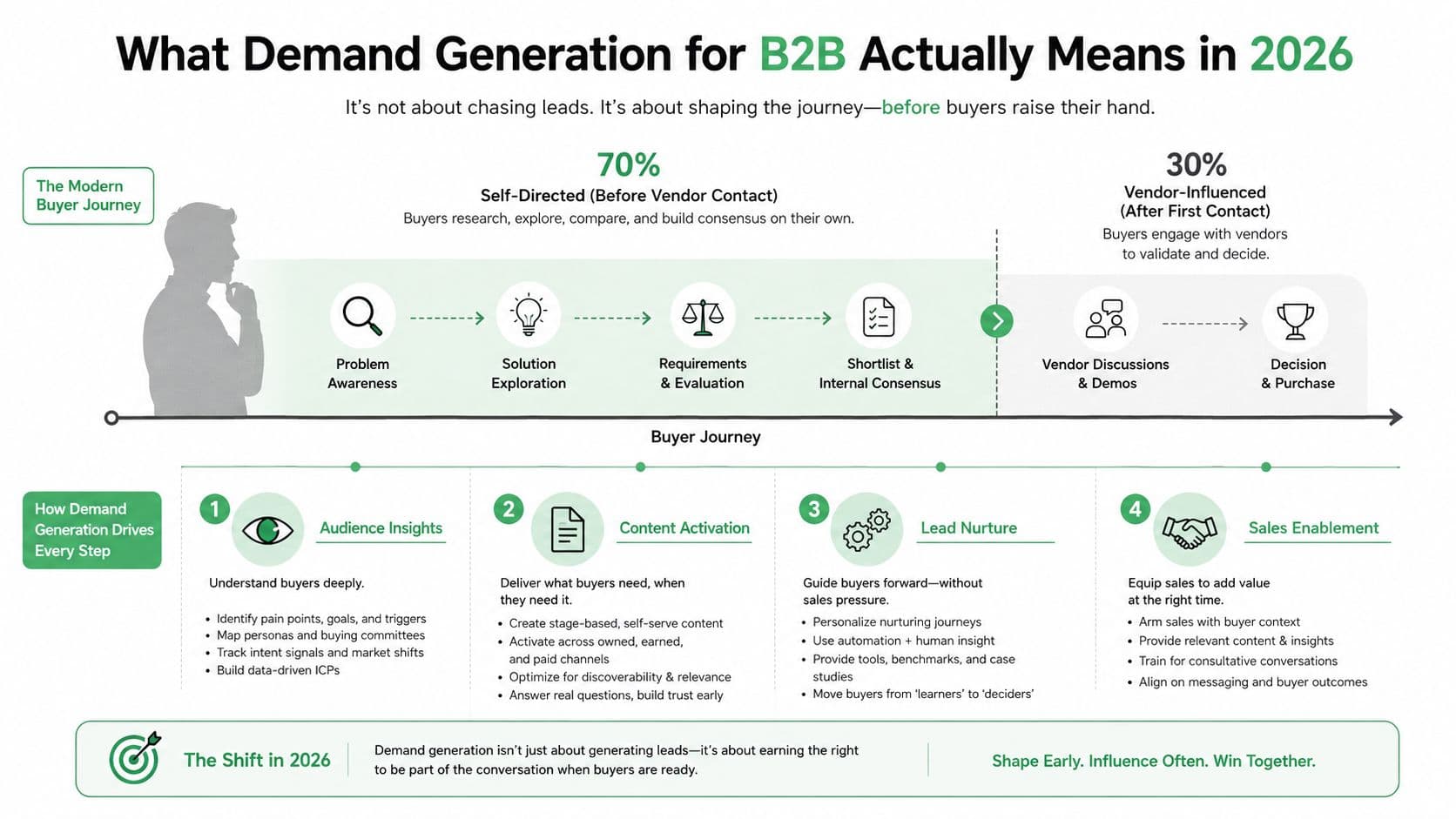
A buyer can arrive on a sales call after researching your category, comparing vendors, and aligning internal stakeholders without filling out a form. Research compiled from Gartner and Forrester indicates that buyers spend only17% of total purchase time in direct vendor contact, while roughly80% of the journey is self-directed (B2B buyer journey statistics). Buying committees average6 to 10 decision-makers, and Forrester reports13 people in the average enterprise buying group. One downloaded guide rarely represents the whole opportunity.
That is whydemand generation marketing explained must cover the complete path from discovery to revenue. Demand generation combinesaudience definition, channel orchestration, conversion infrastructure, and revenue feedback. Audience definition identifies the accounts and stakeholder problems worth pursuing. Channel orchestration makes paid, organic, lifecycle, and account-based activity reinforce one another. Conversion infrastructure turns attention into observable actions. Revenue feedback shows which actions create qualified opportunities and closed business.
Practical rule: Do not optimize for the biggest number in the CRM. Optimize for pipeline contribution, buying velocity, and sourced revenue per dollar.
The wrong target is “more MQLs.”92% of B2B buyers start with at least one vendor already in mind,41% start with a single preferred vendor, and86% of purchases stall somewhere in the process. Your program must create evidence before the first sales conversation, help champions build an internal case, and preserve momentum when the committee goes quiet.
A practicalB2B digital marketing strategy should answer four operating questions:
- Who matters: Which accounts fit the ICP, and which stakeholders influence the decision?
- Where evidence appears: Which channels help buyers discover, compare, and validate the solution?
- What action means: Which behaviors indicate research, active evaluation, or procurement readiness?
- What sales learns: Which source, asset, score, and handoff pattern leads to qualified pipeline?
Use those answers as one feedback loop. Choose channels based on pipeline evidence, score fit and intent together, and set sales SLAs that expose where momentum breaks before increasing spend.
Building the Channel Mix Around Pipeline, Not MQLs
A channel mix earns budget when it produces evidence of buying progress, not when it fills the CRM.Paid channels such as LinkedIn, Google Ads, and retargeting provide controlled tests.Organic channels such as SEO, dark social, and communities build discovery and trust over time.Lifecycle channels such as email, in-product messaging, and ABM motions turn existing attention into account movement.
Each layer needs its own job and its own measurement. A lead-form campaign may generate immediate responses, while an SEO cluster or analyst mention influences several people in an account before anyone converts. Track acquisition, qualification, opportunity creation, and sourced revenue as separate stages.
Benchmark context helps, but it cannot replace pipeline evidence. LinkedIn lead-generation forms are reported at6% to 13% conversion, while external LinkedIn landing pages typically convert at2% to 5% (B2B lead generation benchmarks). Lower friction can increase response while producing weaker-fit leads. Channel choice should therefore connect to lead scoring and sales feedback, not conversion rate alone.
| Channel | Pipeline Contribution | CAC Payback |
|---|---|---|
| LinkedIn ABM | Account engagement and qualified opportunities | Measure by opportunity stage |
| Google Ads | High-intent demand when query and landing page match | Measure by sourced revenue |
| SEO clusters | Compounding discovery and assisted pipeline | Measure across the buying cycle |
| Paid display | Awareness and retargeting support | Judge by assisted progression |
| Email and lifecycle | Nurture, recycle, and expansion influence | Measure by stage progression |
Build the mix around your own CRM stages, source hygiene, and sales SLA. A channel that generates leads but fails to create accepted opportunities is exposing a scoring, targeting, or handoff problem. Fix that constraint before increasing spend. Teams choosing amongB2B demand generation channels should connect every channel to a defined account action and CRM outcome.
A hypothetical$50,000 monthly budget should not remain locked in low-converting display because display produces cheap clicks. Move a portion into LinkedIn ABM for named accounts, fund SEO clusters around high-intent problems, and reserve paid search for queries with clear commercial meaning. Review performance at qualified opportunity creation, then compare sourced revenue and acquisition cost.
Email supports the loop only when messages reach real prospects. Audit list quality, sender practices, and engagement signals toimprove deliverability for B2B. Then use sales acceptance and opportunity progression to decide whether the channel deserves more budget, tighter targeting, or a different role.
Campaign and Content Templates That Move Buying Groups
A content asset earns its budget when it helps a buying group make a decision. Since committees include multiple stakeholders, every campaign should give the champion material they can forward to finance, operations, security, procurement, or executive leadership.
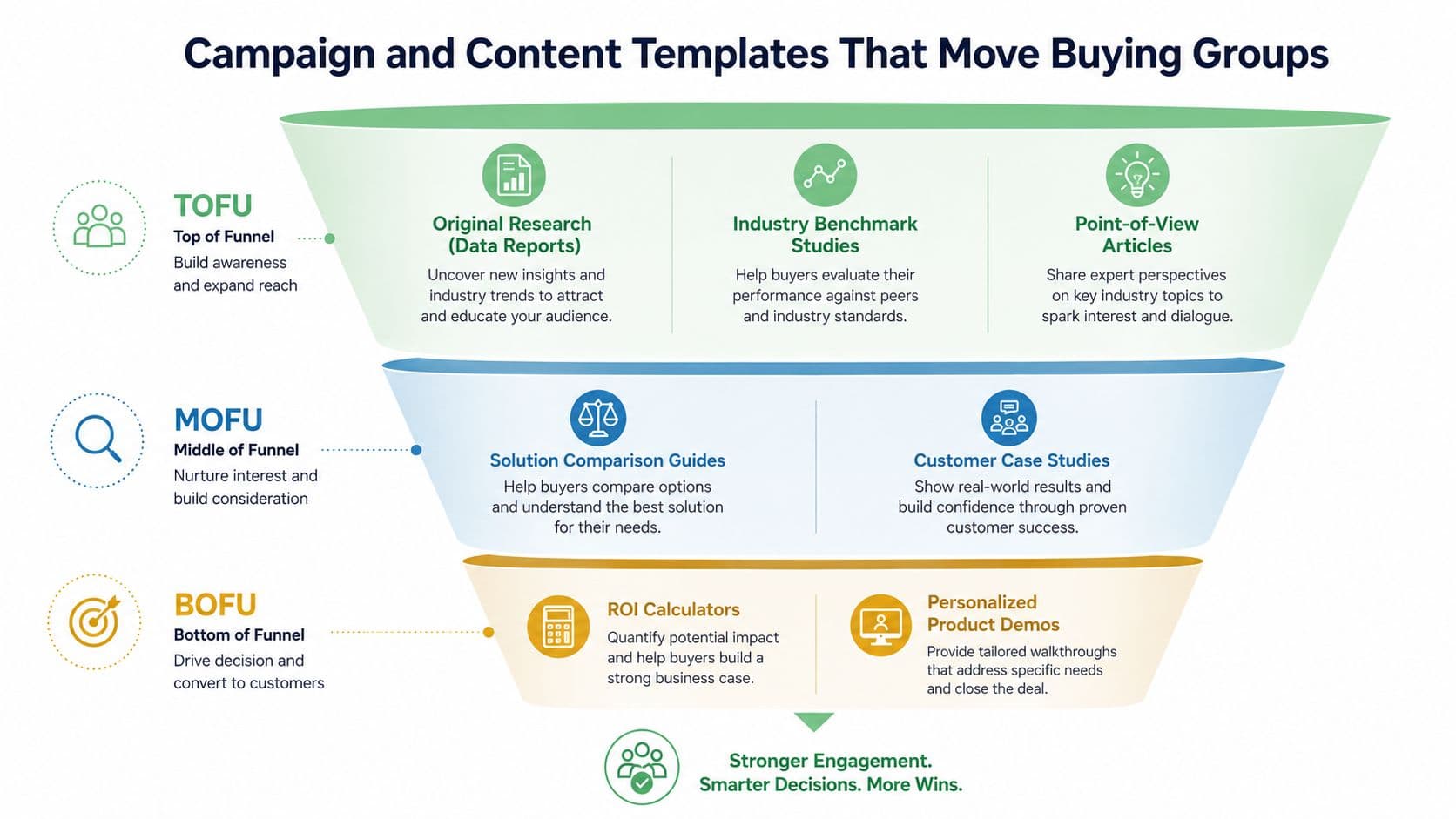
Top of funnel creates shared problem language
At the awareness stage, publish material that helps buyers recognize the problem and understand its consequences. Useful formats include original research, industry benchmark studies, and strong point-of-view articles. A report such as“2026 SaaS Security Stack” can serve an IT leader while giving an executive sponsor a concise view of risk, cost, and decision criteria.
Don't gate every useful idea. Buyers need enough substance to decide whether your category deserves attention. Ungated analysis, short videos, expert interviews, and research summaries create the evidence that helps a vendor enter the shortlist.
Middle of funnel helps champions build the case
Consideration content should make comparison easier. Create solution comparison guides, implementation checklists, ROI calculators, and vendor evaluation matrices. AnROI calculator for operations buyers should let the user model the business case using their own assumptions, then provide a summary they can share internally.
A buyer committee enablement kit can combine a one-page executive brief, technical requirements, implementation expectations, frequently asked questions, and a comparison framework. That kit is more useful than another generic product brochure because it helps the internal champion coordinate the committee.
Bottom of funnel removes friction
Decision-stage content should answer the questions that delay procurement. Use case-study packs, reference-call preparation, security documentation, implementation plans, and procurement materials. A personalized demo should connect the product to the buyer's stated workflow instead of repeating the homepage.
A campaign should leave the buyer with fewer internal objections than it started with.
Use the funnel as a production system, not a labeling exercise. Each asset needs an owner, a target stakeholder, a next action, and a CRM field that records whether it influenced an opportunity.
Designing Lead Scoring That Sales Trusts
Sales distrusts scoring when it rewards activity without context. A useful model separatesfirmographic fit frombehavioral intent. Fit establishes whether an account belongs in the target market. Behavior shows whether people at that account are actively moving toward a decision.
For a hypothetical$25,000 to $100,000 ACV motion, use a model with fit points from0 to 40 and behavior points from0 to 60. The exact weights must reflect your sales history, but the structure matters. Once an account passes the fit threshold, meaningful behavior should carry more weight than a job title.
| Dimension | Signal | Points | Decay |
|---|---|---|---|
| Firmographic fit | Target industry and company profile | 0 to 40 | Review as ICP changes |
| Behavioral intent | Pricing-page revisit or evaluation activity | 0 to 60 | 30-day decay |
| Behavioral intent | Multiple stakeholders engaging | 0 to 60 | 30-day decay |
| Negative fit | Competitor or student profile | Negative score | Reassess manually |
| Inactivity | No meaningful engagement | Negative score | 30-day decay |
The common misfires are predictable. Teams score every webinar attendee identically, treat any form fill as high intent, and allow old activity to remain permanently valuable. A contact who downloaded an introductory guide months ago shouldn't outrank an in-fit account whose finance and operations stakeholders are comparing implementation details now.
Build the model from CRM evidence. Review accepted and rejected MQLs, opportunity creation, closed-won records, and disqualification reasons. Then test whether the score explains sales behavior. If it doesn't, the score is decorative.
The handoff should also expose disagreement. If SDRs reject more than25% of marketing-qualified leads, the scoring model needs investigation before anyone blames sales. Review the rejected records, identify the missing or misleading signal, and adjust the model with both teams.
Yourlead qualification marketing process should define the threshold, the reason for qualification, and the next action. A score without those details creates routing noise rather than trust.
Aligning Marketing and Sales SLAs
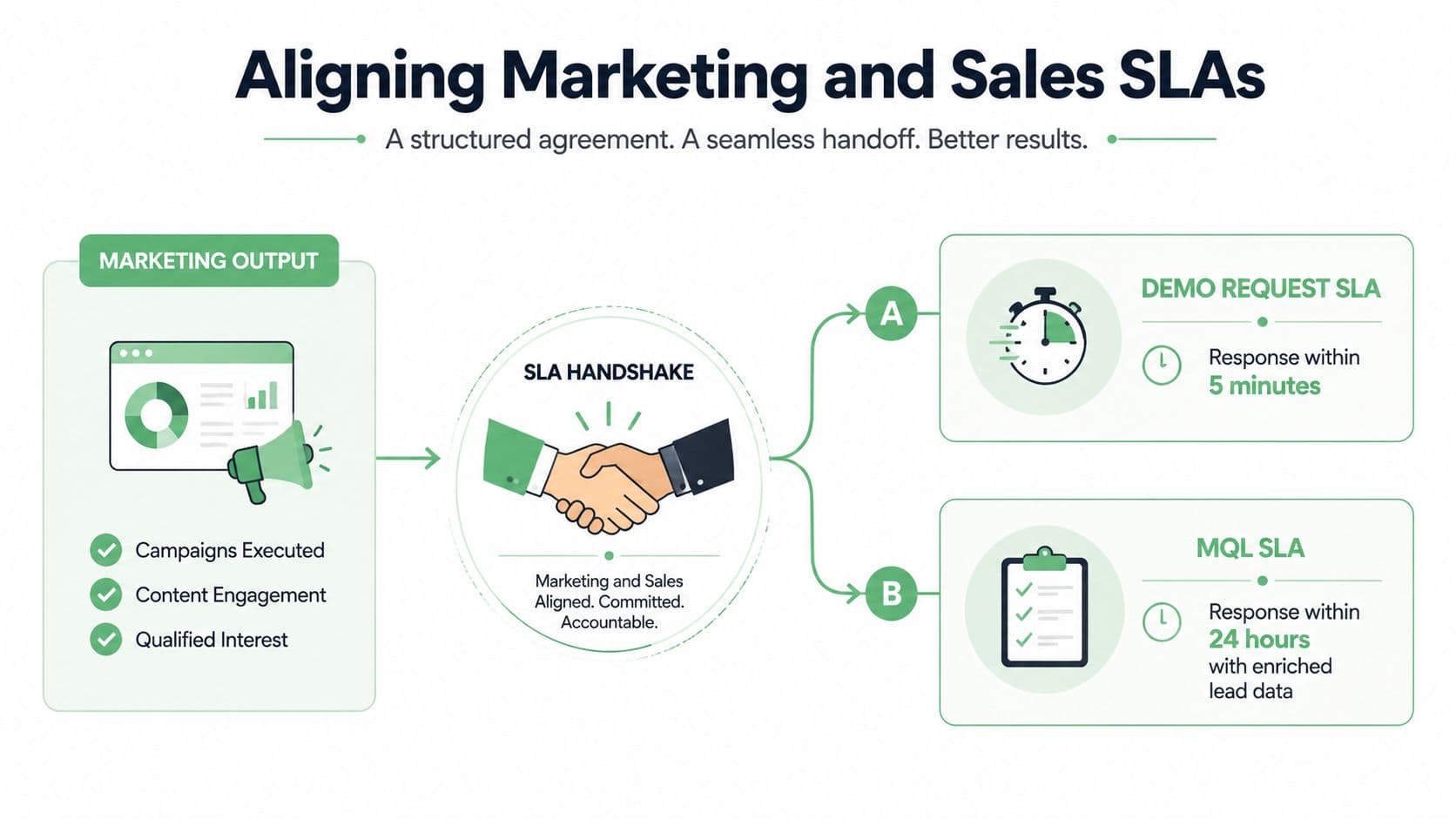
A marketing-to-sales handoff is a contract, not a shared Slack channel. Marketing owes sales enough context to act, and sales owes marketing enough feedback to improve targeting, scoring, and messaging.
For demo requests, require a response within5 minutes. For MQLs, require a response within24 hours, accompanied by enriched firmographics and the last five pages visited. Sales should record a disposition code for every lead within72 hours, provide weekly feedback on lead quality, and assign named owners for each segment.
Use different rules for different motions
A high-consideration enterprise motion needs more context and coordinated account coverage. A product-led or lower-friction motion may need faster routing and lighter enrichment. The matrix below gives teams a starting structure without pretending that every business should use identical rules.
| Product motion | Marketing commitment | Sales commitment | Primary review metrics |
|---|---|---|---|
| Enterprise, sales-led | Enriched account data, stakeholder activity, buying-stage context | Named account owner and disposition | Acceptance, opportunity conversion, recycle rate |
| Mid-market, inbound-led | Source, offer, recent activity, and qualification reason | Timely first response and next-step status | Speed-to-lead, acceptance, opportunity conversion |
The silent killers areno recycle path, inconsistent definitions of MQL and SQL, and SDRs who only follow up with the top decile of scores. A rejected lead isn't necessarily a dead lead. Route it into a nurture path with a reason code, then return it to sales when behavior changes.
Review the SLA weekly at the operational level. Review the model quarterly with marketing and sales together. Re-weight scores, revise disqualification criteria, inspect segment ownership, and remove fields nobody uses.
The best SLA is visible in the CRM, enforceable in routing, and easy to audit.
Measure speed-to-lead, acceptance rate, opportunity conversion from MQL, and recycle rate. Don't let activity counts substitute for those outcomes.
Measurement, AI Discovery, and the Compound Loop
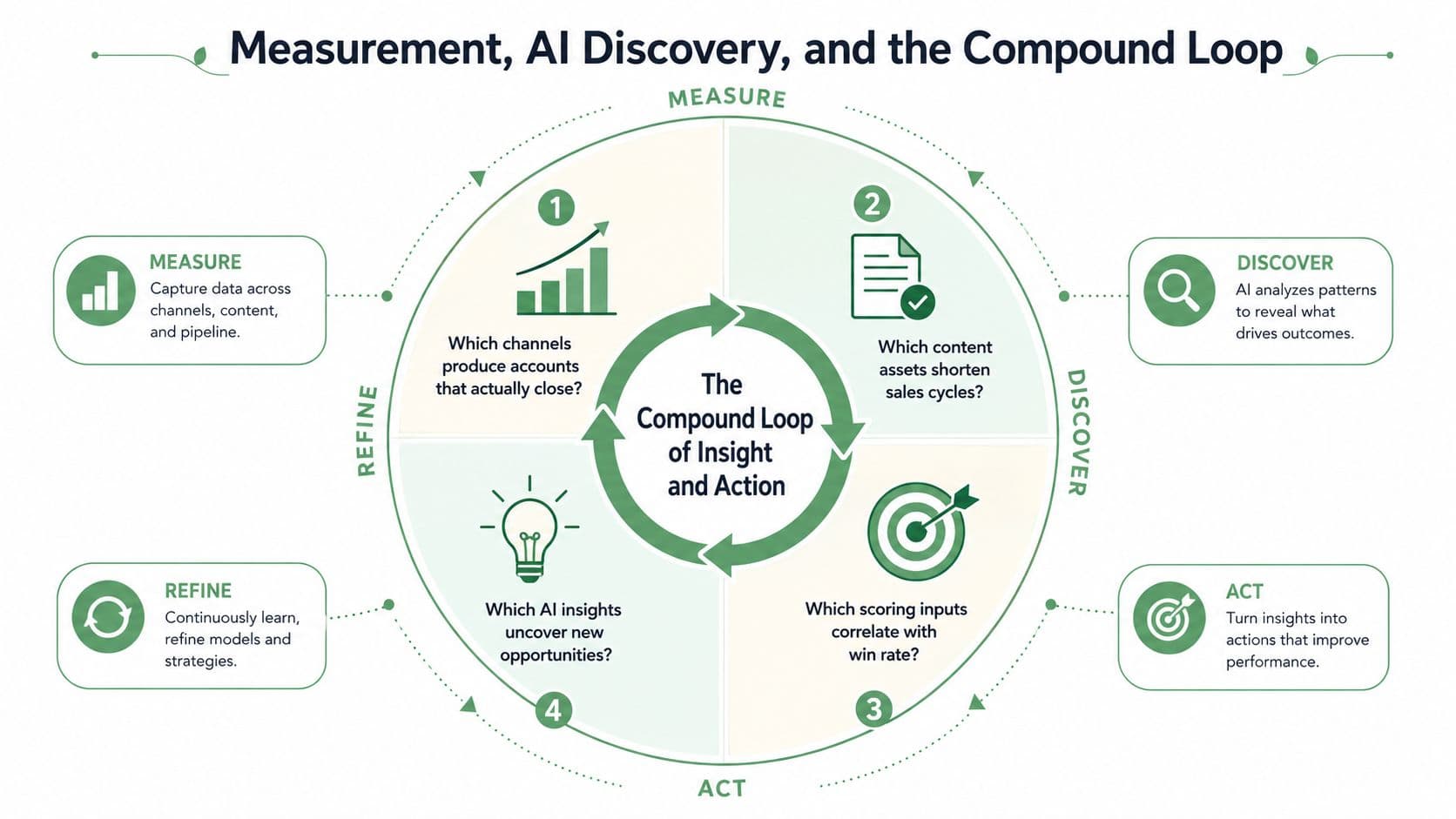
A demand engine improves only when each campaign produces evidence for the next decision. Track four answers: which channels create accounts that close, which assets shorten sales cycles, which scoring inputs align with wins, and where revenue leaks between stages. This turns demand generation into an operating loop, not a contest for lead volume.
Connect GA4, Google Ads, Google Search Console, and CRM stages through consistent source and campaign naming. Add themes from call recordings, sales disposition codes, and closed-won feedback. Send those findings back into bidding, landing-page priorities, scoring, nurture logic, and content production.
AI-mediated discovery creates another measurement gap. Recent research summarized in 2026 reports that51% of B2B software buyers begin research in an AI chatbot rather than Google, up from29% eleven months earlier, and69% changed vendors based on AI chatbot guidance (AI-mediated B2B discovery statistics). That journey may begin before a prospect visits your site, so last-click reporting leaves part of the buying process invisible.
Track brand mentions, cited sources, assistant referrals, direct-traffic patterns, and sales reports of AI-assisted discovery. Use these as supporting signals, then validate them against accepted opportunities, pipeline movement, and revenue. AI visibility should influence investigation, not replace CRM evidence.
Teams needing a practical starting point can review thisAI marketing analytics tool guide. Keep the operating cadence focused:
- Weekly: Review pipeline movement, accepted leads, stalled opportunities, and SLA breaches.
- Monthly: Rebalance channel investment using qualified opportunity creation and sales velocity.
- Quarterly: Retrain scoring logic, revise content priorities, and update disqualification criteria.
The compounding advantage comes from disciplined feedback.Pipeline quality is the asset that appreciates when marketing records buyer behavior, sales records what it learns, and the CRM confirms what converts. Fix the weakest evidence in that loop before increasing spend.
Your 30-Day Demand Generation Starter Plan
Use the first month to ship a working system, not another strategy document.
- Week 1, baseline: Map visitor-to-lead, MQL-to-SQL, and opportunity stages in GA4, ad platforms, and the CRM. Shadow one SDR day. Decide which funnel constraint deserves attention, and assign one owner.
- Week 2, campaign reset: Rewrite one campaign brief against TOFU, MOFU, and BOFU needs. Select the two channels with the strongest evidence of qualified pipeline. Decide what to pause.
- Week 3, scoring and SLA: Combine firmographic fit with behavioral intent, add decay, document negative signals, and write the marketing-to-sales handoff. Assign segment owners.
- Week 4, launch and inspect: Apply UTM and source-of-pipeline tracking, launch the revised campaign, and schedule the recurring pipeline review. Decide which signal will determine the next budget change.
Don't wait for perfect attribution. Make the source definitions consistent, record sales dispositions, and improve the model from observed evidence. If you want a faster diagnostic, book a working session to map your current funnel against this blueprint and identify the first constraint to fix before adding spend.
Crescade connects paid acquisition, SEO, conversion optimization, lifecycle marketing, CRM, analytics, automation, and AI-assisted growth operations into one accountable system.Visit Crescade to request a 20-minute audit of your demand engine and find the constraint your team should fix first.