- b2b paid media agency
- paid media strategy
- Google Ads management
- demand generation
- marketing measurement
B2B Paid Media Agency: What They Actually Do
By Crescade · · 18 min read
Learn what a B2B paid media agency delivers, how pricing and service models work, and which signals to use when evaluating one for mid-market and B2B tech.
Your paid campaigns are spending, but the numbers don't tell a clean story. Google Ads reports leads, LinkedIn reports engagement, sales reports that many inquiries aren't qualified, and nobody can explain which campaigns are creating pipeline. You're now deciding whether to hire aB2B paid media agency, build the capability in-house, or bring in a fractional operator.
That decision should start with measurement and operating capacity, not a vendor shortlist. A strong agency manages acquisition, conversion, and feedback loops into the CRM. A weak one manages platform dashboards and sends you more leads to sort through. This guide explains what the engagement should include, how the commercial models differ, what the first 90 days should produce, and how to judge whether an agency can connect spend to qualified revenue.
Table of Contents
- When a B2B Paid Media Agency Is the Right MoveHire for a defined operating gap
- Compare the alternatives honestly
What a B2B Paid Media Agency Actually Does
Engagement Models and Pricing Structures
Core Services Inside a B2B Paid Media Program
- Paid search captures intent
- Paid social creates and qualifies attention
- Display and conversion work need discipline
How to Evaluate a B2B Paid Media Agency
Realistic Outcomes in the First 90 Days
- Days 1 to 30 build the foundation
- Days 31 to 60 create usable evidence
- Days 61 to 90 establish the cadence
Measurement Beyond MQLs and Pipeline
Choosing Your Next Step and What to Ask First
When a B2B Paid Media Agency Is the Right Move
Hiring an agency makes sense when paid acquisition has become an operating constraint. Your marketing lead may be covering SEO, events, content, product marketing, and sales enablement while also trying to manage Google Ads and paid social. Campaign structure becomes stale, search terms go unchecked, creative testing slows down, and nobody has enough time to investigate why leads fail to progress.
The practical question is whether you need specialist capacity faster than you can recruit it. An agency can give you access to paid search, paid social, creative, conversion optimization, and measurement operators without waiting for several hires to ramp. That can be useful when pipeline is under pressure or leadership needs an informed challenge to the existing attribution model.
Hire for a defined operating gap
An agency is usually a fit when:
- Your channels need senior ownership: You need experienced operators to manage bidding, audiences, search-query quality, budgets, and testing.
- Your funnel has a usable conversion path: You can measure more than an early engagement, such as a qualified inquiry, sales opportunity, or another meaningful stage.
- Your CRM can receive campaign data: Someone can connect source information to later sales outcomes.
- Your team needs speed: You want a functioning acquisition cadence without building every role internally.
The decision is different when your ideal customer profile is still vague. If you don't know which market, buyer, problem, or offer you're targeting, an agency will mostly help you spend money faster while learning basic positioning. The same is true when the only realistic conversion event is a webinar registration with no reliable follow-up or qualification process.
Compare the alternatives honestly
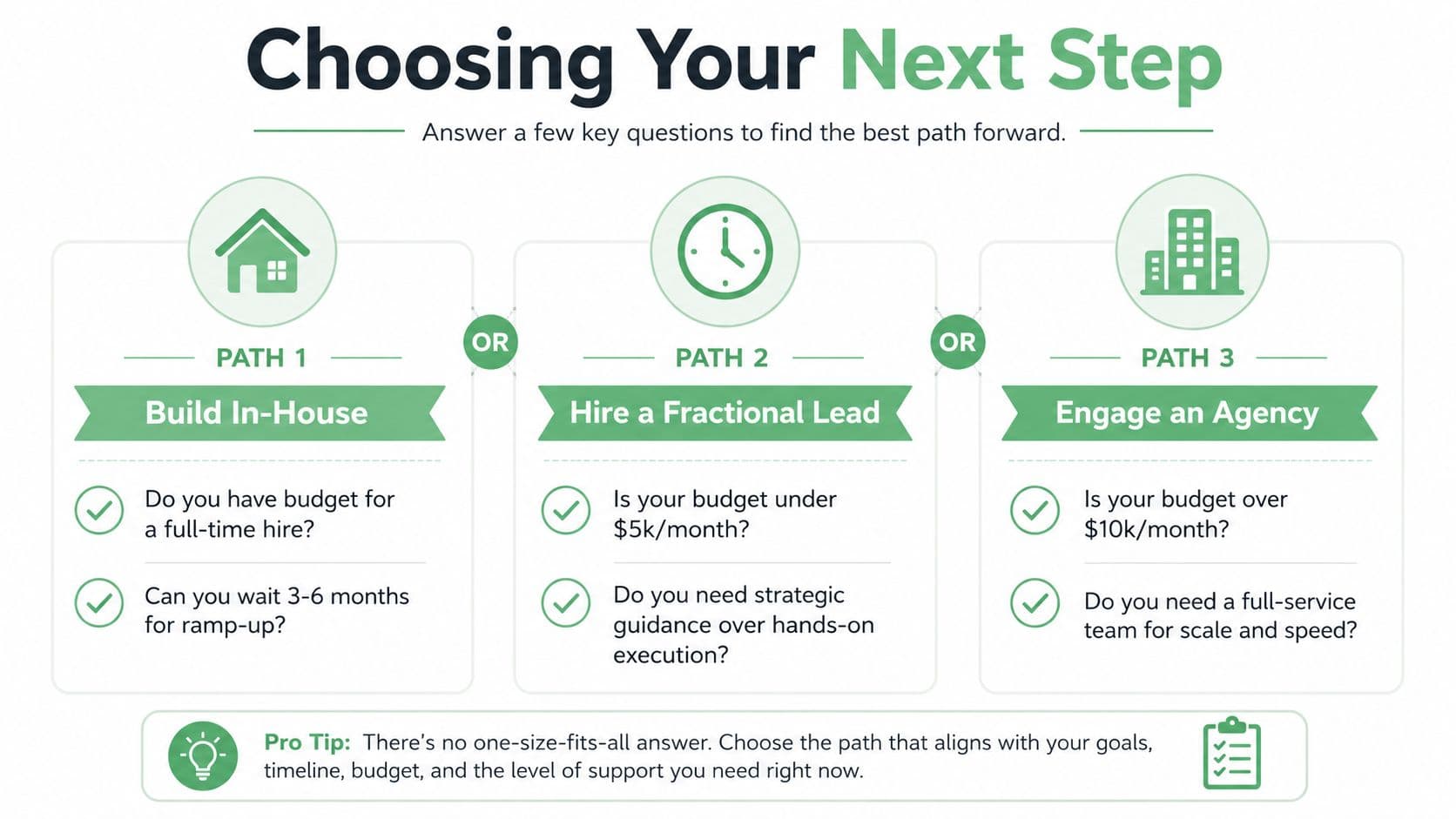
Build in-house when paid media is central to your long-term advantage and you can support channel expertise, creative production, analytics, and management. Choose a fractional lead when strategy is the missing piece but your team can execute. Choose an agency when you need a complete operating unit and clear accountability across several connected functions.
Practical rule: Don't outsource uncertainty about your market. Outsource execution and systems after you can state what a qualified opportunity looks like.
Worldwide B2B digital advertising is projected to reach$48.15 billion by 2026, compared with$38.67 billion in 2024, and the US represents47.4% of that projected category, according toPPC Chief's B2B advertising statistics. The category is mature enough to require disciplined operating decisions, but maturity doesn't make an unclear funnel investable.
What a B2B Paid Media Agency Actually Does
AB2B paid media agency owns paid acquisition as a connected system. It should define where paid media fits in the buying journey, select channels, build campaigns, manage budgets, improve the post-click experience, and report on the sales stages that matter.
That work starts before ads launch. The agency should map search intent, buyer roles, account lists, offers, objections, and conversion paths. It should then translate that research into campaign architecture, audience rules, ad messaging, landing-page direction, creative briefs, and a measurement plan.
The work behind the dashboard
A credible engagement often includes:
- Strategy and channel planning: Decide which demand to capture, which audiences to develop, and how paid search, paid social, and display support each other.
- Campaign architecture: Separate brand, non-brand, competitor, audience, geography, product, and funnel objectives where that separation improves control and reporting.
- Media management: Adjust bids, budgets, exclusions, placements, frequency, and targeting based on evidence.
- Creative direction: Turn positioning into ad concepts, copy variations, visual requirements, and testing priorities.
- Conversion improvement: Identify friction in landing pages, forms, offers, and routing instead of treating the click as the finish line.
- Revenue reporting: Connect campaign activity to CRM stages so the team can evaluate quality, not only lead volume.
B2B differs from B2C because buying groups are larger, sales cycles are longer, and the person who clicks may not be the person who approves a purchase. The agency therefore needs a way to preserve source information while a lead moves through sales development, opportunity creation, and revenue reporting.
A generalist marketing agency may include ads alongside SEO, content, web design, and public relations. That breadth can be useful, but it doesn't guarantee deep platform management. A performance creative shop may produce strong assets without owning targeting, bidding, or CRM feedback. The agency you want sits between those models, combining channel execution, creative direction, and measurement accountability.
For a useful example of how channel planning can be adapted to a specialized B2B market, review this resource onpaid media strategy for manufacturing companies. The important evaluation point isn't the industry label. It's whether the operator understands technical buyers, long consideration periods, and the relationship between message, intent, and sales progression.
Engagement Models and Pricing Structures
The commercial model shapes behavior. A retainer can give an agency room to plan and improve the account. A performance fee can create stronger pressure around outcomes, but it may also encourage lead volume when lead quality is difficult to verify. A short project can expose problems quickly, but it won't automatically create the ongoing cadence needed for compounding improvement.
Compare scope before price
| Engagement Model | Typical Fee Structure | Best Fit | Watch Out For |
|---|---|---|---|
| Retainer plus media spend | Fixed monthly management fee, with advertising spend paid separately | Teams that need ongoing channel ownership and reporting | Creative, landing pages, CRO, and analytics may be excluded |
| Performance-based | Percentage of spend, defined acquisition fee, or outcome-based arrangement | Programs with stable tracking and agreed quality definitions | Volume incentives can conflict with pipeline quality |
| Project or sprint | Fixed fee for an audit, rebuild, or launch over a defined period | Teams testing a market, repairing an account, or preparing an internal handoff | The agency may leave before the operating system is proven |
| Hybrid retainer | Ongoing base fee with scheduled performance reviews or variable components | Mid-market teams that want continuity with accountability | The contract may still hide unclear deliverables |
Don't compare agencies by management percentage alone. Ask what your team receives each month, who performs the work, how often senior strategy is involved, and which costs sit outside the agreement.
Ask for a deliverables ledger
Your proposal should state whether it includes:
- Media operations: Account structure, bid management, query review, audience exclusions, budget allocation, and platform administration.
- Creative work: Concept development, copywriting, design, video, asset resizing, and refreshes.
- Conversion work: Landing-page recommendations, implementation, forms, offers, and testing.
- Measurement: Tagging, GA4 events, CRM fields, offline conversion imports, dashboards, and analysis.
- Communication: Weekly operating reviews, monthly reporting, quarterly planning, and access to senior staff.
A helpful reference for comparing fee logic is Crescade's guide tomarketing agency pricing models. Use it to structure the commercial conversation, then force each agency to map its model to your actual scope.
The best arrangement for many mid-market teams is a hybrid retainer with explicit quarterly reviews tied to qualified pipeline contribution. That doesn't mean the agency should guarantee revenue. It means both sides agree on the decisions the data must support, the limitations of attribution, and the actions that follow from missed targets.
Core Services Inside a B2B Paid Media Program
A serious program has four operating pillars. The agency may use contractors or specialist partners, but one accountable owner must coordinate the whole chain. If your search team doesn't know what social is teaching the market, or your media team can't see which leads become opportunities, you've purchased silos.
| Service Pillar | Channel Examples | Execution Signals |
|---|---|---|
| Paid search | Google Ads, Microsoft Advertising | Intent-mapped campaigns, search-query reviews, negative keyword hygiene, responsive search ad testing, and budget separation |
| Paid social | LinkedIn, Meta, Reddit | ICP-based audiences, account-list uploads, exclusion logic, retargeting paths, creative rotation, and role-based messaging |
| Programmatic and intent display | Display networks, account-based placements, retargeting | Audience quality controls, placement review, frequency management, and clear mid-funnel objectives |
| Demand generation and CRO | Landing pages, forms, offers, routing, lifecycle handoffs | Message continuity, offer testing, friction reduction, lead routing, and feedback from sales outcomes |
Paid search captures intent
Search execution should go beyond adding keywords to an account. The operator should map queries to buying intent, separate high-value themes from research traffic, review actual search terms, and maintain negative keyword rules. Responsive search ad testing should have a stated hypothesis, not just a rotating collection of headlines.
Thepaid search advertising guide from Crescade provides useful context for understanding how search fits into the broader acquisition system. The agency's job is to turn that mechanism into a controlled operating process.
Paid social creates and qualifies attention
LinkedIn can support account-based targeting and role-specific messaging. Meta and Reddit may support retargeting, education, or broader demand development when the audience and creative justify their use. Good execution includes exclusion logic, contact or account matching where appropriate, creative variation, and a clear distinction between attention-building and direct-response campaigns.
For operational detail onagency Meta Ads workflows, look for the same principle you should demand from a B2B partner: repeatable account management, documented changes, and clear ownership.
Display and conversion work need discipline
Programmatic and intent-based display can extend reach, but impressions aren't a business outcome. The agency should define the audience, exposure objective, placement controls, and follow-up path. Retargeting should also have sensible exclusions and frequency management so the same visitor isn't shown an endless stream of irrelevant ads.
Landing pages, forms, offers, and routing complete the system. An agency that only buys traffic can't fix a weak offer or a form that creates sales friction. Make sure the scope says whether the agency recommends changes, builds them, tests them, or reports that conversion is poor.
How to Evaluate a B2B Paid Media Agency
A polished pitch deck tells you very little about operating depth. Ask the agency to show how it thinks through a long sales cycle, uncertain attribution, creative fatigue, budget concentration, and poor lead quality.
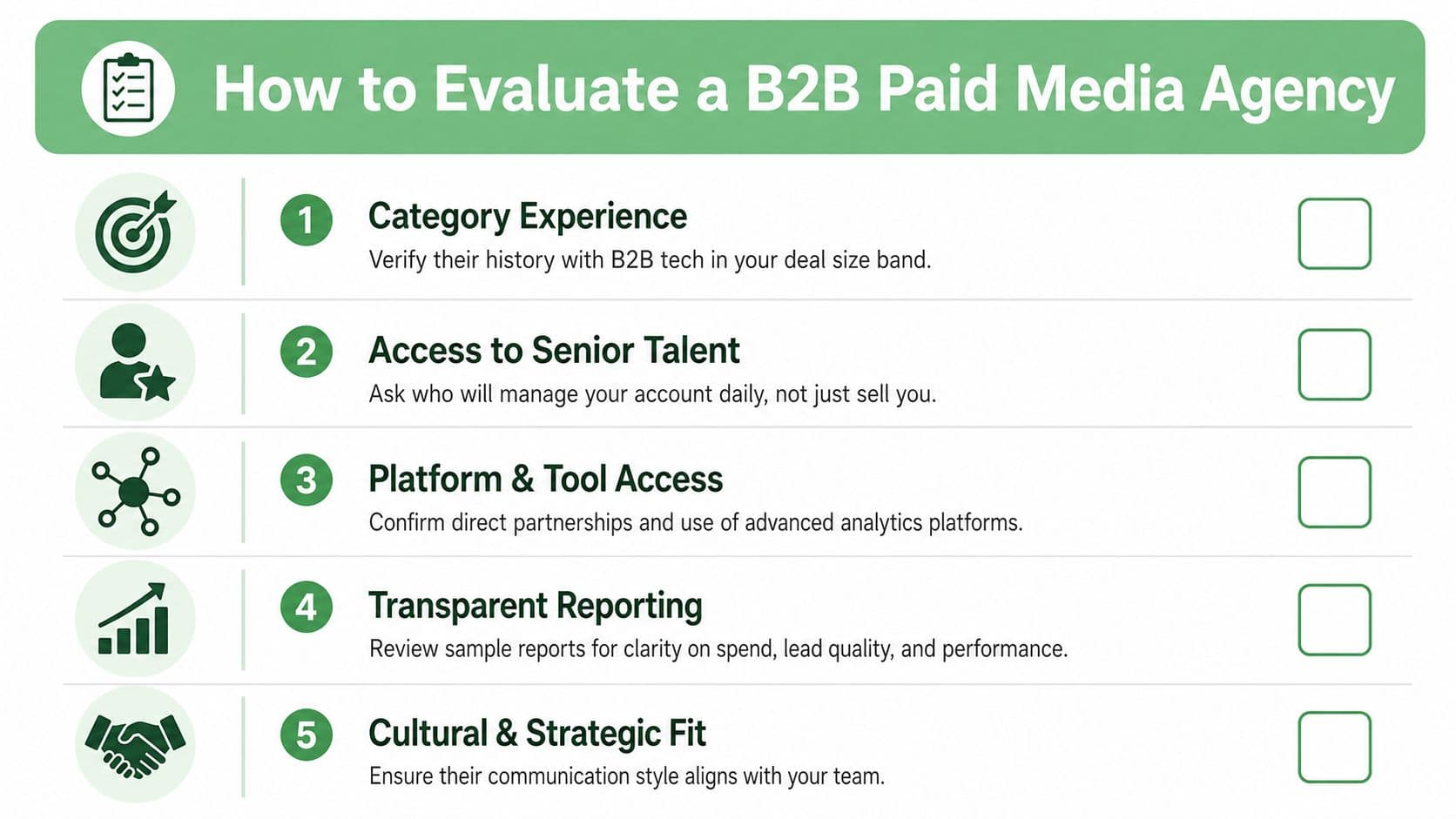
The first criterion is category and commercial experience. A team that understands B2B technology may still be a poor fit if it has never worked with your deal complexity, geography, buying committee, or sales motion. Ask for examples of account structures and measurement approaches, not just logos.
Five questions that expose capability
- Who does the work daily? Find out whether the senior strategist who sells the engagement will review campaigns, join operating calls, and make budget recommendations.
- What can you access? You should retain direct access to advertising accounts, analytics, CRM records, tags, audiences, and exported reporting data.
- How is quality measured? Require a path from click to form, qualified lead, sales-accepted lead, opportunity, pipeline, and revenue where the systems support it.
- How are experiments chosen? The agency should explain the hypothesis, audience, creative or landing-page change, success signal, time horizon, and decision rule.
- Who owns the roadmap? A partner should bring recommendations, not wait for a task list while campaigns deteriorate.
Red flags worth taking seriously
Be cautious when an agency uses a proprietary dashboard to avoid showing the underlying accounts or CRM evidence. A dashboard can organize information, but it can't replace transparent definitions, source fields, and access to the systems that generate the data.
Vague attribution language is another warning sign. Ask whether the agency uses platform-reported conversion, directional multi-touch attribution, self-reported attribution, controlled testing, or CRM stage reporting. Each method has limits. The problem is refusing to explain those limits.
Finally, ask what happens when pipeline misses. Strong operators will discuss diagnosis, budget changes, offer changes, qualification problems, sales follow-up, and measurement failure. They won't blame the platform by default. For a broader framework on selecting a partner, use Crescade's guide tohow to hire a marketing agency.
Realistic Outcomes in the First 90 Days
The first quarter should produce a trustworthy baseline and a better operating cadence. It shouldn't be judged by a dramatic week-two result, especially when the team is repairing tracking, changing campaign structure, or waiting for sales stages to mature.
Days 1 to 30 build the foundation
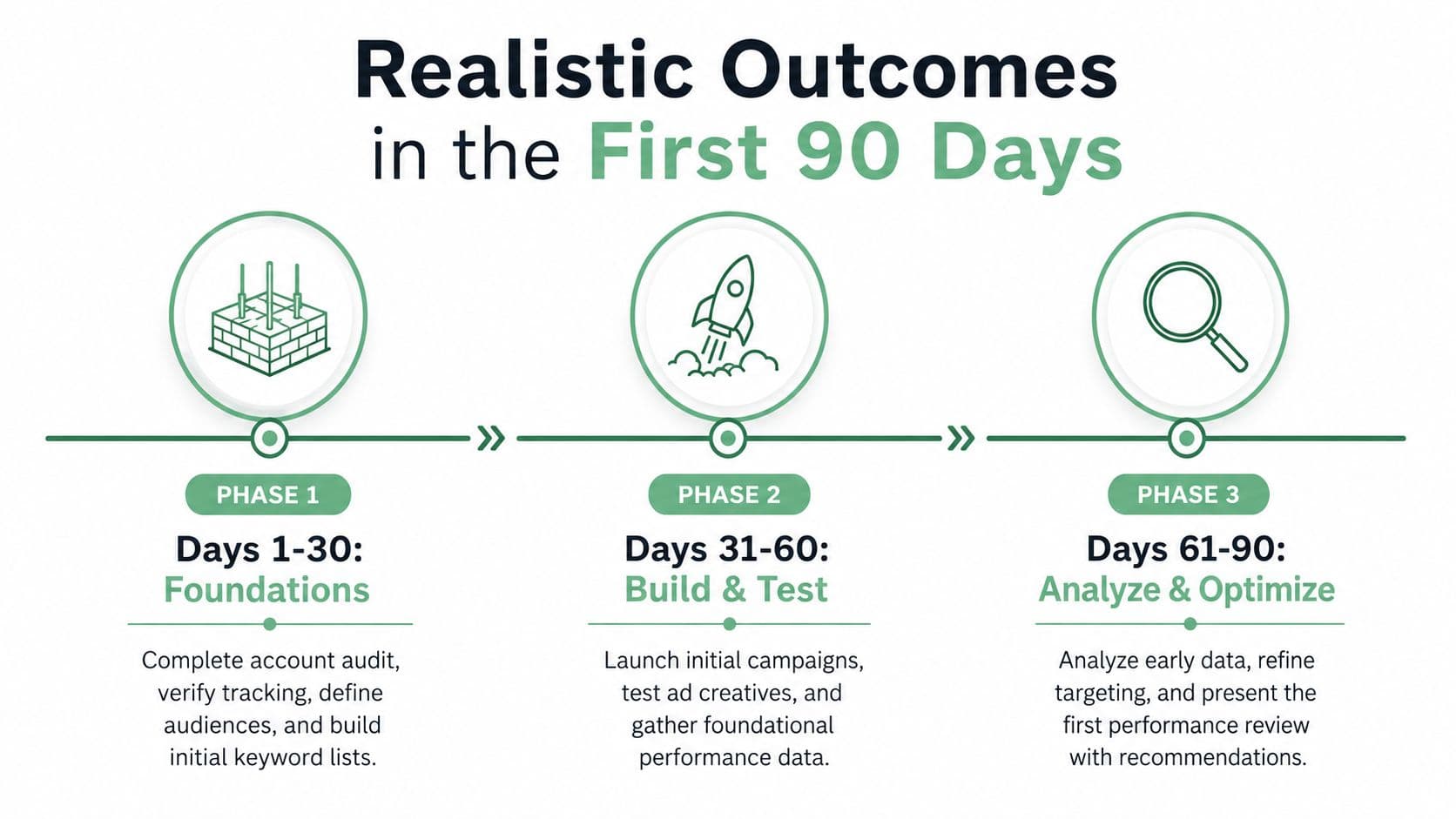
The agency should audit accounts, verify conversion measurement, review audiences and search terms, inventory creative, inspect landing pages, and document the measurement plan. It should also identify broken handoffs, duplicate conversions, unqualified form activity, and missing CRM fields.
The output is a prioritized operating backlog. You should know what will be fixed immediately, what requires a test, which data is trustworthy, and which conclusions must wait.
Days 31 to 60 create usable evidence
The second phase should introduce structural tests, budget adjustments, audience changes, new creative, and landing-page iterations. Reporting should compare activity with the initial baseline and distinguish between platform signals and downstream quality.
Don't expect every test to win. You want a clear record of what changed, why it changed, and what the team learned. That record prevents the agency from presenting routine maintenance as strategy.
Days 61 to 90 establish the cadence
By the third phase, the team should scale credible winners, cut weak segments, introduce new audiences or formats, and connect media activity to available pipeline stages. The first performance review should include recommendations for the next planning period, not just a retrospective chart pack.
Meaningful pipeline contribution often takes longer than the first quarter to become visible. Treat the first 90 days as the period for measurement repair, controlled learning, and operating alignment, then evaluate the program over a longer sales-cycle window.
Measurement Beyond MQLs and Pipeline
MQL volume is a starting signal, not a business result. A campaign can produce many form submissions while contributing little qualified pipeline, especially when targeting is broad or the offer attracts people outside the buying committee.
The reporting system should show how paid activity relates to sales progression. That includes cost per qualified opportunity, stage conversion, pipeline velocity, and revenue influence where the data supports those measures. It should also show the uncertainty, because no attribution model can observe every offline interaction perfectly.
Build a connected measurement path
Google recommends a measurement foundation that collects and consolidates first-party data, including implementation of the Google tag for valuable website actions. GA4 can mark important events as key events and use those events to create Google Ads conversions, helping keep measurement consistent between the two platforms. TheGoogle Ads measurement guidance explains that foundation.
For B2B lead tracking, capture source information such as GCLID and UTM parameters when someone submits a form, store those values in the CRM, and send later qualified-opportunity or closed-deal outcomes back as offline conversions. This process allows bidding and analysis to use more meaningful outcomes than the initial form event, as described in thisB2B conversion tracking guide.
| Tier | Example Metrics | Why It Matters |
|---|---|---|
| Delivery | Spend, impressions, clicks, CPC, reach | Shows whether campaigns are running and buying attention |
| Response | CTR, landing-page conversion, form completion, cost per lead | Identifies message and post-click friction |
| Qualification | Lead-to-SQL rate, sales acceptance, disqualification reasons | Reveals whether targeting and offers attract the right buyers |
| Pipeline | Opportunity creation, cost per opportunity, stage conversion, pipeline velocity | Connects media activity to sales movement |
| Revenue | Closed-won source, influenced revenue, acquisition cost, payback analysis | Supports investment and budget decisions |
Recent B2B measurement research reports that71% of B2B marketing organizations report pipeline velocity as the primary demand metric to executives, according toThe Starr Conspiracy's 2025 measurement trends brief. That shift matters because MQLs can remain operationally useful while still failing to answer the executive question, which paid efforts are helping revenue move.
A Growth Operations partner connects the media team, analytics, CRM, lifecycle marketing, and sales feedback. Crescade describes this type of work as an AI-assisted operating system in which people set strategy and approve budgets while automation accelerates research, production, and analysis. The value isn't another dashboard. It's a shared decision process that turns campaign evidence into the next budget, creative, and funnel decision.
Choosing Your Next Step and What to Ask First
You don't need an agency by default. Choose the operating model that matches your budget, measurement maturity, and internal capacity.
| Choose this path | When it fits | Main tradeoff |
|---|---|---|
| Build in-house | Paid acquisition is a durable core capability and you can support channel, creative, analytics, and management roles | More control, but slower capability assembly and higher internal coordination demands |
| Hire a fractional lead | You need senior strategy, governance, and hiring support while the team executes | Good guidance, but limited hands-on capacity |
| Engage an agency | You need a ready-made team across media, creative, CRO, and measurement | Faster coverage, but you must manage scope, access, and accountability |
Use the first call as a diagnostic
Ask direct questions:
- How do you define success? Listen for qualified stages and pipeline, not only platform conversions.
- Who creates the creative? Clarify whether the agency writes, designs, briefs contractors, or relies entirely on your team.
- What happens when pipeline misses? Look for a structured diagnosis across targeting, offer, conversion, qualification, sales follow-up, and measurement.
- Where does the data live? Confirm that the agency works inside your advertising accounts, GA4, and CRM rather than hiding results behind an inaccessible dashboard.
- What happens during a pilot? Request a paid diagnostic or a focused 30-day pilot with defined outputs before agreeing to a long retainer.
The decision should be based on the largest constraint. If the constraint is unclear positioning, fix that first. If it is campaign execution, hire channel specialists. If it is conversion, measurement, and lifecycle coordination, choose a partner that can connect those functions rather than another isolated media buyer.
Start by mapping current spend to actual sales outcomes, then identify the largest measurement or operating gap. Use that gap to define the pilot scope, the agency scorecard, and the engagement model you can manage responsibly.
Crescade connects paid acquisition, conversion rate optimization, lifecycle marketing, CRM, analytics, automation, and AI-assisted production into a managed Growth Operations system. If your paid media is generating activity but not dependable pipeline evidence, visitCrescade to review the constraint and request a20-minute audit focused on measurement, conversion, and the next practical decision.