- b2b paid search strategy
- google ads b2b
- b2b lead generation
- paid search bidding
- marketing measurement
B2B Paid Search Strategy: A Practical Build Guide
By Crescade · · 17 min read
A step-by-step B2B paid search strategy: account structure, keyword and bid choices for qualified leads, high-intent landing pages, and GA4 plus CRM reporting.
Most B2B paid search advice starts with keywords, ad copy, and landing pages. That order is backwards. The first question in aB2B paid search strategy is whether Google Ads can distinguish a promising buyer from a low-value form fill, then send that distinction back to bidding and budget decisions. Paid search remains the largest single source of B2B lead volume at22% of total leads in one 2026 benchmark, but its share fell3 percentage points since 2024, a signal that search still captures active demand without automatically earning more budget.The same benchmark reports a 1.30% average CTR, $6.29 average CPC, 0.31% conversion rate, and $606 cost per conversion for B2B Google Ads. Those economics make qualification, CRM integration, and pipeline reporting more important than generating more clicks.
Table of Contents
- Why B2B Paid Search Is a Measurement Problem First
- Mapping Your B2B Audience and Account StructureBuild the structure around reporting decisions
Keyword Strategy and Bidding for B2B Search
Landing Pages That Convert High-Intent B2B Traffic
Measurement Architecture With GA4 and CRM
Closed-Loop Reporting and Operating Cadence
Rolling Out Your B2B Paid Search Program
Why B2B Paid Search Is a Measurement Problem First
A campaign can produce an attractive cost per lead and still fail commercially. A SaaS company may optimize toward demo requests, celebrate a full form queue, and later discover that most submissions came from companies outside its serviceable market, students, competitors, or buyers without a credible project. Google receives a conversion signal, increases delivery toward similar users, and the account becomes more efficient at producing the wrong outcome.
The core failure is usually not a bad keyword. It's an undefined sales handoff. If marketing hasn't agreed with sales on what qualifies as an SQL, which fields indicate buying intent, and what cost per pipeline stage is acceptable, the ad platform has no reliable business objective to pursue.
Practical rule: Never let a form fill become the final definition of success when revenue happens in the CRM.
A mature account treats search as a measurement layer as well as a demand-capture channel. A 2024 benchmark covering17,253 advertiser accounts found a median$208.66 cost per lead for B2B technology advertisers on Google Ads in 2023, alongside a3.04% average paid search CTR and3.75% average conversion rate.That benchmark also reported that B2B advertisers allocated 33% of digital media budgets to paid search in fiscal year 2023 to 2024. The figures don't establish a target for every account, but they do show why leaders need a system for deciding whether expensive leads are becoming useful opportunities.
A practical B2B paid search strategy has five jobs:
- Map the audience: Define the accounts, roles, use cases, and disqualifiers that matter.
- Layer keyword intent: Separate research behavior from active vendor evaluation.
- Choose bids deliberately: Match automation to the amount and quality of conversion data available.
- Align the page: Make the destination answer the query and qualify the visitor.
- Close the loop: Import meaningful CRM outcomes so optimization follows pipeline.
Teams that need to separate channel influence from last-click reporting can also usethis guide to multi-touch attribution as a planning reference. Attribution won't repair weak definitions, but it can help leadership evaluate search within a broader buyer journey once the underlying records are trustworthy.
Mapping Your B2B Audience and Account Structure
Start with the SQL definition, not the campaign menu. Suppose a SaaS company sells a revenue operations platform to mid-market finance teams. Its useful audience might include finance operations leaders, controllers, and revenue operations stakeholders at companies with complex forecasting and reporting needs. The qualification rule could require a relevant use case, an active project, an appropriate company profile, and a credible implementation timeline.
That definition should shape every later layer. Firmographic fit determines which companies deserve attention. Role-based signals help distinguish an economic buyer from a researcher. Decision-committee signals, such as repeated visits from finance and operations roles, can indicate account-level interest even when one individual hasn't requested a demo.
Build the structure around reporting decisions
Google Ads won't magically produce clean pipeline reporting because ad groups have tidy names. The taxonomy must reflect how sales evaluates opportunities. For the example above, organize campaigns around the product line or commercial motion, then divide ad groups by persona and pain point where that division changes the message or qualification path.
A useful sequence is:
- Define the SQL: Write the required fit, pain, authority, and timing criteria.
- Name the personas: Identify who searches, who influences, and who approves.
- Assign audience signals: Use customer lists, remarketing pools, and relevant observation audiences where available.
- Create ad group logic: Group terms by a shared problem and landing-page promise, not by superficial wording.
- Add exclusions: Remove employees, existing customers, competitors, job seekers, and irrelevant research traffic where those audiences don't belong.
| ICP Attribute | Signal in Google Ads | Account Structure Output | Exclusion |
|---|---|---|---|
| Finance operations role | Role and account signals, plus query language | Finance operations ad group | Students and job seekers |
| Forecasting pain point | Terms focused on forecasting, planning, or reporting | Pain-point ad group with matched copy | Free templates and definitions |
| Relevant company profile | CRM customer lists and first-party audience signals | Separate qualified-account reporting view | Existing customers when acquisition is the goal |
| Active evaluation | Pricing, platform, vendor, or demo language | High-intent campaign or ad group | Informational queries without a commercial modifier |
| Committee involvement | Returning visitors and account-level engagement | Shared campaign reporting by audience quality | Employees and internal traffic |
Keep the account readable enough that a sales leader can understand where qualified demand came from. If every persona and intent level sits in one undifferentiated campaign, you may still buy traffic, but you'll struggle to explain which segment deserves more investment.
Keyword Strategy and Bidding for B2B Search
Match types and bid strategies solve different problems. Match type controls how much interpretation Google can apply to a keyword. Bidding controls how aggressively the system competes for available impressions. Audience signals provide context, but they shouldn't compensate for vague conversion definitions.
Phrase match is a defensible workhorse for a new B2B account because it provides query coverage while preserving more control than broad match. Exact match belongs around known converter terms, branded product searches, and tightly qualified commercial language. Broad match can expand discovery, but it should come after search-term reviews, negative lists, and conversion tracking are reliable.
Choose the bid strategy by evidence
Manual CPC can be useful during early learning when you need to understand query quality, auction behavior, and landing-page fit. It gives the operator more control, but it also demands regular review and won't independently solve weak traffic quality.
A common progression is to testtCPA once 30 conversions exist, then move toward Maximize Conversions with a tCPA floor when the account has enough trustworthy data to support automation.This maturity-based approach is also described in the benchmark and playbook material referenced by Refine Labs. The important qualification is that the conversions must represent a meaningful action. Thirty low-value downloads don't give an algorithm the same learning signal as thirty well-qualified sales inquiries.
| Account Stage | Match Type Mix | Bid Strategy | Audience Signals | Switch Trigger |
|---|---|---|---|---|
| Early learning | Exact for known terms, phrase for controlled discovery | Manual CPC | Remarketing in observation | Search terms and conversion definitions are clean |
| Stable qualified volume | Exact for priority terms, phrase for expansion | Test tCPA after 30 reliable conversions | Customer Match and remarketing in observation | CRM quality confirms the conversion event |
| Controlled scale | Phrase-led with selective broad testing | Maximize Conversions with a tCPA floor | In-market segments in observation, qualified customer signals | Expansion produces acceptable SQL quality |
| Mature optimization | Intent-led mix based on CRM outcomes | Bid toward the stage the business can measure reliably | Audience layers used to compare quality | Pipeline contribution remains consistent |
Layer audiences last. Use remarketing to understand how previous visitors behave, Customer Match to reconnect with known customers or qualified accounts where appropriate, and in-market segments as observation rather than automatic targeting. The rollout should be phased: clean queries, verify conversion quality, establish negative keywords, test automation, then expand signals.
A 2026 benchmark across56 advertisers reported a6.33% CTR, $9.76 average CPC, 1.9% click-to-lead rate, and $524 cost per lead for B2B Google Ads.Those figures reinforce the need for strict query matching and landing-page discipline. Strong engagement still doesn't make an unqualified lead valuable.
Landing Pages That Convert High-Intent B2B Traffic
A high-intent click deserves a page that continues the conversation. Sending someone searching for “SOC 2 compliance software” to a generic SaaS homepage creates unnecessary friction. The visitor has already named a problem, but the page asks them to reconstruct whether your product applies.
A query-aligned page would name security and compliance leaders, explain the relevant workflow, address the SOC 2 timeline, and offer a custom demo. The form could request company size, use case, and timeline because those fields help sales qualify the request without turning the form into an interrogation.
Match the page to the buying question
The page doesn't need to repeat the keyword mechanically. It needs to confirm relevance quickly and provide a credible next step.
| Element | Generic Page | Query-Aligned Page |
|---|---|---|
| H1 | Broad product headline | Headline that reflects SOC 2 compliance software |
| Subhead | General efficiency claim | Clear relevance for security and compliance leaders |
| Form | Name, email, and a long profile form | Essential qualification fields tied to use case and timing |
| Proof | General customer logos | Evidence organized around the relevant industry or risk |
| CTA | “Learn more” | A tailored demo or consultation matched to commercial intent |
Use a dedicated page when the query represents a distinct problem, persona, or buying stage. Dynamic keyword insertion can help with tightly related terms, but it shouldn't substitute for a page with substantively different proof and qualification logic. A feature page may perform well organically and still fail for paid traffic if it never addresses why the searcher arrived.
Page speed and relevance also matter because every extra delay or mismatch gives a high-value visitor a reason to leave. Test the H1 and message hierarchy before changing the form, offer, and page layout at the same time. A clean experiment changes one primary variable, keeps the audience and traffic source comparable, and runs long enough to produce a directional signal rather than a premature winner.
For a broader framework on diagnosing friction after the click, seeB2B conversion rate optimization guidance. The practical objective isn't the highest possible form-fill rate. It's a conversion path that produces enough information for sales while preserving a useful experience for qualified buyers.
Measurement Architecture With GA4 and CRM
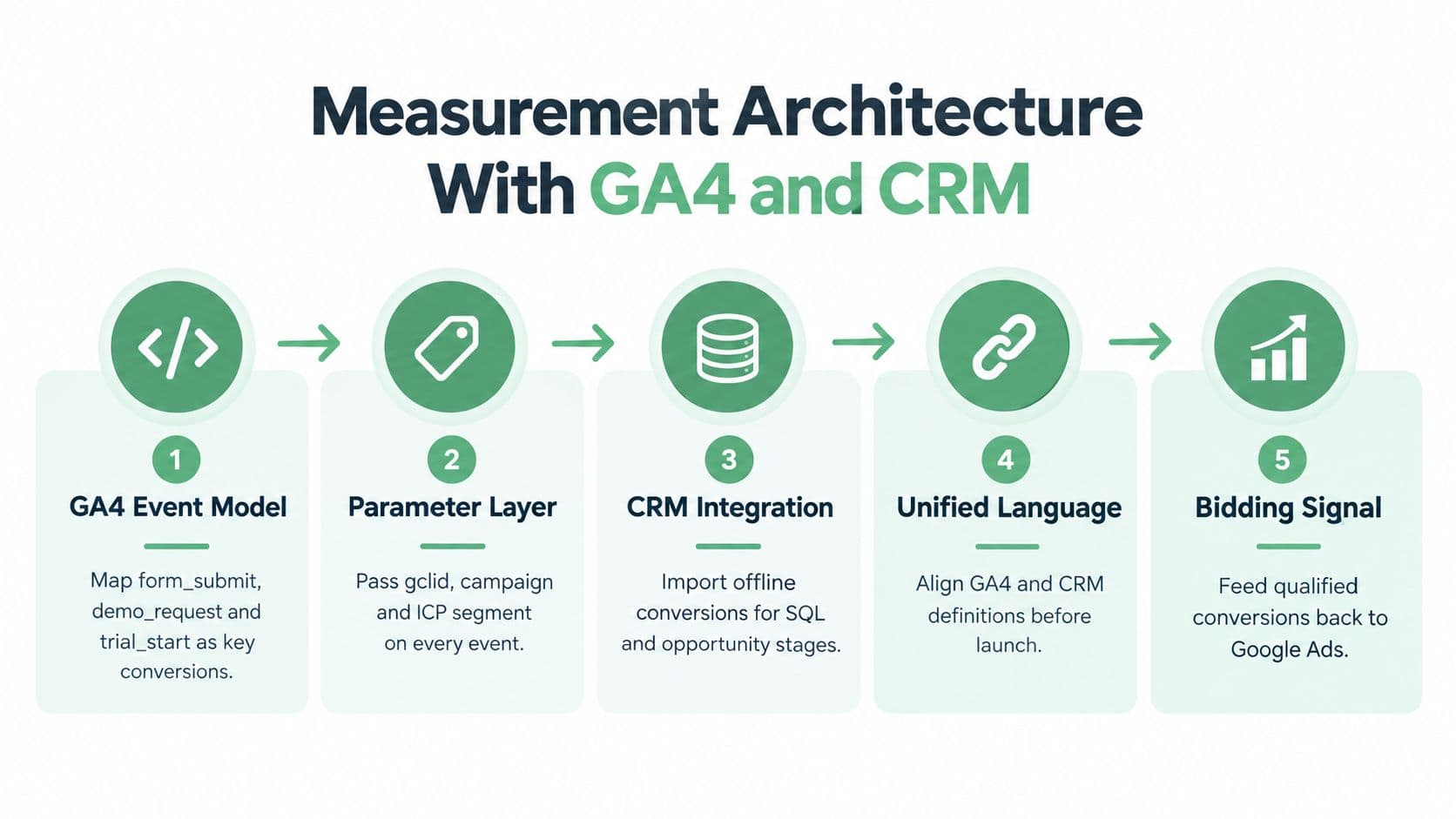
Design the measurement path before launching campaigns. GA4 can describe what happened on the site, while the CRM records whether the person matched the ICP, entered a sales process, progressed through opportunity stages, or became revenue. Those systems need shared event names, identifiers, and definitions.
A workable event model might includeform_submit,demo_request, andqualified_lead. Pass campaign, ad group, keyword, and ICP segment parameters with the event wherever the analytics implementation supports them. The event names matter less than the operating agreement behind them. Everyone should know which events are diagnostic, which are primary optimization signals, and which represent actual commercial progress.
Connect online actions to offline outcomes
Google Ads recommends using the Google tag to measure valuable website actions and says enhanced conversions can improve the accuracy of online and offline measurement.Its guidance on enhanced conversions for leads recommends using first-party data rather than relying only on the Google Click ID. In practice, that means capturing consented customer information appropriately, hashing it as required by the platform, and sending the resulting signal through the approved measurement setup.
Offline Conversion Import then connects CRM milestones back to Google Ads.Google Ads measurement guidance explains that advertisers can connect a CRM so actions outside the website, including completed applications or signed contracts, can be attributed to advertising. The exact milestones depend on the sales process, but the principle is consistent: don't ask the ad platform to optimize for revenue if revenue never returns to the account.
Track at least:
- Source fields: UTM source, medium, and campaign.
- Click identity: Persist the gclid where the implementation allows it.
- Lifecycle state: Store lead stage, SQL status, opportunity stage, and closed status.
- Commercial outcome: Record closed revenue in the CRM and reconcile it to imported conversions.
- Definition history: Document when event names, qualification rules, or pipeline stages change.
Ignore last-click attribution in isolation, raw session-quality scores, and view-through conversions when they obscure a long sales cycle.Google Ads conversion guidance also emphasizes selecting data sources and grouping conversions, which is particularly important when a demo request and a qualified opportunity are both labeled “conversion.”
A one-page audit should answer whether every lead has a durable campaign identity, whether sales can reject or accept it using documented criteria, whether CRM stages flow back to Google Ads, and whether reported revenue reconciles to source records. If those answers are unclear, changing bids is premature.
A short visual walkthrough can help teams align the implementation sequence before engineering work begins.
For teams connecting marketing events, lifecycle stages, and sales data,CRM marketing integration guidance provides a useful implementation lens.
Closed-Loop Reporting and Operating Cadence
Measurement architecture only matters when it changes decisions. Build the operating cadence around the same stages that bidding and finance reviews consume, rather than maintaining one dashboard for marketing activity and another disconnected report for revenue.
The first useful thresholds are lead-to-SQL, SQL-to-opportunity, and cost per closed or departed deal. The exact acceptable level depends on margin, sales capacity, deal size, and payback expectations, so teams should set those thresholds with finance and sales operations. A campaign that looks efficient at MQL stage should lose funding if qualified opportunities consistently fail to progress.
Use weekly reviews for control
The weekly meeting should be short and operational:
- Spend versus plan: Identify overspend, underspend, and unexpected auction pressure.
- Qualified leads by campaign: Review quality, not just volume.
- Form-to-MQL speed: Find routing or response delays that make good demand look weak.
- Search-term changes: Add negatives, pause irrelevant themes, and protect high-intent queries.
- Bid drift: Check whether automated bidding is pursuing the agreed conversion event.
Monthly review requires a longer lens. Compare closed revenue by campaign source, changes in deal-stage velocity, and the performance of tCPA, tROAS, and Maximize Conversions where those strategies are in use. Reallocate budget using departed or closed stages, not MQL totals.
A useful cost-per-lead calculation still has a place in the diagnostic layer. Teams can useRecepta.ai's explanation of CPL to standardize the basic formula, then extend the analysis to cost per SQL, opportunity, and closed deal. CPL is a starting measurement, not the budget allocation rule.
The dashboard should make it uncomfortable to scale a campaign that produces activity but no qualified pipeline.
MQL-only reporting creates a predictable bias. Campaigns that offer an easy conversion often receive more budget because they generate visible volume, while campaigns attracting fewer but better-fit buyers appear weak. Moving the operating layer to SQL or departed stage forces the team to make the tradeoff explicit. Fewer leads may be acceptable when the remaining demand has a clearer path to revenue.
The cadence should also include sales feedback. A marketer can identify a keyword that produces form fills, but a sales representative can identify whether those inquiries mention a real project, fit the buying committee, and arrive at a workable time. That qualitative feedback should influence exclusions, ad language, page qualification, and the next reporting cycle.
Rolling Out Your B2B Paid Search Program
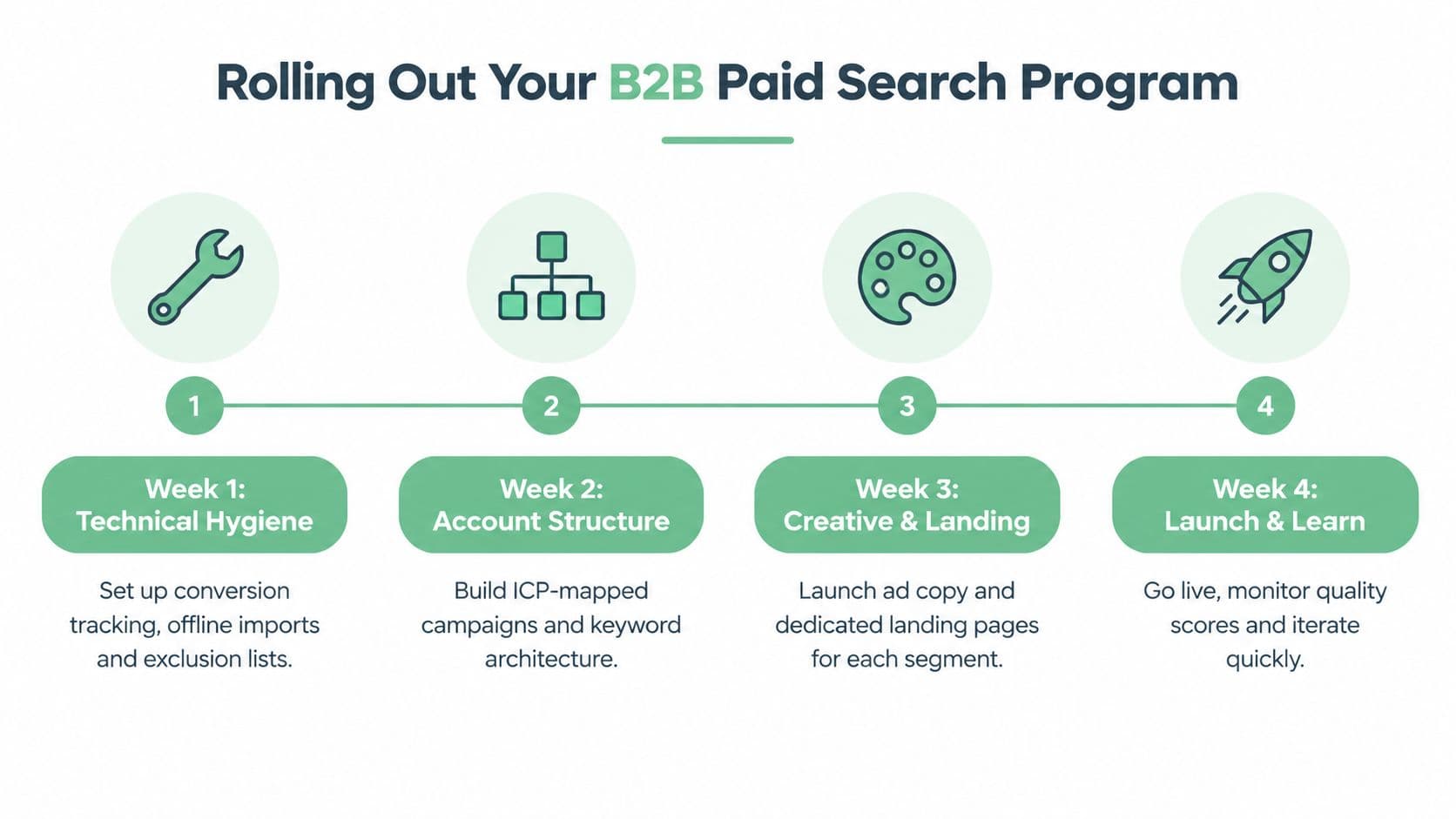
A reliable rollout is staged so technical uncertainty doesn't get mistaken for media performance. Start by proving that the account can capture, qualify, and reconcile outcomes. Only then add automation and broader reach.
Four phases for the initial build
Week one is technical hygiene. Audit Google Ads conversion actions, GA4 events, CRM fields, offline imports, consent handling, and exclusion lists. Confirm that gclid persistence, UTMs, lead routing, and lifecycle definitions work in a test record.
Week two is account structure. Build campaigns around the ICP, product line, persona, pain point, and intent level. Map keywords to ads and landing pages, then document which terms belong in exact, phrase, or later broad-match testing.
Week three is creative and landing-page alignment. Write ads that reflect the searcher's commercial question. Launch dedicated variants for meaningful segments, then inspect whether the page reinforces the role, problem, proof, and next step promised in the ad.
Week four is controlled activation. Turn on bid automation only after the conversion signal has been validated. Add audience signals in observation, monitor search terms closely, and use dashboards that show qualified stages rather than only clicks and forms.
Weekly checkpoints should cover search-term pruning, negative keyword additions, CPA drift, budget pacing, and lead-to-SQL feedback. Monthly checkpoints should examine pipeline value by campaign, cost per SQL, deal velocity, and whether budget should move toward campaigns that produce stronger downstream stages.
A quarterly audit should produce four concrete artifacts:
- Measurement health checklist: Events, identifiers, imports, definitions, and reconciliation status.
- Keyword intent map: Commercial themes, exclusions, match types, and CRM quality by category.
- Landing-page scorecard: Query alignment, qualification friction, offer fit, and experiment history.
- CRM tie-out reconciliation: A record-level comparison between ad conversions, CRM stages, and closed outcomes.
Schedule that audit as a recurring meeting with sales operations, not as an ad hoc marketing task. Paid search should be paused, expanded, or materially restructured only aftertwo sales cycles of CRM data confirm its pipeline contribution.Google's conversion tracking guidance supports the broader practice of importing downstream milestones rather than optimizing only to website activity.
Crescade offers an AI-assisted growth operations approach that connects paid acquisition, conversion work, lifecycle marketing, CRM integration, analytics, and automation into a managed decision system. If your Google Ads account needs a clearer qualification model, reliable pipeline feedback, and a practical operating cadence, visitCrescade to discuss the measurement and acquisition constraints first.