- demand gen vs lead gen
- demand generation
- lead generation
- growth operations
- pipeline quality
Demand Gen vs Lead Gen: A Founder's Decision Guide
By Crescade · · 17 min read
Demand gen vs lead gen explained for founders and growth teams. Learn how goals, tactics, KPIs, and budgets differ, and when to run both as one system.
The popular advice saysdemand gen creates awareness and lead gen creates pipeline, so companies should choose one based on their immediate priority. That framing is too simplistic.Demand gen vs lead gen is really a question of sequencing and operating design: demand generation builds future pipeline and preference, while lead generation captures identifiable intent when a buyer is ready to act. A founder planning the next budget should fund both motions, then decide which one deserves more weight based on sales-cycle length, ACV, pipeline coverage, and stage conversion.
Table of Contents
- How to Read This Guide on Demand Gen vs Lead Gen
- What Demand Gen and Lead Gen Actually Mean
- Where Each Motion Lives in the Funnel and Buyer JourneyChannel roles are different
KPIs and Pipeline Math That Prove Each Motion Is Working
Budgeting and Channel Mix That Funds Both Motions
Wiring Demand Gen and Lead Gen Into One Operating System
Which Motion to Lean On at Your Stage and Sales Cycle
A One-Page Decision Checklist and Your Next Step
How to Read This Guide on Demand Gen vs Lead Gen
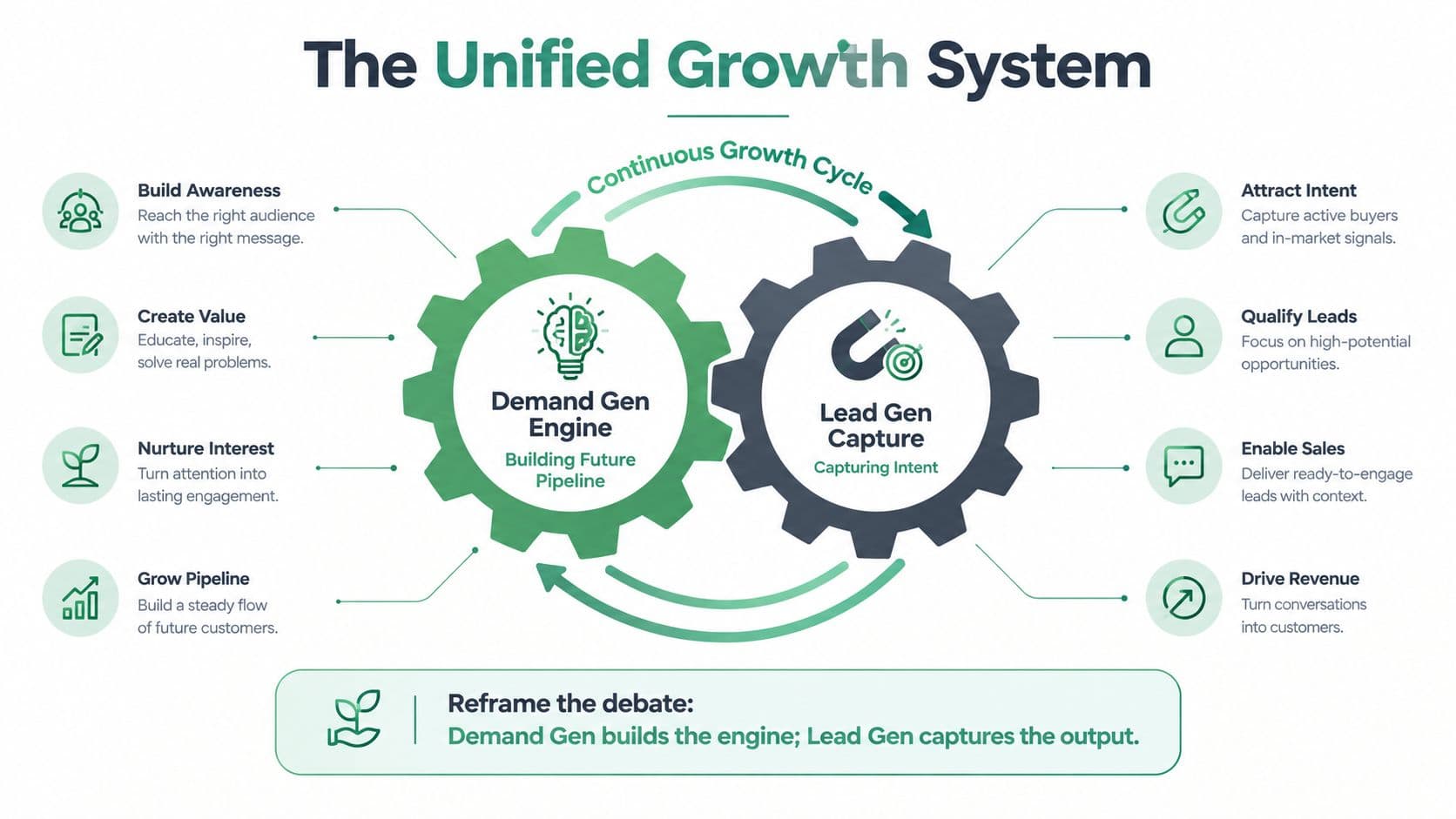
Treat demand gen and lead gen astwo connected stages of one growth system, not competing departments. Demand generation creates the conditions for future buying. It helps the right audience understand a problem, trust your point of view, and remember your company before a sales conversation makes sense. Lead generation converts that existing interest into a known prospect through a form, demo request, trial, consultation, or another intentional action.
That distinction matters because optimizing only for captured leads can hide serious leakage. Only27% of marketing-generated leads are ever contacted by sales, and79% of marketing leads never convert to sales, according to theB2B lead generation statistics compiled by Whistle. The problem isn't always insufficient lead volume. It may be weak trust, poor qualification, incomplete nurturing, bad routing, or a sales team receiving contacts that never had meaningful intent.
Use this guide as a planning framework before the next budget cycle:
- Define the job of each motion. Separate market education from intent capture.
- Place each motion in the buyer journey. Identify where the current constraint sits.
- Measure the right KPI stack. Demand gen needs account and pipeline signals. Lead gen needs contact, qualification, and conversion signals.
- Set the budget mix. Weight investment toward the stage that limits revenue, not the channel with the most convenient dashboard.
- Wire the operating system. Connect lifecycle marketing, CRM stages, scoring, routing, and sales feedback.
- Review the system regularly. Reallocate when pipeline quality, CAC payback, or stage conversion changes.
The key decision isn't “demand gen or lead gen?” It'swhich motion should carry more responsibility right now, and what evidence will justify changing the mix?
What Demand Gen and Lead Gen Actually Mean
Demand generation creates awareness, education, and buying preference before a prospect is ready to identify themselves. It answers the strategic question:who may buy from us later, and what must they believe before they do? Ungated thought leadership, useful SEO content, research, podcasts, webinars, events, and community participation all support this work. Thedemand generation overview from Infuse frames the distinction clearly, demand gen shapes the market, while lead gen captures demand when it becomes identifiable.
Lead generation captures existing interest from prospects who are actively evaluating a problem or solution. It answers a more immediate question:who is ready to enter a buying process now? Forms, demo requests, pricing pages, trials, calls, gated assets, and comparison pages create the conversion path. The contact becomes identifiable, which allows marketing and sales to qualify, nurture, route, and measure the opportunity.
| Dimension | Demand Gen | Lead Gen |
|---|---|---|
| Primary job | Build awareness, trust, and future buying intent | Capture and qualify existing intent |
| Practical question | Who may buy from us later? | Who is ready to take a commercial next step? |
| Typical assets | Ungated research, SEO content, thought leadership, podcasts, webinars, events | Forms, demos, trials, gated resources, pricing pages, consultations |
| Funnel role | Creates demand and warms accounts | Captures demand and creates identifiable prospects |
| Main time horizon | Compounds through repeated exposure and education | Converts active interest into a measurable handoff |
| Core measurement | Account movement, influenced pipeline, sourced pipeline, preference signals | Lead volume, qualification rate, cost per lead, opportunity conversion |
| Main risk | Building attention without a capture path | Capturing low-intent contacts that sales can't use |
The two motions compound when the handoff is intentional. Demand gen gives lead gen a warmer audience and stronger message-market fit. Lead gen gives demand gen first-party signals about which topics, accounts, and problems produce commercial movement.
For a practical SaaS application of this model,Crescade's SaaS demand generation guide connects search demand, content usefulness, landing pages, and qualified actions rather than treating content reach as the final outcome.
Where Each Motion Lives in the Funnel and Buyer Journey
Demand generation usually operates across thetop and middle of the funnel. Buyers may be researching a business problem, learning the language of a category, comparing approaches, or forming an early shortlist. At this stage, a hard conversion request can create friction because the buyer may not yet have enough context to evaluate a vendor.
Lead generation belongs closer to the point whereintent becomes visible. A prospect visits a pricing page, requests a demo, starts a trial, downloads a decision-stage asset, responds to a relevant outreach sequence, or attends an event with a stated business need. The capture mechanism turns anonymous interest into a contact or account signal that the revenue team can act on.
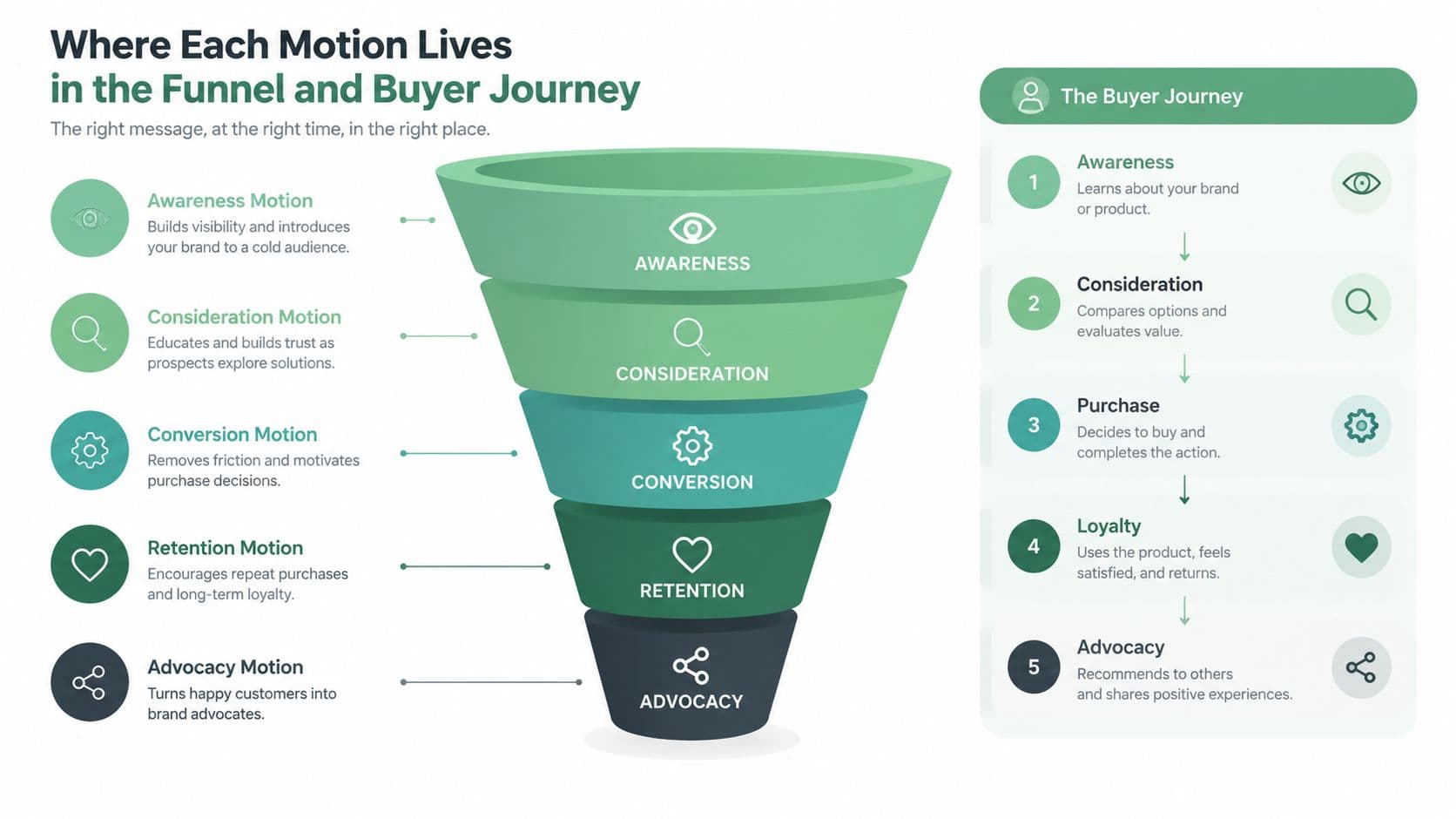
The practical market split is often described as95% of the market being out of market and 5% actively buying, according toBlendB2B's explanation of demand creation and demand capture. The exact operating implication is more important than treating the ratio as a forecast. Most accounts aren't searching for a vendor today, so a company that invests only in capture will compete intensely for the narrow slice already displaying intent.
Channel roles are different
Demand gen channels create memory and preference:
- SEO and ungated content answer problem-level questions before a product search begins.
- Thought leadership and research give buyers a framework for understanding the category.
- PR, podcasts, and community extend credibility beyond owned channels.
- Events and webinars create richer interaction without requiring an immediate sales conversation.
Lead gen channels convert known or emerging intent:
- Paid search reaches buyers actively searching for a solution.
- Lifecycle email develops contacts who need more education before sales outreach.
- Outbound uses account and contact signals to create a targeted commercial conversation.
- Conversion pages, forms, trials, and demos make the next step explicit.
TheZoomInfo comparison of demand generation and lead generation makes a similar asset distinction, demand gen commonly uses ungated education, while lead gen relies on gated resources and conversion mechanics.
The handoff shouldn't be linear in the CRM. An account may engage with demand content, disappear, return through paid search, and then request a demo after sales has already seen a related contact. Your system must preserve that history rather than crediting the final click with the entire outcome.
KPIs and Pipeline Math That Prove Each Motion Is Working
Judge demand gen and lead gen by different signals, then connect both to revenue stages. Reach alone can make demand gen look productive while creating no commercial progress. CPL can make lead gen look efficient while filling the CRM with contacts sales will never accept.
For demand gen, trackshare of voice, branded search behavior, account engagement, CRM-verified account movement, influenced opportunities, and pipeline created or influenced. Anonymous research and multi-stakeholder buying mean these signals rarely map cleanly to one contact. Use first-party account and opportunity data, not last-click attribution alone, to capture that movement.
Lead gen needs a tighter scorecard:MQL volume, MQL-to-SQL or SAL conversion, cost per lead, SQL-to-opportunity conversion, speed-to-lead, and opportunity quality by source. TheApollo guide to demand generation and lead generation measurement separates the motions clearly. Demand gen is measured through account movement and pipeline contribution, while lead gen is measured through volume, cost, and conversion.
Use stage math, not dashboard optimism
For mid-market B2B programs with45–120 day sales cycles, practical benchmark ranges includeVisitor-to-Demo at 0.5–2.0%,pricing or product page conversion at 3–8%,MQL-to-SQL or SAL at 20–40%,SQL-to-Opportunity at 40–60%, andOpportunity-to-Win at 20–35%. Enterprise win rates sit at10–20%, according to thePedowitz Group's demand generation benchmarks.
| Metric | Demand Gen | Lead Gen |
|---|---|---|
| Primary question | Are target accounts moving toward a buying process? | Are captured prospects becoming qualified opportunities? |
| Leading indicators | Share of voice, branded search, account engagement, content interaction | MQL volume, cost per lead, response rate, lead velocity |
| Stage indicators | Account progression, influenced pipeline, sourced pipeline, sales-cycle velocity | MQL-to-SQL, SQL-to-opportunity, opportunity-to-win |
| Quality test | More target accounts advance with less friction | More captured leads become accepted, qualified opportunities |
| Failure signal | Reach rises while account movement and pipeline stay flat | Lead volume rises while SQL conversion and win rate decline |
The decisive test is downstream improvement. Demand gen is working when target accounts convert faster or progress further, even if contact volume stays flat. Lead gen is failing when CPL falls but MQL-to-SQL conversion and win rate deteriorate.
Source quality also varies sharply by market. A 2026 compilation reports median B2B CPL ranging from$31 in mid-market AdTech to $748 in regulated insurance tech, with13% median MQL-to-SQL conversion and 28% at the top quartile. The same compilation reports that61% of B2B teams use AI for lead scoring, while the comparison with23% reported in 2024 comes from the compilation's historical reference. These figures appear inDigital Applied's B2B lead generation data points. Treat them as context, not universal targets. Optimize for source-level SQL conversion, scoring precision, and lower waste per opportunity.
Measurement rule: If sales doesn't accept the leads, the campaign hasn't produced qualified demand. It has produced a routing problem.
Budgeting and Channel Mix That Funds Both Motions
Budget allocation should follow the economics of the business. A company with a long sales cycle and high ACV needs enough demand creation to influence buyers before they enter a capture channel. A company with strong brand awareness, short cycles, and clear purchase intent can put more money into capture because buyers already understand the problem and are actively looking.
Use this planning framework as a starting point, not a permanent formula:
| Scenario | Demand Gen % | Lead Gen % | Primary Channels |
|---|---|---|---|
| Sales cycle exceeds 90 days or ACV exceeds $25K | 50–70% | 30–50% | SEO, thought leadership, podcasts, research, events |
| Sales cycle under 45 days and ACV under $10K | 30–40% | 60–70% | Paid search, intent-filtered paid social, conversion pages |
| Mid-range cycle and ACV | Around 50% | Around 50% | Blended content, partnerships, search, lifecycle, events |
These allocation ranges come from the operating framework in the brief. They should be adjusted when the business has weak brand awareness, limited capture infrastructure, poor sales follow-up, or saturated paid channels.
Consider a$500,000 annual marketing budget. Under a long-cycle, higher-ACV model, a 60% demand gen and 40% lead gen allocation would assign$300,000 to demand creation and $200,000 to capture. Under a short-cycle, lower-ACV model, a 35% and 65% split would assign$175,000 to demand gen and $325,000 to lead gen. A mid-range 50/50 plan would place$250,000 in each motion. These are allocation examples, not performance forecasts.
Fund the constraint, then rebalance
Demand gen investment should support durable assets, including useful SEO content, category education, executive thought leadership, podcasts, partnerships, and events. Lead gen investment should support paid search, intent-filtered paid social, conversion-focused landing pages, forms, nurture sequences, and sales follow-up.
Automation helps only when the underlying stages and definitions are sound. Teams comparing workflow platforms can reviewautomation tools featured by Supercenter, then evaluate each option against CRM connectivity, lifecycle logic, routing, reporting, and governance rather than buying features in isolation.
Rebalance quarterly using evidence:
- Pipeline coverage: Increase demand investment when future coverage is thin and target accounts aren't progressing.
- CAC payback: Reduce spend from channels that generate contacts but extend payback through weak conversion.
- Channel saturation: Shift away from a capture channel when additional spend reaches the same audience without stronger opportunity yield.
- Stage conversion: Fund the motion that improves the weakest commercially important stage.
Budget principle: Don't split money evenly to appear balanced. Split it according to where revenue is leaking.
Wiring Demand Gen and Lead Gen Into One Operating System
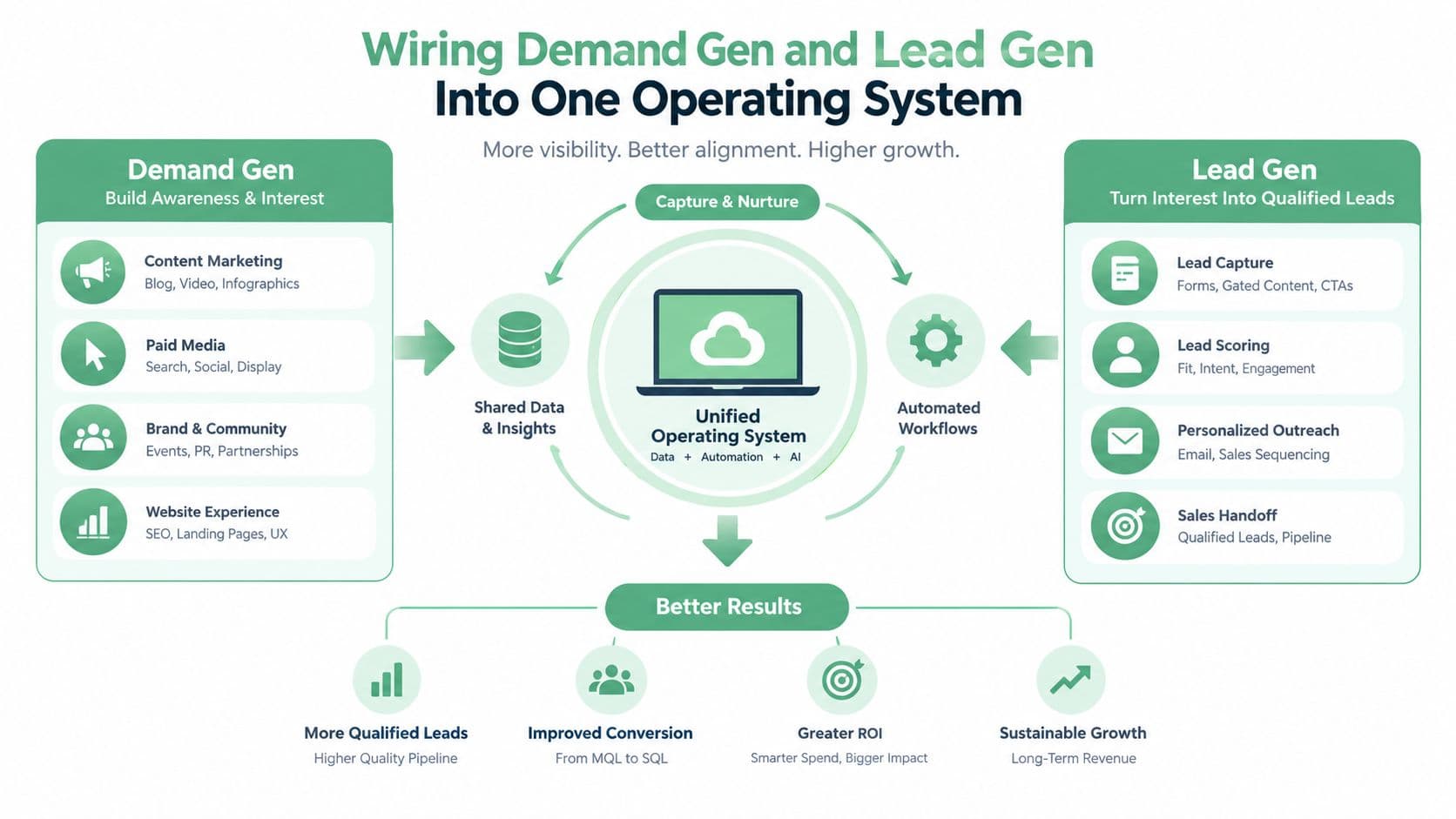
The operating system starts with one lifecycle model that both marketing and sales accept. A practical sequence issubscriber, engaged account, qualified lead, opportunity, closed-won, and expansion. The exact labels can vary, but the movement criteria must be explicit. A contact shouldn't become “qualified” just because they downloaded an asset, and an account shouldn't remain invisible because the buying group hasn't completed a form.
Build the data model before the campaign calendar
Demand-gen signals should enrich first-party audiences and account scoring. Track which target accounts consume educational content, return to key pages, engage with events, or show repeated interest across channels. Don't force every anonymous interaction into an MQL threshold that sales never trusts.
Lead-gen signals belong more directly in contact scoring and routing. A demo request, pricing interaction, qualified form response, or relevant reply should trigger a defined next action. The handoff needs a shared SQL definition, routing rules, ownership, and a service-level agreement. Speed matters operationally. Benchmark guidance citesunder five minutes for speed-to-lead and same-day first touch as material levers for meeting rates, according to thePedowitz Group benchmark resource.
A unified scoring model can use two layers:
- Account score: Fit, engagement depth, buying-group activity, and movement across demand-gen touchpoints.
- Contact score: Role, stated need, commercial action, timing, and response to lead-gen follow-up.
Establish a decision cadence
Run a weekly growth standup with marketing, sales, and revenue operations. Review:
- Pipeline created by source and segment.
- Pipeline influenced by demand-gen activity.
- MQL-to-SQL and SQL-to-opportunity conversion.
- Channel efficiency and CAC payback.
- Stuck opportunities and handoff failures.
- Sales feedback on lead quality and messaging.
Hold a monthly budget review around one North Star metric, such as pipeline coverage or payback CAC. That cadence turns reporting into a control system. It also gives the team a way to distinguish a creative problem from a routing problem, a demand problem from a capture problem, and a channel problem from a sales-cycle problem.
Teams that need the operating architecture can useCrescade's full-funnel marketing framework as a reference for connecting acquisition, conversion, lifecycle marketing, analytics, automation, and revenue feedback.
Which Motion to Lean On at Your Stage and Sales Cycle
Founders shouldn't choose between demand gen and lead gen based on whichever dashboard looks more active. Choose based onhow quickly buyers decide, how much each customer is worth, how much pipeline coverage exists, and whether the market already knows why the category matters.
| Company Stage | ACV | Sales Cycle | Demand Gen % | Lead Gen % | Primary Focus |
|---|---|---|---|---|---|
| Pre-seed, under $1M ARR | Low ACV | Short cycle | 20–30% | 70–80% | Capture branded and high-intent demand |
| Growth stage, $1M–$10M ARR | $10K–$50K | 30–90 days | Around 50% | Around 50% | Build preference and convert active buyers |
| Past $10M ARR | Higher enterprise ACV | Over 90 days | 60–70% | 30–40% | Create account-level demand and future pipeline |
For a pre-seed company with a short sales cycle and low ACV, prioritizepaid search on branded and high-intent terms, retargeting, and direct demo offers. The company needs a repeatable capture path before it builds a large content machine. Keep demand gen active, but don't use long-horizon awareness work to avoid fixing an empty pipeline.
A company between$1M and $10M ARR, selling to mid-market buyers at$10K–$50K ACV with30–90 day cycles, should generally run a balanced system. Fund SEO, partnerships, LinkedIn thought leadership, and useful education alongside forms, event follow-up, lifecycle email, and sales-assisted conversion.
Past$10M ARR, enterprise cycles over90 days require heavier demand creation. Account-based programs, executive content, events, research, partner influence, and category education should keep future pipeline developing while lead gen captures active opportunities.
Run this checklist before changing the mix
- ACV: Is the contract value high enough to support a longer education and buying process?
- Cycle length: Does sales need months of account development before an opportunity can close?
- Pipeline coverage: Is the future pipeline sufficient, or is the immediate capture layer underperforming?
- Brand awareness: Do target accounts recognize the category and your company?
- Conversion quality: Is MQL-to-SQL improving, or is volume masking weak qualification?
- Sales feedback: Does sales trust the handoff and follow-up process?
Warning signs of a bad mix includerising CAC with flat pipeline,MQL volume increasing while win rate declines, and sales teams repeatedly reporting poor lead quality. If those symptoms appear, adding more media won't solve the system. Audit the stage definitions, source mix, scoring, nurture, routing, and sales response first.
For teams focused specifically on execution,Crescade's lead generation campaign resource provides a relevant reference point for connecting campaign activity to qualified actions.
A One-Page Decision Checklist and Your Next Step
Run this review in a30-minute planning session. Don't leave the meeting with separate demand-gen and lead-gen targets that no one can reconcile in the CRM.
- Pipeline coverage versus target: Is future pipeline sufficient for the revenue plan?
- MQL-to-customer trend: Is lead quality improving, stable, or declining?
- Budget mix: How much spend supports durable brand and SEO assets versus immediate capture?
- Scoring model: Does the CRM combine account engagement and contact intent?
- Lifecycle nurture: Are prospects receiving relevant education and commercial follow-up?
- Review cadence: Do marketing, sales, and revenue operations inspect the same funnel every week?
- North Star KPI: Is the quarter governed by one metric, such as pipeline coverage or payback CAC?
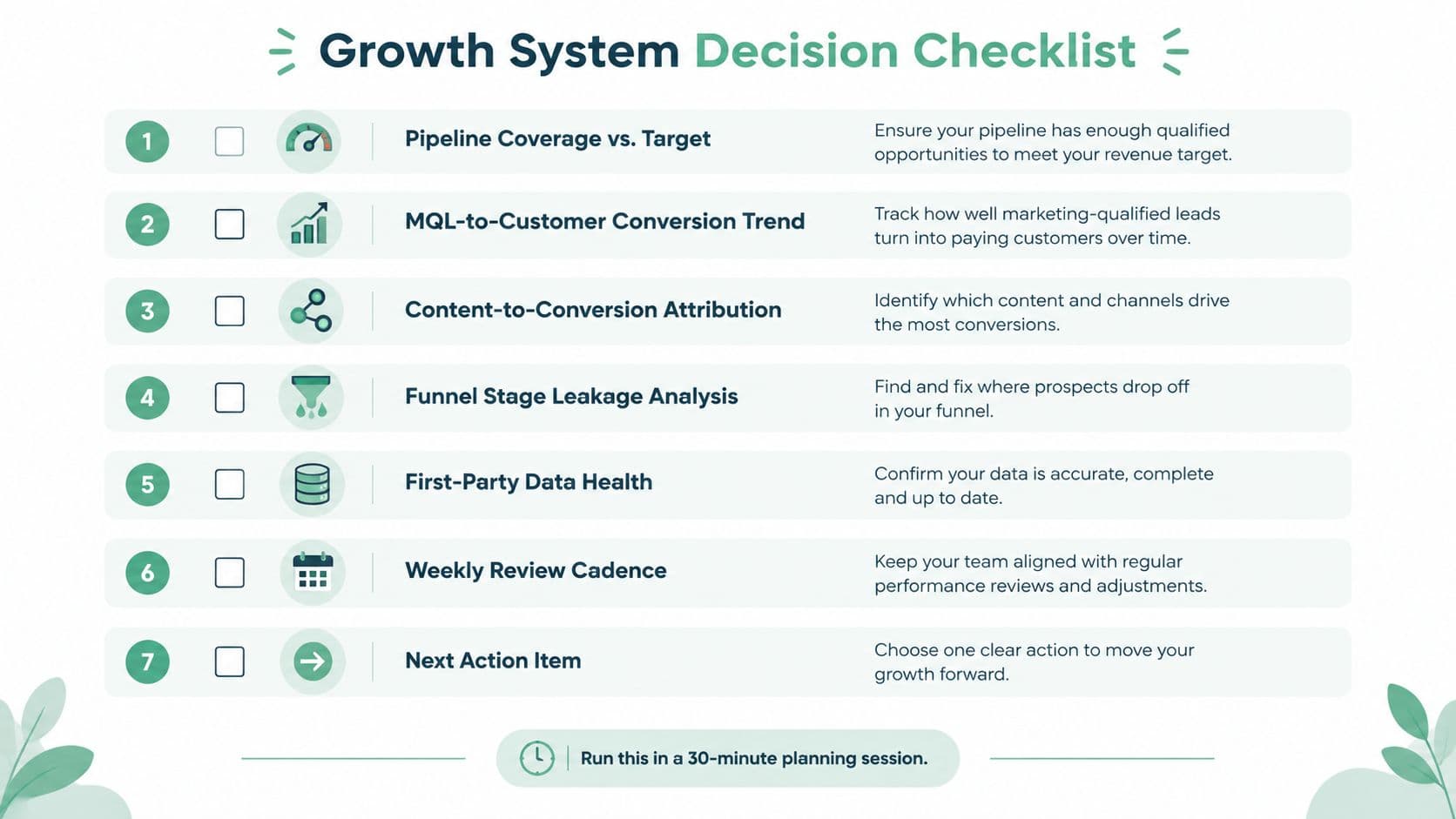
Avoid two predictable failures. First, don't optimize lead volume while win rate is falling. Second, don't invest heavily in demand gen without a capture mechanism, lifecycle path, and CRM reporting layer underneath it.
The right answer to demand gen vs lead gen is arunnable growth operating system. Demand gen builds future preference, lead gen captures active intent, lifecycle marketing develops readiness, and revenue operations turns the resulting evidence into the next budget decision.
Crescade helps teams connect acquisition, conversion, lifecycle marketing, CRM signals, analytics, automation, and AI-assisted production into one accountable growth operations system. VisitCrescade to see how a unified measurement and operating layer can turn your demand and lead programs into a clearer pipeline decision.